A clear, no-hype guide to booking, arriving, boarding and flying privately for the first time, including baggage, pets, documents and costs.
The short answer
A first private jet flight is usually simpler than a commercial journey, but it is not informal or rule-free. You still need the correct travel documents, an approved passenger list, an aircraft suited to the mission and enough time for security, customs or immigration where required.
The main differences are:
- you normally use a private terminal or FBO rather than the main airline terminal;
- the operator confirms a specific arrival time instead of asking every passenger to arrive hours early;
- baggage is loaded directly onto the aircraft, but capacity is limited by the exact model;
- the schedule is more flexible, but late changes can create costs or operational problems;
- the crew works for a certified commercial operator and must follow the same safety and border requirements that apply to the flight.
The best first experience comes from knowing exactly what has been booked: the aircraft, operator, airports, baggage allowance, inclusions, cancellation conditions and ground arrangements.
First-flight timeline
From confirmed charter to arrival
A private departure is faster than a commercial journey, but every step still depends on the operator, airport and route.
- 1
Confirm the mission
Route, airports, passengers, baggage, pets and special requirements.
- 2
Review the operator
Licensed operator, aircraft, inclusions, substitution terms and cancellation rules.
- 3
Follow the final briefing
Use the confirmed FBO, reporting time and passenger-document instructions.
- 4
Board after crew clearance
Baggage is loaded, safety instructions are completed and the cabin is secured.
- 5
Complete arrival formalities
Customs, immigration, ground transport and onward connections remain route-specific.
Before confirmation: verify the exact aircraft or category, operator, airports, baggage approval, inclusions, substitution terms and cancellation rules.
Before you book: verify the flight, not only the aircraft photo
A professional charter proposal should identify or clearly explain:
- the operating company;
- the aircraft category and, once available, the exact model;
- passenger capacity and practical baggage capacity;
- departure and arrival airports;
- planned schedule;
- whether the mission is nonstop;
- what is included and excluded;
- cancellation and change conditions;
- aircraft substitution terms;
- whether the price is subject to availability or final confirmation.
For a commercial charter, the flight should be operated by a company holding the appropriate air operator certificate or equivalent national authorization. A broker may arrange the flight, but the certified operator is responsible for conducting it.
Do not judge an offer only by the brand of aircraft. Two examples of the same model can have different cabin layouts, refurbishment dates, Wi-Fi systems and baggage arrangements.
Give complete passenger information early
The operator normally needs the passenger manifest before departure. Depending on the route, this can include:
- full legal name;
- date of birth;
- nationality;
- passport or identity-document details;
- document expiry date;
- contact details;
- information required for border authorities;
- details for minors travelling with or without both parents.
The spelling must match the travel document. A nickname used in conversation is not sufficient for the manifest.
International, non-Schengen and non-EU journeys can require additional procedures. Visa, passport-validity and entry rules depend on the passenger's nationality and itinerary. The charter advisor can coordinate the flight, but official government requirements remain the passenger's responsibility.
How early should you arrive?
There is no universal “arrive 15 minutes before every private flight” rule.
For a straightforward domestic or intra-Schengen mission from a well-equipped FBO, the operator may ask passengers to arrive roughly 15 to 30 minutes before departure. More time may be needed for:
- non-Schengen immigration;
- customs declarations;
- additional security procedures;
- pets;
- firearms or controlled sporting equipment where legally permitted;
- oversized baggage;
- a large passenger group;
- unfamiliar or remote airports;
- special assistance;
- last-minute manifest changes.
Use the reporting time stated in the final itinerary. Arriving much earlier does not necessarily make the aircraft depart earlier, while arriving late can affect crew duty limits, airport slots and the next mission scheduled for the aircraft.
Finding the correct terminal
Private flights often depart from a fixed-base operator, usually called an FBO, a general aviation terminal or a business aviation terminal.
The terminal may be located on a different side of the airport from the commercial building. The final itinerary should therefore include:
- the FBO name;
- the full address;
- a contact number;
- parking instructions;
- the reporting time;
- the aircraft or flight reference;
- chauffeur or transfer details.
At some airports, several FBOs operate on the same field. Going to the airport name without checking the FBO can cause a significant delay.
What happens at the FBO?
The process varies by airport, but a typical departure includes:
- arrival at the private terminal;
- identity and document verification;
- security screening where applicable;
- customs or immigration where required;
- baggage acceptance;
- a short wait in the lounge or direct boarding;
- transport to the aircraft by foot or vehicle.
Private terminals reduce queues, but they do not eliminate legal security or border requirements. Some airports allow direct vehicle access close to the aircraft; others require passengers to use the terminal and an airside vehicle.
Baggage: more flexible does not mean unlimited
Private aviation does not use one standard baggage allowance across all aircraft.
The usable capacity depends on:
- the exact aircraft model;
- cabin configuration;
- number of passengers;
- route length and fuel load;
- baggage-compartment shape;
- door dimensions;
- weight-and-balance limits;
- whether baggage is accessible during flight.
A light jet carrying six passengers may have much less practical baggage space than a midsize jet carrying the same group. Hard-shell suitcases can also be harder to load than soft bags.
Before confirmation, provide:
- the number of bags;
- approximate dimensions;
- approximate weight;
- photos of skis, golf bags, instruments, mobility equipment or unusual items.
The operator should confirm baggage compatibility for the exact aircraft offered. Do not rely on generic claims such as “unlimited luggage”.
Pets on private jets
Many charter operators accept pets in the cabin, but approval is not automatic.
The operator may need:
- species and breed;
- weight and size;
- veterinary or vaccination documents;
- microchip details;
- import permits;
- information about the carrier or restraint;
- confirmation that the destination accepts the animal;
- additional cleaning arrangements.
Some countries and airports impose strict animal-entry procedures. A private terminal does not bypass veterinary, customs or quarantine rules.
Large animals, multiple pets or unusual species can affect aircraft choice. Tell the broker at the first request, not after the aircraft has been selected.
Catering and special requests
Basic refreshments may be included, but the service varies by aircraft, operator, flight length and departure airport.
Confirm in advance if you require:
- a full meal;
- allergies or dietary restrictions;
- children's food;
- specific beverages;
- birthday or event arrangements;
- medication refrigeration;
- premium catering;
- a particular brand or product.
Short regional flights on small aircraft may have limited galley space and no oven. A request that is simple on a heavy jet may be impractical on a very light jet.
Boarding the aircraft
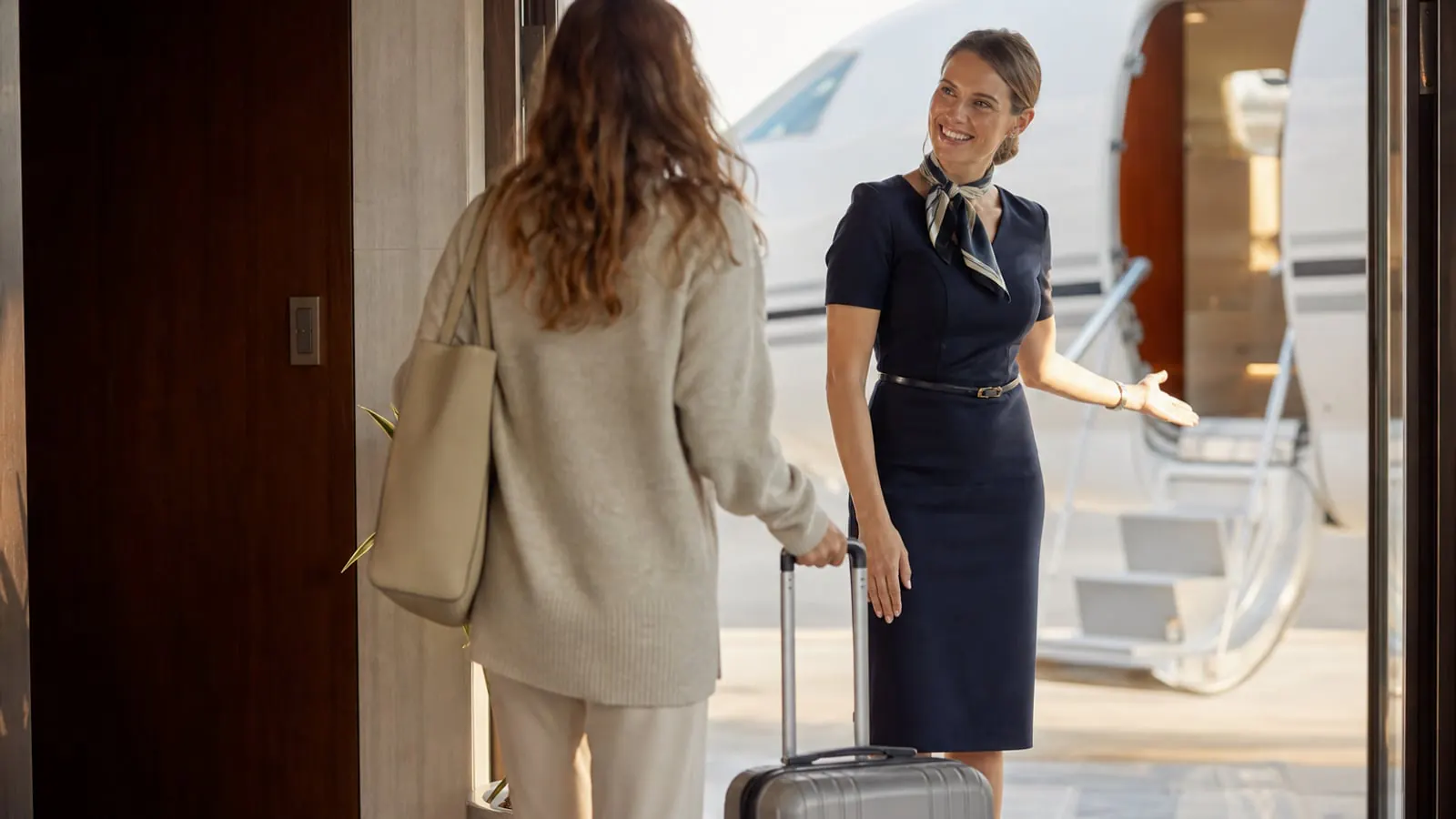
The captain or crew will normally welcome the passengers and give a safety briefing. Listen even if the process feels informal.
The briefing can cover:
- seat belts;
- emergency exits;
- life vests or oxygen where applicable;
- baggage stowage;
- smoking restrictions;
- use of electronic devices;
- lavatory operation;
- movement in the cabin;
- turbulence procedures.
Passengers should remain seated when instructed. A private cabin is still an aircraft operating under professional safety procedures.
Seating and cabin layout
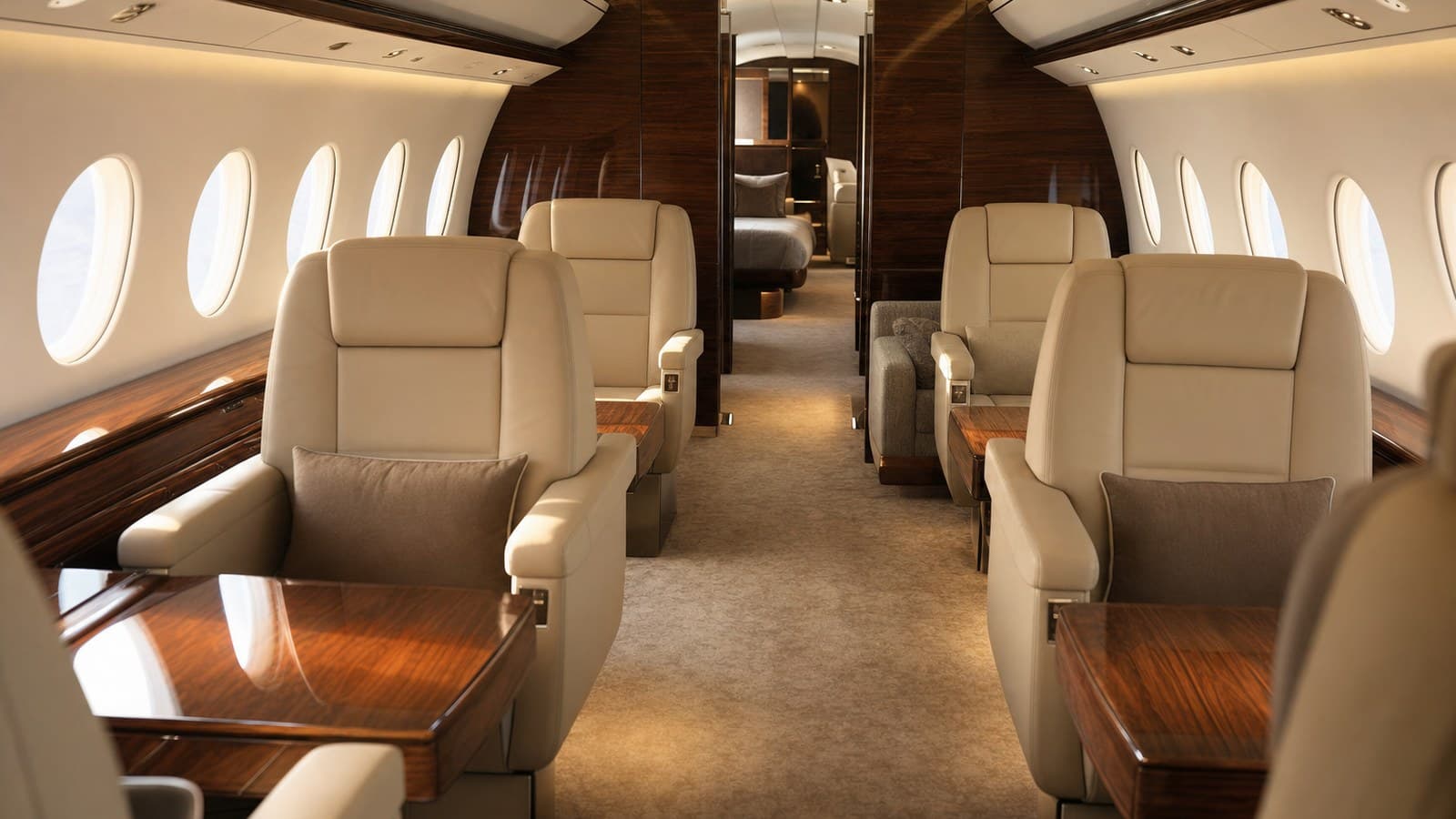
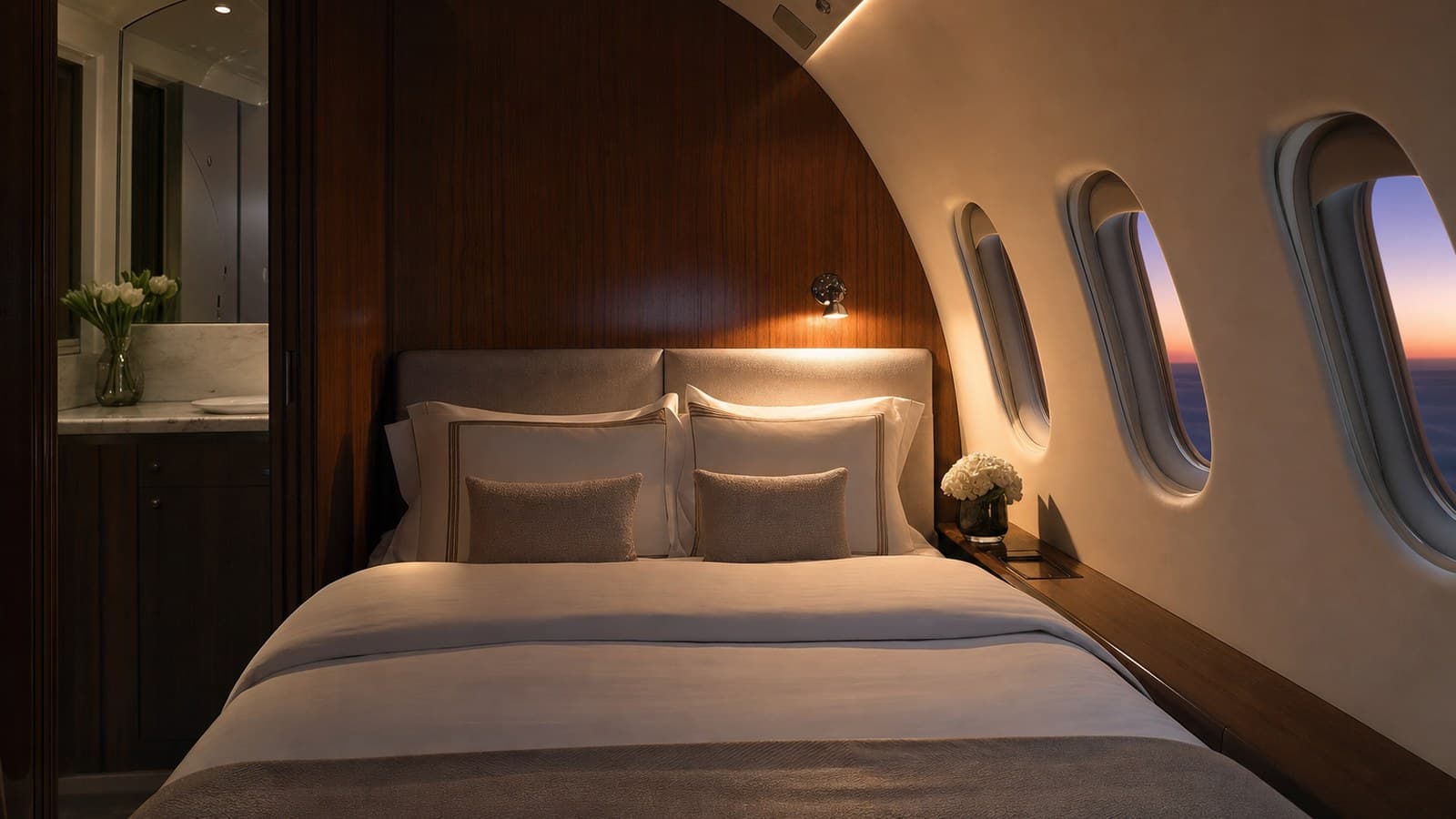
Many business jets use club seating, with pairs of seats facing each other. Some include a divan, conference table, single forward-facing seats or seats that convert into beds.
The most comfortable arrangement depends on the mission:
- forward-facing seats can suit passengers sensitive to motion;
- club seating works well for conversation or meetings;
- a divan may be useful for children or rest, but is not equivalent to a full-size bed;
- certified passenger capacity may include seats that are less comfortable on long flights.
Ask for the actual cabin layout when the seating arrangement matters.
Wi-Fi, calls and electronic devices
Wi-Fi is not guaranteed on every private jet.
Confirm:
- whether it is installed;
- where it works geographically;
- whether streaming or video calls are supported;
- whether usage is included in the price;
- whether a data limit applies;
- whether the system works during the entire route.
Mobile-phone use also depends on the aircraft system and applicable rules. Do not assume a normal mobile signal will remain available at altitude.
For an important meeting, download files before boarding and prepare an offline backup.
Toilets and privacy
The term “private lavatory” can describe very different facilities.
On some very light and light jets, the lavatory may be compact, partially screened or located near the baggage area. Larger aircraft generally provide a fully enclosed lavatory, and some long-range aircraft have two.
When privacy is essential, ask specifically whether the lavatory is fully enclosed rather than relying on a generic equipment list.
Turbulence and motion sensitivity
Private jets can fly high and efficiently, but they are not immune to turbulence. Smaller aircraft may feel movement more noticeably than larger cabins.
Passengers sensitive to motion can consider:
- choosing a forward-facing seat;
- eating lightly before the flight;
- avoiding excessive alcohol;
- discussing suitable medication with a healthcare professional;
- informing the crew before departure.
The crew may adjust the route or altitude when operationally possible, but comfort cannot be guaranteed in all weather.
Delays, weather and de-icing
Private aviation offers scheduling flexibility, not immunity from weather, air traffic control or airport restrictions.
A delay can result from:
- fog, wind, thunderstorms or snow;
- de-icing;
- runway contamination;
- airport slots;
- crew duty limitations;
- a late previous flight;
- technical inspections;
- border or customs availability;
- a destination airport becoming unavailable.
A reputable operator will not compromise safety to protect the schedule. For time-critical travel, ask about alternative airports and backup options before departure.
Changes after booking
Private charter is customized, but changes are not automatically free.
Changing the departure time, passenger number, airport or baggage can affect:
- aircraft suitability;
- crew duty;
- slots;
- airport opening hours;
- positioning;
- fuel requirements;
- price.
Read the cancellation and change conditions before payment. A charter aircraft is reserved for a specific mission, so cancellation terms can be stricter than commercial-airline tickets.
On arrival
After landing, the aircraft usually taxis to the general aviation area. Passengers may walk or take a short vehicle transfer to the FBO.
Depending on the itinerary, the arrival can involve:
- passport control;
- customs;
- veterinary checks for pets;
- baggage collection;
- direct transfer to a waiting vehicle;
- onward helicopter or chauffeur service.
Do not assume that a car can always wait beside the aircraft. Airside access depends on airport security rules and local permission.
Private jet etiquette
Be ready at the agreed time
The aircraft may be flexible, but the crew, slots and subsequent schedule are not unlimited.
Treat the cabin as professional equipment
Avoid damaging surfaces, moving heavy items without assistance or placing liquids near controls and electronics.
Smoking is usually prohibited
Do not smoke or vape unless the operator has expressly confirmed that it is permitted on that exact aircraft. In practice, many operators prohibit it completely.
Alcohol remains subject to crew authority
The crew can refuse service or boarding when a passenger's condition creates a safety risk.
Tipping is not mandatory
Tipping practices vary by country, operator and client. It should not be presented as a required fixed amount. A sincere thank-you is always appropriate; the broker can advise on local practice if the client wishes to recognize exceptional service.
Ask before photographing crew or operational areas
Photography can be restricted for privacy, security or airport reasons.
Red flags for a first-time charter client
Be cautious when:
- the operator is not identified;
- the seller cannot explain who holds operational responsibility;
- the price is dramatically below comparable offers without explanation;
- payment is requested to an unrelated personal account;
- no written cancellation terms are provided;
- the aircraft is described only as “or equivalent” without an equivalence standard;
- baggage or nonstop capability is promised without checking the mission;
- taxes and airport charges are vague;
- an international flight is proposed without document or customs coordination.
First-flight checklist
Before payment
- Confirm the operator and aircraft category.
- Read the cancellation and substitution terms.
- Confirm inclusions and exclusions.
- Provide passenger, baggage and pet details.
- Verify the airports and ground-transfer plan.
Twenty-four hours before departure
- Check the final itinerary and FBO address.
- Confirm passports, visas and permissions.
- Confirm the reporting time.
- Reconfirm catering and special assistance.
- Keep the broker or operations contact available.
Before leaving for the airport
- Check for schedule updates.
- Carry the original travel documents.
- Ensure baggage matches what was declared.
- Bring essential medication in the cabin.
- Download important files for offline use.
How Flyius should prepare a first-time passenger
A complete client briefing should confirm:
- who operates the flight;
- where to arrive;
- when to arrive;
- what documents to bring;
- what baggage is approved;
- what is available onboard;
- what charges are included;
- how changes and cancellations work;
- who to contact on the day;
- what the backup plan is if operations change.
Final recommendation
Your first private flight should feel calm because the operational details were handled before you arrived, not because rules were ignored.
The most important questions are simple:
- Is the operator properly authorized?
- Is the aircraft appropriate for the passengers, route and baggage?
- Are the total costs and conditions clear?
- Do you know the exact terminal and reporting time?
- Are documents, pets and special requests confirmed?
Once those points are settled, the passenger experience is normally straightforward: arrive at the designated private terminal, complete the required formalities, board after a safety briefing and travel on a schedule built around the mission.
Sources and methodology
This guide is based on European commercial air transport principles, operator briefing practices and Flyius charter-review procedures. In Europe, a commercial air transport operator must hold the appropriate Air Operator Certificate and operate within its approved specifications. See the EASA Air Operator Certificate overview and the EASA Air Operations rules. Airport reporting time, security, customs and immigration remain route-specific and the final operator briefing always takes priority.
For related planning, read how to charter a private jet, how to choose the right aircraft, private jet baggage rules, flying private with pets and what an FBO is.
Frequently asked questions
How early should I arrive for a private jet flight?
Use the reporting time in the final itinerary. Around 15 to 30 minutes may be sufficient for a straightforward domestic or intra-Schengen departure from an established FBO, but international formalities, pets, special baggage or local security requirements can require more time.
Do private jet passengers go through security?
Security procedures depend on the airport and route. Private terminals usually provide a faster process, but passengers remain subject to identification, security, customs and immigration requirements where applicable.
How much baggage can I bring?
There is no universal private-jet allowance. Capacity depends on the exact aircraft, passenger count, route, fuel load and shape of the baggage compartment. The operator should approve the number and dimensions of bags before confirmation.
Can I take a pet in the cabin?
Many operators accept pets, but approval and documentation are route-specific. Vaccinations, microchips, import permits, cleaning charges or restraints may be required. The pet must be declared before the aircraft is selected.
Is Wi-Fi always available?
No. Wi-Fi equipment, coverage, speed and price vary by aircraft. Confirm the service for the exact aircraft and route when connectivity is important.
Can the departure time be changed after booking?
Often it can be requested, but a change may affect crew duty, airport slots, opening hours, aircraft positioning and price. The operator must reconfirm the revised mission.
Do I need to tip the crew?
Tipping is not mandatory and practices vary by country and operator. It should not be treated as a fixed requirement. The broker can advise on local practice if a passenger wishes to recognize exceptional service.
What happens if the weather is bad?
The operator may delay, reroute, use an alternative airport or cancel when conditions make the planned flight unsuitable. Safety and regulatory requirements take priority over the original schedule.
Looking to book a private jet?
Get a Free QuoteWritten by
Flyius
Flyius publishes these charter guides. A firm price is confirmed only after an operator quote.