A practical guide for executives and travel teams comparing European private charter by total journey time, airport access, risk, cost and productivity.
The executive summary
Business aviation creates value when it solves a scheduling or access problem that commercial travel cannot solve efficiently.
The strongest use cases are usually:
- several executives travelling together;
- a same-day return with limited airline frequency;
- a multi-city itinerary;
- travel to a regional airport with no practical nonstop airline service;
- confidential work that cannot be performed in a public terminal or cabin;
- a critical meeting where schedule control has high commercial value;
- transport of specialist teams or time-sensitive equipment.
The decision should not be based on flight time alone. A professional comparison includes the complete journey:
office departure → airport transfer → terminal process → flight → arrival formalities → final ground transfer.
A private jet can save several hours on the right mission, but it is not automatically faster or more economical on every route.
When business aviation makes economic sense
A private charter is more likely to create measurable value when at least three of the following are true:
- four or more people need to travel together;
- the commercial itinerary requires a connection;
- the meeting location is far from a major airline hub;
- an overnight stay can be avoided;
- the team can complete several meetings in one day;
- the passengers need privacy for sensitive work;
- the cost of delay is high;
- the schedule may change during the trip;
- the team carries specialist equipment or confidential material;
- the travel policy values employee time and duty of care.
It is less compelling when a frequent nonstop airline service links two convenient airports, only one passenger is travelling and the schedule has no commercial urgency.
Compare total journey time, not airborne minutes
Commercial and private flights should be compared using the same start and end points.
A useful model is:
Total journey time = ground transfer to departure airport + reporting and processing + airborne time + arrival processing + final transfer.
For commercial travel, also include:
- check-in and security buffer;
- boarding and gate closure;
- possible connection time;
- baggage reclaim;
- transfer from a hub airport that may be far from the meeting.
For private travel, include:
- transfer to the selected FBO;
- passenger and customs formalities;
- realistic taxi and slot time;
- transfer from the business-aviation airport;
- any operational constraint at a smaller field.
The nearest airport is not always the fastest option. A closer field with limited hours or a short runway can be less reliable than a larger airport slightly farther away.
Indicative European business routes
The following values are indicative Flyius category prices reviewed in July 2026. They are not fixed fares and depend on aircraft availability, positioning, airport charges and the exact mission.
| Route | Distance | Estimated flight time | Light jet | Midsize jet |
|---|---|---|---|---|
| London → Paris | 379 km | 51 min | From €4,500 | From €7,500 |
| Paris → Geneva | 410 km | 55 min | From €4,500 | From €7,500 |
| Frankfurt → London | 658 km | 1 h 13 | From €5,500 | From €8,000 |
| London → Geneva | 750 km | 1 h 30 | From €6,500 | From €10,000 |
| Zurich → London | 807 km | 1 h 25 | From €6,500 | From €9,500 |
The effective cost per passenger depends on how many seats are used. A €6,500 aircraft charter equals approximately:
- €3,250 per person for two passengers;
- €1,625 per person for four passengers;
- about €1,083 per person for six passengers.
This calculation does not prove that charter is cheaper than business class. The commercial decision must also account for ground transport, hotels, connections, lost working time and schedule risk.
Build a business case using value of time
A simple internal model can use:
Productive time saved × number of travellers × internal hourly value
Then add or subtract:
- hotel nights avoided;
- ground transport differences;
- commercial tickets replaced;
- meeting opportunities protected;
- additional charter cost;
- cost of operational risk;
- cost of a backup plan.
Example:
A five-person leadership team saves three working hours each. That equals 15 person-hours recovered. The finance team can assign its own internal value to those hours and compare it with the incremental cost of the charter.
The model should remain conservative. Do not treat every minute onboard as fully productive and do not assign speculative revenue to the trip unless the business can justify it.
Airport selection is often more important than aircraft selection
European cities frequently have several possible airports. The best choice depends on the meeting location, operating hours, runway, slots, customs and aircraft category.
London
Possible business-aviation airports include Farnborough, Luton, Biggin Hill, London City and Stansted, among others.
The decision should consider:
- destination within Greater London;
- opening hours;
- weekend and night restrictions;
- runway and aircraft acceptance;
- slot availability;
- customs arrangements;
- road traffic;
- handling quality;
- helicopter or rail alternatives.
Farnborough may suit west or central London missions and offers dedicated business-aviation infrastructure. Biggin Hill can be useful for south-east London and Canary Wharf-related journeys. Luton can offer broad handling capability but road traffic remains relevant. London City is close to financial districts but aircraft and operational requirements are more restrictive.
There is no universally “best London airport”. The correct choice is mission-specific.
Paris
Paris Le Bourget is the principal dedicated business-aviation airport for the Paris region and is normally the first option for executive charter.
The final choice can still depend on:
- destination in Paris or the western business districts;
- event congestion;
- airport restrictions;
- onward commercial connection;
- aircraft category;
- availability of the selected operator.
Charles de Gaulle or Orly may be relevant for a direct airline connection or a specific operational need, but they do not offer the same dedicated business-aviation environment as Le Bourget.
Geneva
Geneva has a dedicated business aviation terminal and a 3,900-metre runway capable of handling all principal business-jet categories.
It is strategically useful for:
- banking and wealth-management travel;
- international organisations;
- commodity trading;
- luxury and watch industry meetings;
- onward travel to Alpine destinations.
Peak winter periods and major events can tighten parking, slots and handling availability. Early coordination is therefore important even when the airport itself is highly capable.
Zurich
Zurich provides strong long-range capability and professional handling for Swiss financial and industrial missions.
For a meeting in central Zurich, the main airport can be practical. For regional Switzerland or Alpine destinations, the ground journey and possible alternatives should be compared.
Frankfurt and the Rhine-Main region
The airport decision should be based on the actual destination: central Frankfurt, the airport business district, Wiesbaden, Mainz or another regional location.
A smaller general aviation field may reduce terminal time but introduce limitations in opening hours, customs or aircraft size. Frankfurt Main provides extensive capability but is a busy airline hub. The broker should compare the complete journey rather than select an airport by reputation.
Multi-city missions: the strongest executive use case
Business aviation can be most valuable when a team must visit several cities that are poorly connected to each other.
A possible day could involve:
- morning departure from London;
- meeting near Paris;
- afternoon meeting in Geneva;
- evening return to London.
Whether this is feasible depends on:
- realistic meeting duration;
- airport transfers;
- slots;
- crew duty limits;
- airport opening hours;
- weather;
- customs requirements;
- aircraft range;
- contingency time.
A schedule that works in a spreadsheet may be too fragile operationally. A responsible planner includes buffers and identifies which meeting or sector can be adjusted if the day runs late.
Privacy and productive work
A private cabin can support confidential discussion better than an airline lounge or public cabin, but privacy is not absolute.
A corporate travel policy should consider:
- who can hear conversations at the FBO;
- secure disposal of printed material;
- use of privacy screens;
- encrypted devices and VPNs;
- aircraft Wi-Fi security;
- photography and social media;
- passenger-list confidentiality;
- ground-transport privacy;
- whether the operator or broker retains trip data.
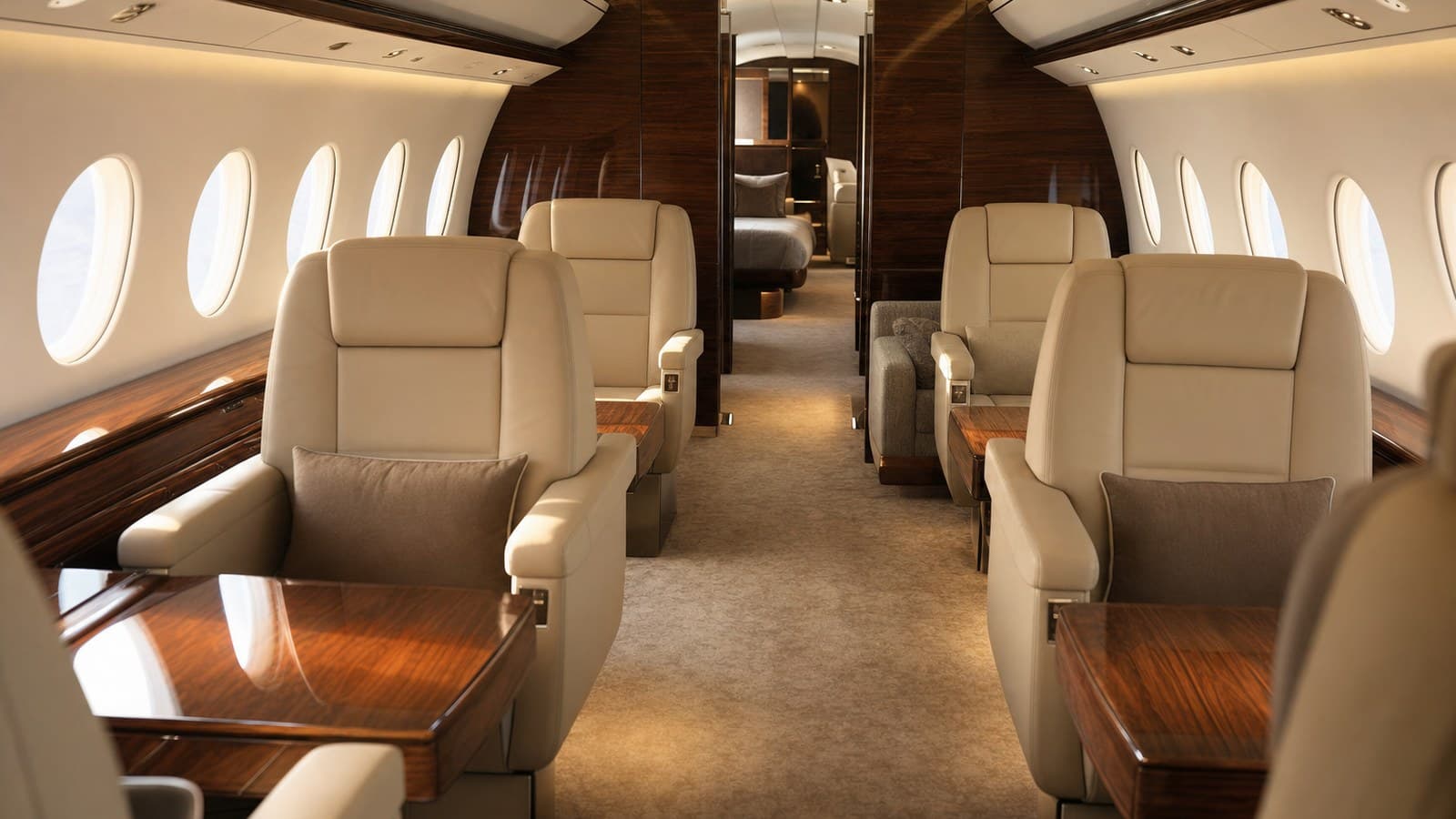
The cabin can be configured for meetings, but productivity depends on aircraft size, turbulence, table space, noise and connectivity.
For important video calls, confirm the exact Wi-Fi system and geographical coverage. “Wi-Fi available” is not the same as stable broadband suitable for conferencing.
Duty of care and operator due diligence
The lowest quote should not be selected without operational review.
A corporate buyer should confirm:
- the operating company;
- the relevant commercial operating authorization;
- aircraft registration and model;
- insurance information where required by policy;
- safety-management and operational standards;
- crew qualification;
- maintenance responsibility;
- substitution rules;
- passenger and baggage limits;
- who provides support during disruption.
A broker coordinates options, but the operator conducts the flight. The travel team should know the distinction.
For recurring corporate use, establish an approved-operator process rather than repeating the entire due-diligence exercise for every trip.
On-demand charter, jet card or fractional programme?
On-demand charter
Best for variable routes and irregular travel.
Advantages:
- ability to compare the market;
- no large upfront commitment;
- broad aircraft choice;
- flexibility by mission.
Limitations:
- prices vary;
- availability is not guaranteed until confirmation;
- service consistency can vary between operators.
Jet card or deposit programme
Best for travellers seeking simplified booking and more predictable commercial terms.
Review:
- hourly-rate definition;
- fuel and tax treatment;
- peak-day rules;
- minimum flight time;
- interchange and downgrade rules;
- refundability of deposits;
- provider financial risk;
- service-area limitations.
Fractional ownership
Best for high and predictable annual usage where access and fleet consistency matter more than mission-by-mission market shopping.
The complete cost includes more than occupied hourly charges. Review acquisition, management fees, depreciation, programme term, exit conditions and repositioning rules.
Cross-border planning in Europe
Europe is operationally dense but not administratively uniform.
The itinerary may involve:
- Schengen and non-Schengen passport procedures;
- EU and non-EU customs rules;
- UK border formalities;
- Swiss customs requirements;
- passenger data submissions;
- visa or residence-permit checks;
- pet or specialist-equipment documentation;
- airport-specific prior notice.
The private terminal can speed up processing but does not remove border rules.
The operator and handler should receive complete passenger details early. Last-minute changes can delay an international departure or make a smaller airport unusable if customs staff are unavailable.
Schedule reliability and backup planning
Private charter provides more control, but reliability still depends on:
- weather;
- technical serviceability;
- crew duty;
- airport slots;
- curfews;
- de-icing;
- air traffic restrictions;
- customs availability;
- previous aircraft sectors.
For a critical meeting, the proposal should address:
- alternative airports;
- aircraft-substitution policy;
- backup operator options;
- commercial-airline fallback;
- latest acceptable arrival time;
- ground-transfer contingencies.
A cheap quote with no credible disruption support can be more expensive when the meeting is time-critical.
Sustainability and reporting
A corporate aviation policy should measure and manage environmental impact rather than rely on vague claims.
Possible actions include:
- selecting the smallest suitable aircraft;
- minimizing empty positioning;
- grouping travellers;
- using rail or airline service when it is operationally efficient;
- requesting sustainable aviation fuel where physically available or through a credible book-and-claim programme;
- recording route, aircraft and estimated emissions;
- reviewing mission necessity;
- reporting the methodology used.
SAF availability varies by airport and supply chain. A provider should state whether the fuel is physically delivered for the mission or represented through another accounting mechanism.
Avoid presenting carbon compensation as if it eliminates the flight's physical emissions.
Corporate travel policy checklist
A mature policy should define:
- who can authorize charter;
- permitted use cases;
- passenger thresholds;
- cost-approval levels;
- approved brokers and operators;
- safety due-diligence requirements;
- aircraft age or equipment requirements;
- sustainability reporting;
- privacy expectations;
- rules for accompanying guests;
- cancellation approval;
- payment controls;
- post-trip reporting.
The policy should be strict enough to manage risk but flexible enough to respond to urgent missions.
How to request a useful corporate quote
Provide:
- precise route and acceptable airports;
- meeting location;
- requested arrival time, not only departure time;
- number of passengers;
- baggage and equipment;
- return or multi-city schedule;
- flexibility;
- Wi-Fi and cabin requirements;
- catering;
- ground transport;
- invoicing entity;
- approval deadline;
- preferred cancellation profile;
- sustainability reporting requirements.
A quote based only on city pairs and passenger count may be fast, but it is not sufficiently precise for an executive decision.
Questions to ask before confirmation
- Who is the operator?
- What exact aircraft is proposed?
- Is the cabin suitable for the planned work?
- Is Wi-Fi confirmed for the route?
- Are the proposed airports best for the meeting locations?
- Which charges are included?
- Is positioning included?
- What are the cancellation terms?
- What happens if the aircraft becomes unavailable?
- What is the backup airport?
- Are customs and passenger data confirmed?
- Can emissions and SAF information be reported?
The Flyius decision framework
Flyius should evaluate a business mission across six dimensions:
- Time: complete door-to-door journey and schedule resilience.
- Access: airport proximity, opening hours, runway and customs.
- Aircraft fit: passengers, baggage, range, cabin and connectivity.
- Commercial value: complete price, positioning and terms.
- Risk: operator quality, substitution, disruption and backup.
- Corporate requirements: privacy, reporting, sustainability and invoicing.
Final recommendation
Use business aviation where it creates a clear operational advantage, not simply because it appears faster or more prestigious.
The strongest decision is based on:
- total journey time;
- number and seniority of travellers;
- airport access;
- commercial urgency;
- schedule complexity;
- privacy needs;
- cost of disruption;
- full charter price;
- operator quality;
- environmental reporting.
On the right European mission, a private aircraft can convert travel time into usable working time and make a complex schedule possible. On the wrong mission, a frequent nonstop airline service may remain the more rational option.
Frequently asked questions
When does a private jet make financial sense for business travel?
It is most compelling when several people travel together, commercial service requires a connection, an overnight stay can be avoided, several cities must be visited or delay has a high business cost. The decision should compare complete door-to-door cost and time, not only ticket price.
Is private charter cheaper than business class for a team?
Sometimes, but not automatically. The effective cost per passenger falls as more seats are used, while charter may also avoid hotels, connections and lost time. A fair comparison must include ground transport, schedule risk and the total charter quote.
Which London airport is best for business aviation?
There is no universal answer. Farnborough, Luton, Biggin Hill, London City and other airports serve different areas and have different operating constraints. The meeting location, traffic, slots, opening hours, aircraft and customs should determine the choice.
Can executives work securely onboard?
A private cabin offers more privacy than public travel, but the company should still use secure devices, encrypted connections and sensible document handling. Wi-Fi capability and security vary by aircraft and should be confirmed.
How should a company verify a charter operator?
Confirm the operating company, its relevant commercial authorization, the aircraft, crew and maintenance responsibility, insurance information where required, substitution terms and disruption support. The broker arranges the flight; the operator conducts it.
Is a jet card better than on-demand charter?
A jet card can simplify booking and offer more predictable terms for frequent travellers, while on-demand charter provides broader market comparison and no major upfront commitment. Compare peak rules, minimums, deposits, refunds, interchange and provider risk.
Can private aviation avoid European border formalities?
No. Private terminals can make processing faster, but passport, customs, visa, passenger-data and other legal requirements still apply. The exact process depends on the itinerary, passenger nationality and airport.
How can a company reduce the environmental impact of charter?
Use the smallest suitable aircraft, reduce empty positioning, combine travellers, choose rail or airline alternatives where efficient, request credible SAF options and record the methodology used for emissions reporting. Compensation should not be described as eliminating physical emissions.
Looking to book a private jet?
Get a Free QuoteWritten by
Flyius
Flyius publishes these charter guides. A firm price is confirmed only after an operator quote.