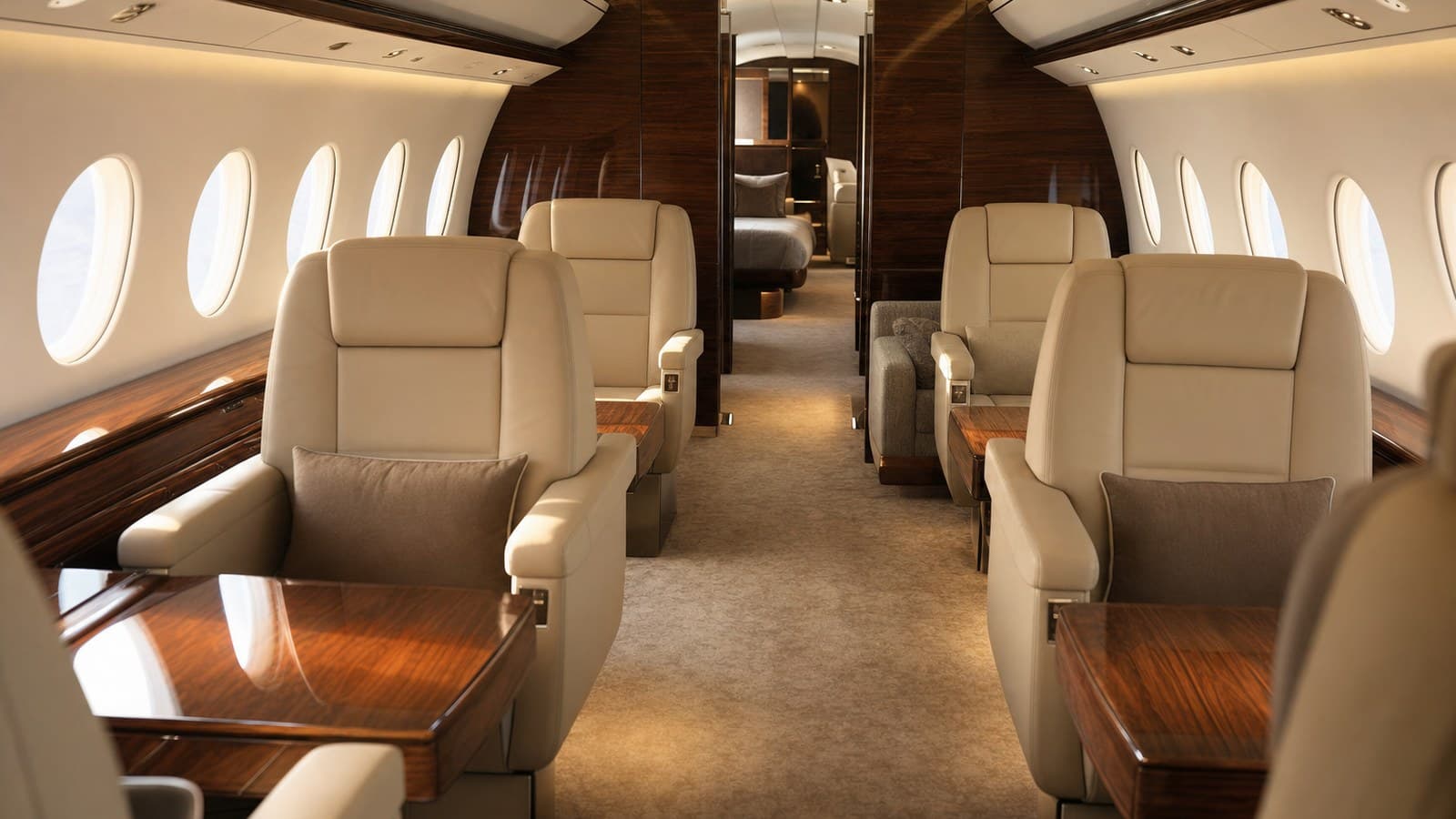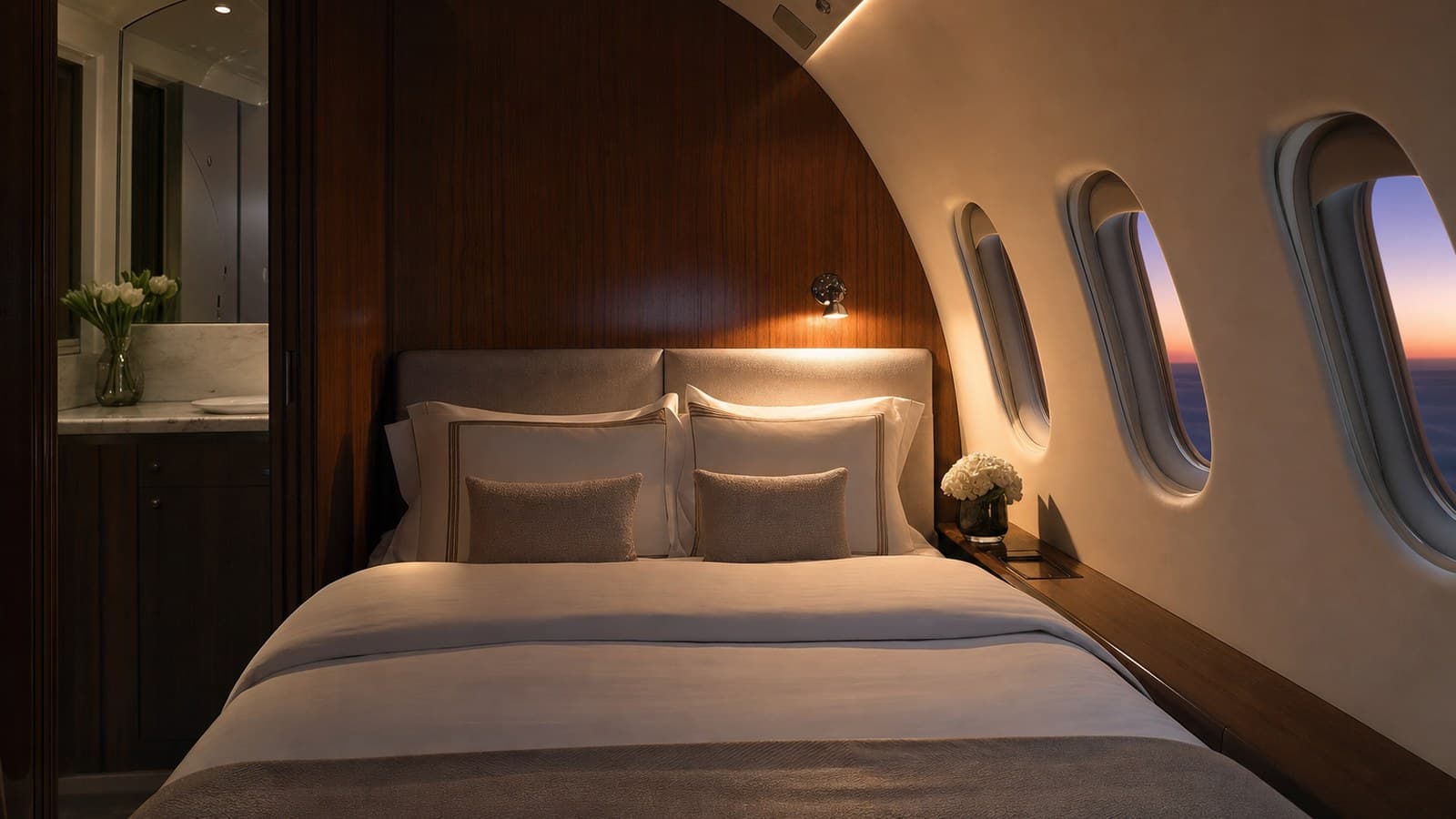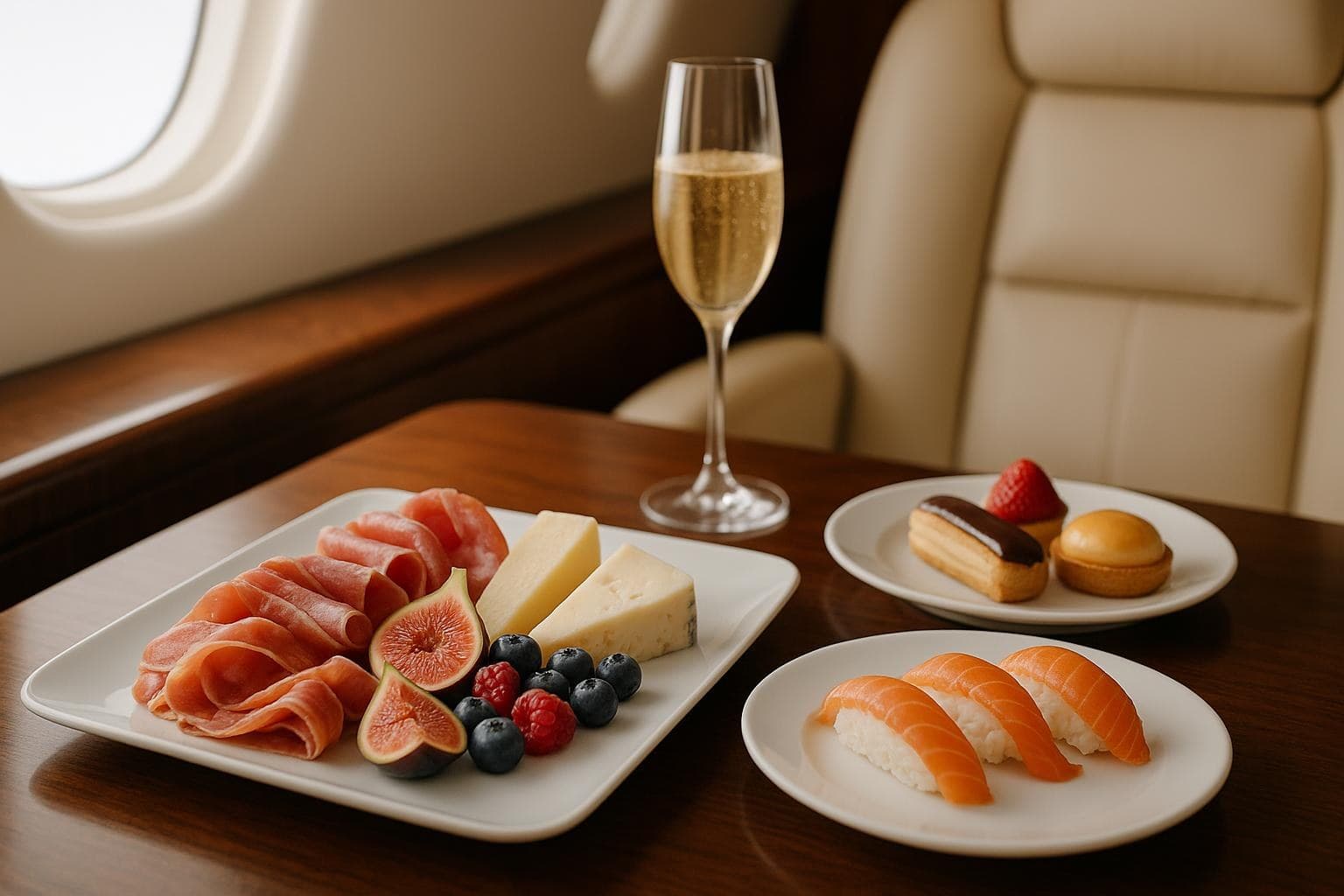
Cold platters on any jet, hot plated dinners only on midsize and larger — what you actually eat on a private jet comes down to two things you can check before you book: the galley on your aircraft and the length of your flight. Here is how private jet catering really works.
Private Jet Catering: What You Actually Eat, and What the Galley Can Really Do (2026)
Search "private jet catering" and every result shows you the same thing: caviar, Wagyu, gold-leaf desserts and a five-star chef. That is real — but it is the menu, not the mechanics, and it hides the one fact that actually decides what lands on your table: the galley on your specific aircraft. A very light jet has no oven and often no galley at all, so your "catering" is a chilled box of sandwiches and a cheese plate, however much you are willing to spend. A heavy jet has a full galley with an oven, so a hot three-course meal is genuinely on the table. This guide explains private jet catering the way an operations desk sees it — what each category of aircraft can serve, what people really order by flight length, how ordering and lead times work, what it costs, and how to handle allergies, kids, alcohol and customs — using aircraft available from partner operators.
The short answer: on a private jet you can eat almost anything you ask for, from a fruit-and-cheese platter to a restaurant-plated dinner — but hot food and multi-course service depend on the galley, which depends on the size of the jet. Cold catering is available on every aircraft; hot, plated meals need a midsize jet or larger. Order it through your operator or broker, ideally 24–48 hours ahead, and it arrives with the aircraft. Everything below is the detail behind that sentence.
The Galley Is the Whole Story
Before you think about menus, understand the piece of equipment that governs them. A galley is the aircraft's onboard kitchen area: at minimum a refreshment centre with cold storage and a place to plate; at best a real unit with an oven, a microwave, an espresso machine, cold and hot storage, and counter space for a cabin attendant to work. Whether your jet has one — and how capable it is — is set by the category of aircraft, not by your budget on the day.
Here is the honest picture across the published aircraft available from partner operators. These galley counts are drawn directly from the aircraft database; the "hot food" and typical-service columns reflect standard operational configurations for each class.
| Category | Galley in fleet | Typical galley | Hot food onboard | Typical catering you'll get |
|---|---|---|---|---|
| Very Light | 11 of 16 | Drinks cabinet, cold box | No | Cold snacks, sandwiches, fruit, pastries |
| Light | 28 of 31 | Cold galley, sometimes hot | Rarely | Cold platters, salads, charcuterie, patisserie |
| Midsize | 40 of 40 | Real galley, usually oven | Yes | Hot mains reheated, plated cold starters |
| Super-Midsize | 23 of 23 | Full galley, oven | Yes | Multi-course hot service, plated to table |
| Heavy | 37 of 37 | Full galley, oven, more storage | Yes | Full multi-course meals, breakfast + dinner |
| Ultra-Long-Range | 20 of 20 | Large galley, cabin crew | Yes | Restaurant-level dining across a full day |
Two things fall out of this table. First, a galley is near-universal but not guaranteed: 159 of the 167 aircraft in the fleet have one, but 5 of 16 very light jets do not, so if you are booking at the smallest end, catering capability is a question to ask, not an assumption to make. Second, the leap that matters for food is the jump to midsize. Below it, catering is essentially cold; at midsize and above, every aircraft in the fleet has both a galley and an enclosed lavatory, and hot, plated service becomes normal. If you want to see how those categories map to space and comfort more broadly, our private jet interior guide breaks down the whole cabin, and types of private jets covers the mission side.
What "No Galley" Really Means for Your Trip
The cabins people actually charter most in Europe are light jets, and this is where the catering myth does the most damage. On a Citation CJ3 or a Phenom 300E — the workhorses of European charter — there is a galley, but it is a cold galley: cold storage, a place to plate, drinks, coffee, but generally no oven. Your caterer works around that by sending food designed to be excellent cold or at room temperature: sushi, charcuterie and cheese, seafood, salads, sandwiches, dips, fruit, and patisserie. It arrives chilled, plated or ready to plate, and it is genuinely very good — it simply is not a hot roast dinner.
At the very light end — a Citation Mustang, where the fleet data shows no galley at all and a cabin you cannot stand up in — "catering" means a cold box you provision before departure. On a 30-minute Geneva to Courchevel hop, that is exactly right: nobody wants a plated dinner on a flight shorter than the taxi to the FBO. Match the food to the flight, and the small-cabin limitation stops being a limitation at all.
What People Actually Eat (It Depends on Flight Length)
Cabin size sets what is possible; flight length sets what is sensible. The single best predictor of what someone eats on a private jet is how long they are in the air, and our private jet flight times guide has the numbers for hundreds of routes. Three broad bands cover almost every trip:
- Short hops (under ~1 hour). Geneva to Courchevel is 29 minutes; Nice to Geneva is 46. On flights this short, most passengers want a drink, coffee, water, and something light to pick at — fruit, nuts, a pastry, a sandwich. Elaborate catering is wasted; there is barely time to serve it before descent.
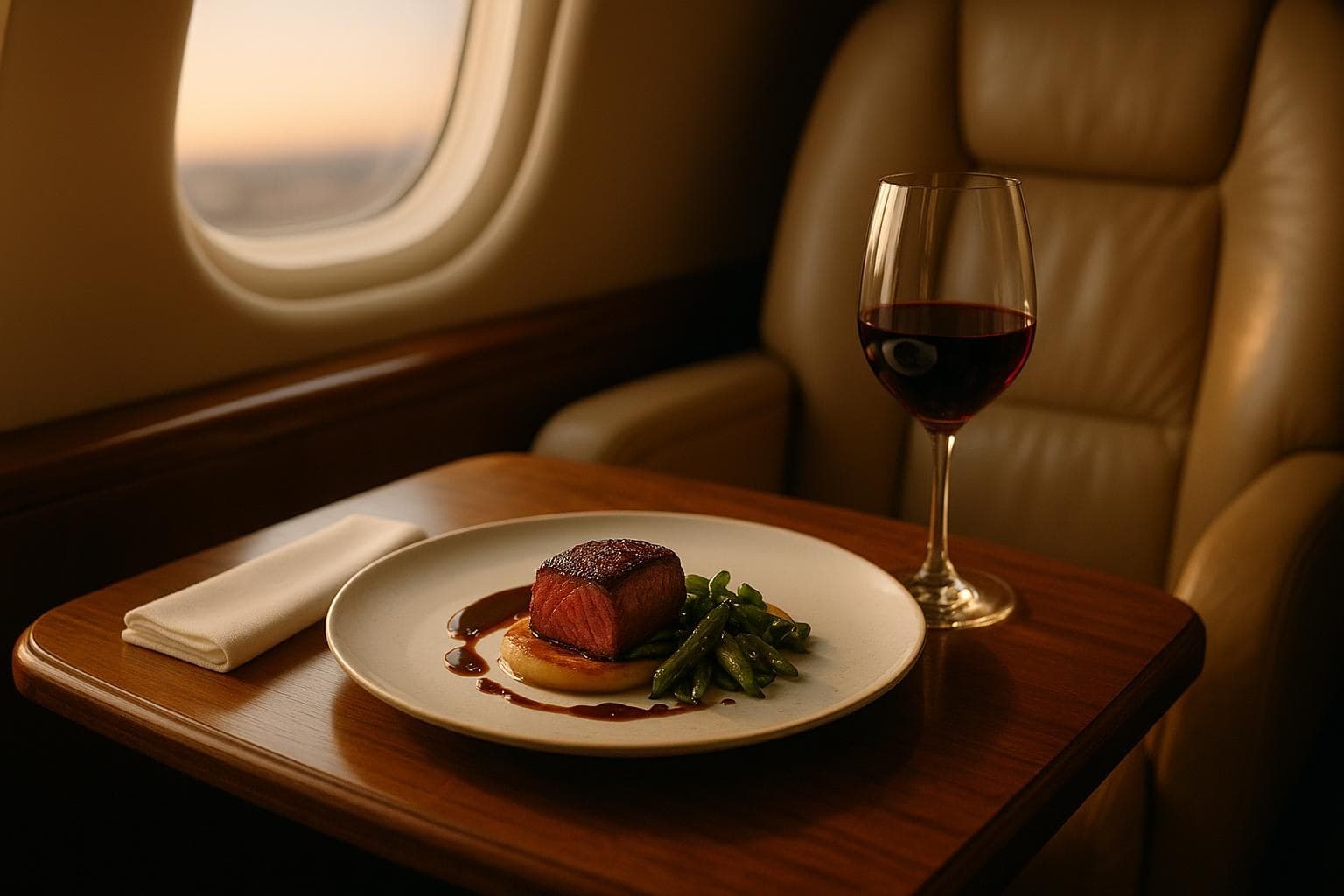
- Medium legs (1–3 hours). London to Nice is around 1 hour 50. This is the sweet spot for a proper cold service or a single reheated hot main on a midsize-plus jet: a plated starter, a main, a dessert, wine. Enough time to eat well without a full restaurant sequence.
- Long-haul (4 hours and up). London to Dubai is roughly 8 hours 15; London to New York is about the same. Here the cabin becomes a dining room across a whole day-part: breakfast after departure, a full multi-course lunch or dinner, snacks, a cheese course, and a cabin attendant to serve it. This is the only band where the caviar-and-Wagyu imagery is genuinely the norm rather than the exception — and it needs a heavy or ultra-long-range jet, with a Global 7500 or Gulfstream G650 at the top of the range, to do it properly.
The lesson operators repeat to first-time flyers: over-ordering is the most common catering mistake. A 45-minute flight does not need a hot three-course meal, and asking for one on a light jet without an oven simply cannot be delivered. If it is your first charter, our first private jet flight guide walks through the whole day, catering included.
How Private Jet Catering Actually Works
There is no menu card in the seat pocket. Private jet catering is arranged on the ground, before the flight, and understanding the chain removes most of the mystery.
Who prepares it. Food rarely comes from the operator's own kitchen. It comes from specialist aviation caterers and from the kitchens attached to FBOs — the private terminals where your jet parks. Major business-aviation hubs such as Paris–Le Bourget, Geneva, Nice and Farnborough have established catering supply chains, so at a big FBO you can order close to anything. At a small regional strip, the choice narrows to whatever a local caterer or restaurant can deliver to the aircraft — another reason your departure airport shapes your menu.
How you order. You brief your operator or broker, who places the order with the caterer and has it delivered to the aircraft before boarding. You can be as loose or as precise as you like: "a light cold lunch for four, no shellfish," or a specific dish from a named restaurant, or a full written menu. The cabin crew (on jets that carry one) or the pilots (on smaller jets, within their duties) store, plate and serve it.
Standard vs. bespoke. Most operators include a level of standard provisioning in the charter price: soft drinks, water, coffee, tea, and light snacks — enough for a typical short European flight. Anything beyond that — plated meals, specific dishes, fine wines, a named restaurant's food — is bespoke catering, ordered and billed on top. The line between the two varies by operator, which is exactly why you should ask what is included rather than assume.
Lead times. Simple, standard catering can often be arranged a few hours out. Bespoke menus, special dietary requirements, kosher or halal meals, celebration cakes, or anything from a specific restaurant need more notice — plan on 24 to 48 hours, and more for elaborate requests or unusual airports. Last-minute charters can still be catered, but your options shrink to what is available near the FBO right now.
What Private Jet Catering Costs
Catering is one of the few parts of a charter that is genuinely elastic, so treat it as a line you control rather than a fixed fee. Standard provisioning — the drinks and light snacks most operators include — adds nothing you will notice on top of the hourly rate, which in aircraft available from partner operators runs from about €2,200 an hour for a very light jet to €17,500 for an ultra-long-range flagship. Bespoke catering sits on top of that and scales with exactly what you order: a few cold platters from an FBO kitchen is a modest line item; a multi-course, restaurant-sourced menu with fine wines for a full cabin is a meaningful one.
The honest framing is proportional. On a light-jet day costing several thousand euros an hour, even generous cold catering is a small fraction of the trip. On a long-haul heavy-jet booking, full plated dining across a day is a larger but still secondary cost next to the aircraft itself. The mistake is not spending too much on food — it is paying for hot, elaborate catering the aircraft cannot serve, or for a full menu on a flight too short to eat it. Brief the caterer for the flight you are actually taking. When you request a Flyius quote, catering is specified alongside the aircraft, so you see what is included and what a bespoke menu adds before you commit.
Special Diets, Allergies, Kids and Celebrations
This is where private catering genuinely outclasses any commercial cabin, because the meal is made for your specific passengers rather than pulled from a trolley.
- Allergies and intolerances. Flag every allergy when you order. A private caterer builds the menu around a nut, shellfish, gluten or dairy restriction as a matter of course — but only if they know in advance, so put it in the brief in writing.
- Dietary preferences. Vegan, vegetarian, pescatarian, kosher, halal, low-carb, keto — all standard requests. Kosher and halal in particular may need a certified supplier and therefore more lead time; ask early.
- Children. Family charters are common, and caterers will happily provide child-friendly food — simpler dishes, familiar favourites, cut fruit — rather than forcing a tasting menu on a five-year-old. If you are flying with young children, say so; it changes the order.
- Celebrations. Birthday cakes, champagne for a milestone, a specific dish for an anniversary — this is routine for private catering and one of the nicer reasons to fly private. Give the caterer the occasion and the lead time and they will make it happen.
Alcohol, and the Customs Catch Nobody Mentions
Alcohol is available on essentially any private flight — from the standard soft drinks and wine many operators include, up to specific champagnes and spirits ordered bespoke. Two practicalities are worth knowing. First, on very light and light jets there is no dedicated bar, so drinks are served from cold storage rather than mixed; on heavy and ultra-long-range cabins with a cabin attendant, proper bar service is normal.
Second — and this is the trap the glossy pages skip — food and drink are goods, and goods cross borders. Onboard catering is generally consumed in flight and rarely an issue, but leftover food, and especially fresh produce, meat, and dairy, can run into agricultural import rules when you land internationally, and duty-free alcohol allowances still apply to what you carry off the aircraft. Flying private does not exempt you from customs; it simply makes the process faster. If you are crossing borders, our private jet customs and security guide explains what actually happens on arrival and what you can and cannot bring in.
How to Brief Your Catering: A 60-Second Checklist
Give your operator these six things and your catering will be right the first time:
- Headcount — how many passengers, and any children.
- Flight length and time of day — this sets whether you want snacks, a single meal, or full service, and whether it is breakfast, lunch or dinner.
- Hot or cold — confirm what your aircraft's galley can actually do before ordering hot food; on a light jet, plan cold.
- Restrictions — every allergy, intolerance and dietary requirement, in writing.
- Preferences — favourite dishes, a specific restaurant, wine and drinks, anything for a celebration.
- Lead time — order 24–48 hours ahead for bespoke menus; earlier for kosher, halal, or unusual airports.
Private Jet Catering: Frequently Asked Questions
Do private jets serve food?
Yes. Every private jet can offer catering, but the type depends on the aircraft. Cold food and drinks — sandwiches, platters, fruit, charcuterie, patisserie — are available on any jet, including very light aircraft. Hot, plated, multi-course meals need a midsize jet or larger, because they require a galley with an oven; in aircraft available from partner operators, all midsize and larger aircraft have a full galley, while 5 of 16 very light jets have no galley at all.
What do you actually eat on a private jet?
Whatever you order, matched to the flight. On short hops most people have drinks, coffee and something light — fruit, pastries, a sandwich. On medium and long flights, expect plated starters, hot mains, desserts, cheese, and wine, up to restaurant-level dining on long-haul heavy and ultra-long-range jets. Popular practical choices are cold platters, sushi, charcuterie, seafood and salads, because they travel and serve well.
Is food included in a private jet charter?
Usually only standard provisioning — soft drinks, water, coffee, tea and light snacks — is included in the charter price. Plated meals, specific dishes, fine wines and restaurant-sourced menus are bespoke catering, ordered and billed on top. The exact line varies by operator, so confirm what is included when you book.
How far in advance do I need to order catering?
Simple catering can sometimes be arranged a few hours before departure. Bespoke menus, special diets, kosher or halal meals, celebration cakes and food from a specific restaurant need more notice — plan on 24 to 48 hours, and longer for elaborate requests or smaller airports with limited catering supply.
Can you get hot food on a private jet?
Only on aircraft with a galley oven, which in practice means midsize jets and larger. Very light and most light jets have cold galleys — or, on the smallest aircraft, no galley — so hot meals are not possible and catering is designed to be served cold. If a hot meal matters, book at least a midsize jet.
Can you request special meals, allergies or kids' food?
Yes, and this is a core advantage of private catering. Caterers build menus around allergies and intolerances, cater for vegan, vegetarian, kosher, halal and other diets, and provide child-friendly food on request. Flag every requirement in writing when you order, and allow extra lead time for certified kosher or halal meals.
The Bottom Line
Private jet catering is not really about the caviar. It is about matching the food to two things you can check before you book: the galley on your aircraft, and the length of your flight. Cold catering — and it can be superb — is available on every jet in the sky. Hot, plated, multi-course dining needs a midsize aircraft or larger, and it comes into its own on the long-haul flights where you are in the cabin for a full day. Order through your operator 24–48 hours ahead, brief every dietary requirement in writing, and specify hot or cold to match the galley, and you will eat exactly as well as the trip deserves — no more, no less.
When you are ready to plan a flight, request a Flyius quote and we will specify catering alongside the right aircraft for your route and group, or browse the full fleet to see which cabins carry a full galley. We will return a indicative estimates; the final price is in the operator's written quote — food included where it should be — in minutes.
Written by Sophie Marchant, Senior Business Aviation Editor. Reviewed for operational and catering-logistics accuracy by Thomas Werner, Aviation Operations Reviewer. Galley availability, cabin data and charter rates are drawn from aircraft available from partner operators database and reflect typical 2026 European operations; individual aircraft configurations and operator catering policies vary, and final pricing depends on availability, routing, and date.
Looking to book a private jet?
Get a Free QuoteWritten by
Flyius
Flyius publishes these charter guides. A firm price is confirmed only after an operator quote.