A private jet interior isn't one thing — it ranges from a snug seated cabin you can't stand up in to a 1.95 m stateroom with a bed and a shower. Here's what's really inside each jet category, with verified cabin dimensions and amenity data from a 152-aircraft European fleet.
Private Jet Interior: What's Actually Inside the Cabin at Every Price Tier (2026)
A private jet interior is not one thing. Search the term and you get bedrooms, showers, and standing lounges — but those belong to a handful of $60-million-plus flagships that make up a tiny fraction of the flights people actually charter. The cabin you will really sit in depends entirely on the category of jet, and that ranges from a snug 1.41-metre-high seat you cannot stand up in, to a 1.95-metre stateroom with a queen bed and a walk-in shower. This guide shows you the real interior of each category — verified cabin dimensions, seating, lavatories, Wi-Fi and beds — using live data from the Flyius fleet of 152 aircraft across Europe, so you know exactly what you are booking before you pay for it.
If you only remember one thing: the single number that defines a private jet interior is cabin height, because it decides whether you can stand up. Everything else — a bed, a shower, a proper galley — follows from the size of the cabin, and the size of the cabin follows from the price. Below, every figure comes from the aircraft database, not a brochure render.
The One Table That Explains Every Private Jet Interior
Here is the whole landscape in a single view. These are average interior dimensions and amenity availability across the published Flyius fleet, grouped by the six standard jet categories. Cabin height is what you feel first; cabin width decides whether seats face each other across an aisle or fold in close; hourly rate is the 2026 European charter figure that comes with each level of space.
| Category | Cabin height | Cabin width | Cabin length | Stand up? | Enclosed lavatory | Bed possible | Hourly rate (€) |
|---|---|---|---|---|---|---|---|
| Very Light | 1.41 m (4'8") | 1.43 m | 3.4 m | No | Usually not | No | 2,200–4,000 |
| Light | 1.45 m (4'9") | 1.46 m | 5.0 m | No | Almost always | Rarely | 2,400–4,600 |
| Midsize | 1.69 m (5'7") | 1.70 m | 5.7 m | Almost | Always | Rarely | 3,800–8,000 |
| Super-Midsize | 1.82 m (6'0") | 2.04 m | 8.2 m | Yes | Always | Sometimes | 5,000–9,800 |
| Heavy | 1.86 m (6'1") | 2.33 m | 10.3 m | Yes | Always | Usually | 6,800–14,000 |
| Ultra-Long-Range | 1.91 m (6'3") | 2.42 m | 14.3 m | Yes | Always | Yes | 11,000–17,500 |
Two facts jump out of this table. First, the interior roughly doubles in every dimension from a very light jet to an ultra-long-range one — height climbs half a metre, width nearly doubles, and cabin length more than quadruples. Second, the amenities people associate with "private jet interior" — a real bed, a walk-in lavatory, distinct cabin zones — do not appear at all until you reach super-midsize and heavy jets. If you want to understand how those categories map to trips and cost, our types of private jets guide covers the mission side; this article stays inside the cabin.
Cabin Height Is the Number That Matters
Before the category-by-category tour, understand the metric that governs the whole experience. Adults notice cabin height before anything else, because it is the difference between walking to your seat upright and shuffling in bent double.
- Under 1.5 m (under 4'11"): a seated cabin. You move around crouched. This is every very light jet and most light jets.
- 1.5–1.75 m (4'11"–5'9"): a "stoop" cabin. Shorter passengers can nearly stand; most adults still duck. Midsize jets live here.
- 1.75 m and above (5'9"+): a genuine stand-up cabin. The tallest ultra-long-range jets reach 1.95 m (6'5"), taller than almost anyone who will fly in them.
Cabin width matters almost as much, because it sets the seating geometry. Below about 1.7 m of width, seats sit close and the aisle is narrow. At 2.2 m and above — heavy and ultra-long-range territory — you get a flat floor, seats that swivel and recline into beds, and room to pass someone without a negotiation. Keep these thresholds in mind and every cabin below explains itself.
Very Light Jet Interior: The Honest Entry Point
The very light jet is where private aviation begins, and its interior is the most misunderstood. Across the fleet these cabins average 1.41 m high, 1.43 m wide and 3.4 m long — an intimate, seated space for four passengers. You do not stand up in a very light jet. Most do not have an enclosed lavatory (roughly 12 of 15 in the fleet offer one, and even then it is a curtained-off seat rather than a room), and only some carry a galley beyond a drinks cabinet.
The Cessna Citation Mustang is the honest archetype: a 1.37-metre cabin, four seats, no galley, a 4-cubic-metre volume — and Wi-Fi on board, because connectivity is now near-universal even at this level (14 of 15 very light jets in the fleet have it). This is the right interior for a one-hour hop where the point is the schedule, not the cabin. Nobody charters a Mustang for the interior; they charter it to skip the terminal. If your group is one to four people flying under 90 minutes, this cabin does the job at the lowest price in private aviation — from around €2,200 an hour.
Light Jet Interior: The European Workhorse Cabin
Light jets are the best-selling charter category in Europe, and their interiors are a clear step up: averaging 1.45 m high, 1.46 m wide and a full 5 m long, they add real seating for six to eight and, crucially, an enclosed lavatory in almost every aircraft (29 of 31 in the fleet). You still cannot stand fully upright — the ceiling is around head height for a seated adult — but there is a proper cabin, a galley for cold catering and drinks, and, on newer types, individual entertainment screens.
The Embraer Phenom 300E, the most-delivered business jet in the world for over a decade, is the benchmark: a 1.55-metre cabin — tall for the class — with an enclosed lavatory, a galley, Wi-Fi and entertainment. The Pilatus PC-24 goes further with a 7-metre cabin and a flat floor unusual for a light jet. Every light jet in the fleet carries Wi-Fi. This is the cabin that flies most European charters — Geneva to Courchevel, London to the Riviera — and it is comfortable for two to three hours without pretending to be a lounge.
Midsize Jet Interior: Where You (Almost) Stand Up
The midsize category is where the cabin changes character. Interiors average 1.69 m high, 1.70 m wide and 5.7 m long — the point at which shorter adults can stand and everyone gets a fully enclosed lavatory, a real galley, and space to hold a meeting in the air. Every midsize jet in the fleet has Wi-Fi, an enclosed lavatory and a galley; this is the first tier where the interior feels like a room rather than a capsule.
The Cessna Citation XLS+ is the archetype — a 1.73-metre cabin, 12.3 cubic metres of volume, seating for eight, with entertainment and a proper galley at around €6,200 an hour. The Citation Latitude pushes cabin height to 1.83 m with a flat floor, giving a genuine stand-up interior at midsize economics. If your trips run two to four hours and you want to arrive able to stretch, work, and use a real lavatory, this is the entry point to a comfortable private jet interior — and a meaningful jump from the light-jet cabin below it.
Super-Midsize & Heavy Jet Interiors: Zones, Flat Floors and Real Beds
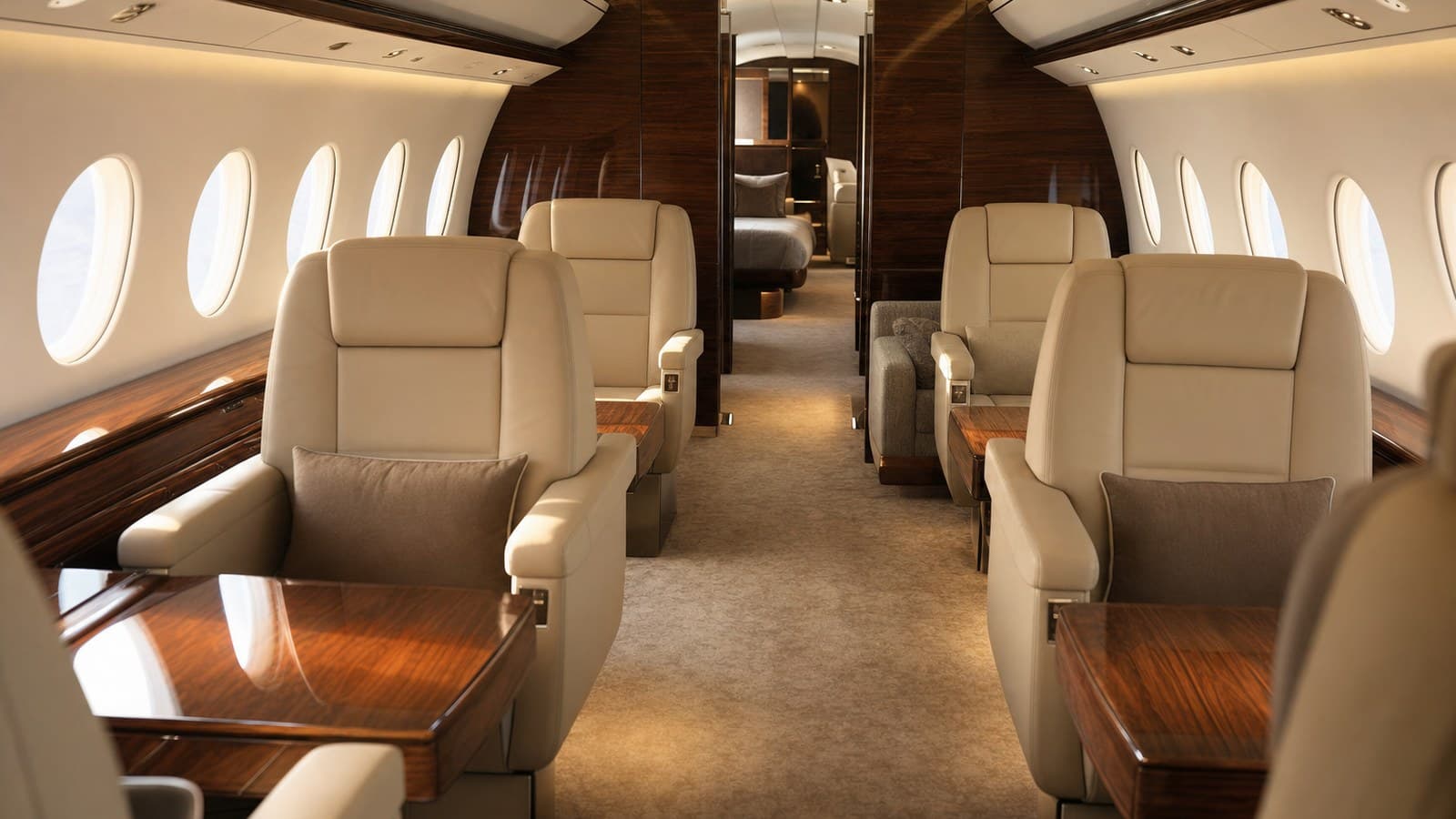
This is where the "private jet interior" of the imagination starts to appear. Super-midsize cabins average 1.82 m high and 2.04 m wide; heavy jets stretch to 1.86 m high, 2.33 m wide and 10.3 m long. At this width the floor goes flat, seats recline and swivel, and — for the first time — beds become real. In the fleet, 6 of 22 super-midsize jets and 10 of 34 heavy jets convert to a bed configuration, using berthable divans and reclining seats rather than a fixed mattress.
The Bombardier Challenger 350 shows the super-midsize interior at its best: a 1.85-metre flat-floor cabin, 2.19 m wide, 21 cubic metres of volume, seats that berth into beds, at around €8,200 an hour. Step up to heavy metal and the Gulfstream G550 delivers a 15-metre cabin — 47 cubic metres — with distinct zones for dining, working and sleeping. These interiors are built for the flights where the cabin is the point: a large group crossing a continent, or an overnight where you want to arrive rested. For the specifics on which aircraft carry a genuine sleeping setup, our private jets with bedrooms guide breaks it down aircraft by aircraft.
Ultra-Long-Range Jet Interior: The Cabin Behind the Photos
Almost every glamorous "private jet interior" photo you have seen is an ultra-long-range jet. These are the flagships — averaging 1.91 m high, 2.42 m wide and 14.3 m long, with the tallest examples reaching 1.95 m (6'5"), taller than the people standing in them. Every ultra-long-range jet in the fleet has a full galley, an enclosed lavatory, Wi-Fi and a bed configuration; many add a dedicated bedroom and, on the largest, a full stand-up shower.
The Gulfstream G650 — a 16.3-metre cabin, 2.59 m wide, 54.8 cubic metres — is the icon of the class. The Bombardier Global 7500 goes further still with a 59-cubic-metre, four-zone cabin, a permanent aft bedroom and an ensuite shower: the single jet that actually matches the fantasy. But note the price of that fantasy — €11,000 to €17,500 an hour, three to five times a light jet. On a one-hour European hop, this interior is spectacular and almost entirely wasted. Its reason to exist is the 12-hour nonstop — London to Dubai, London to New York — flown in a single leg while you sleep in a real bed.
Private Jet Interior Amenities: What's Standard vs. What's Rare
Cabin dimensions aside, buyers ask about specific amenities. Here is the honest 2026 picture, drawn from the fleet:
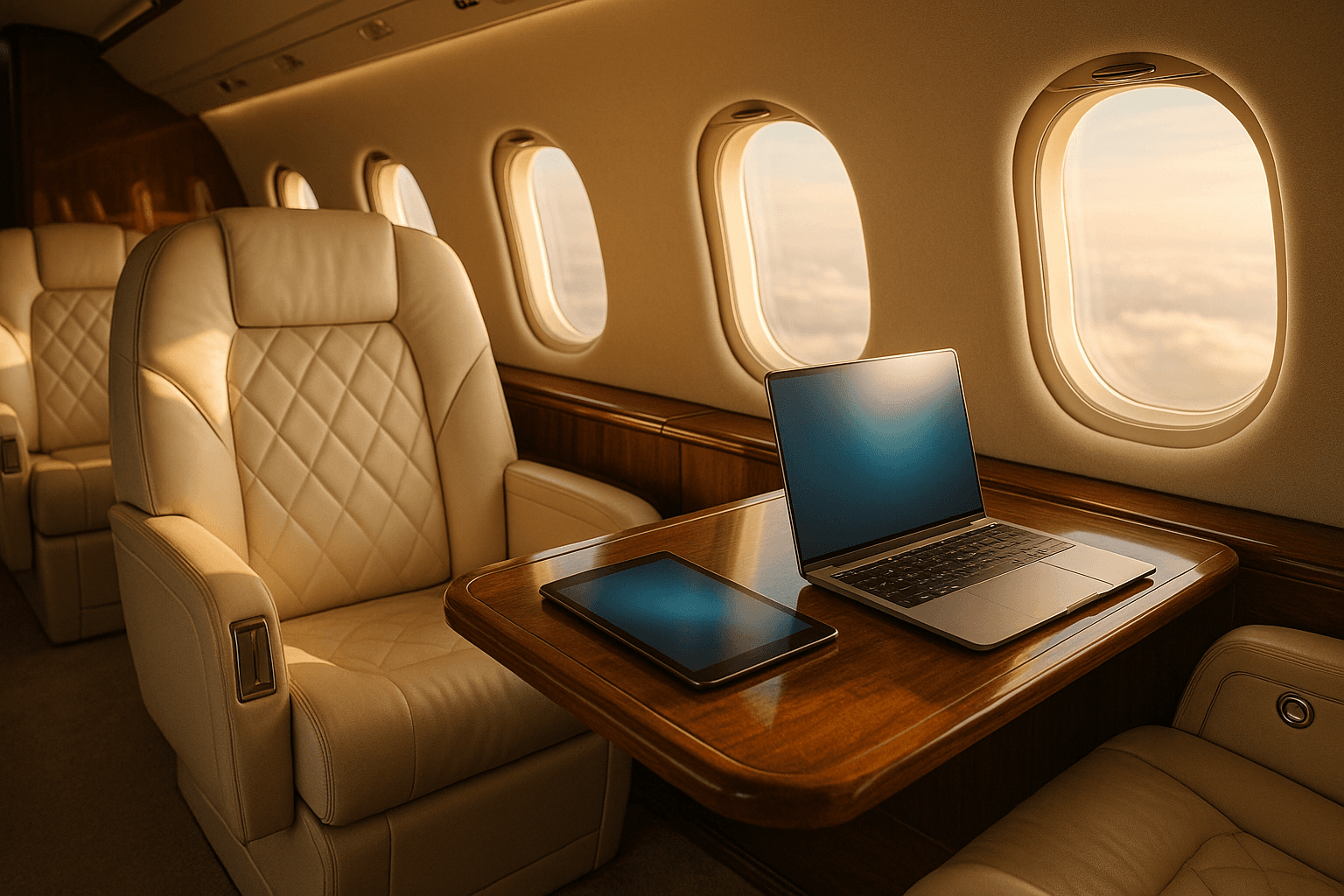
- Wi-Fi: effectively standard. 151 of 152 published aircraft carry it, including nearly every very light jet. Speed and cost vary — older air-to-ground systems are slower than modern satellite Wi-Fi — but connectivity is no longer a luxury-jet feature.
- Enclosed lavatory: universal from light jets up. Only some very light jets lack a proper enclosed toilet. Ask specifically if you are booking a very light aircraft.
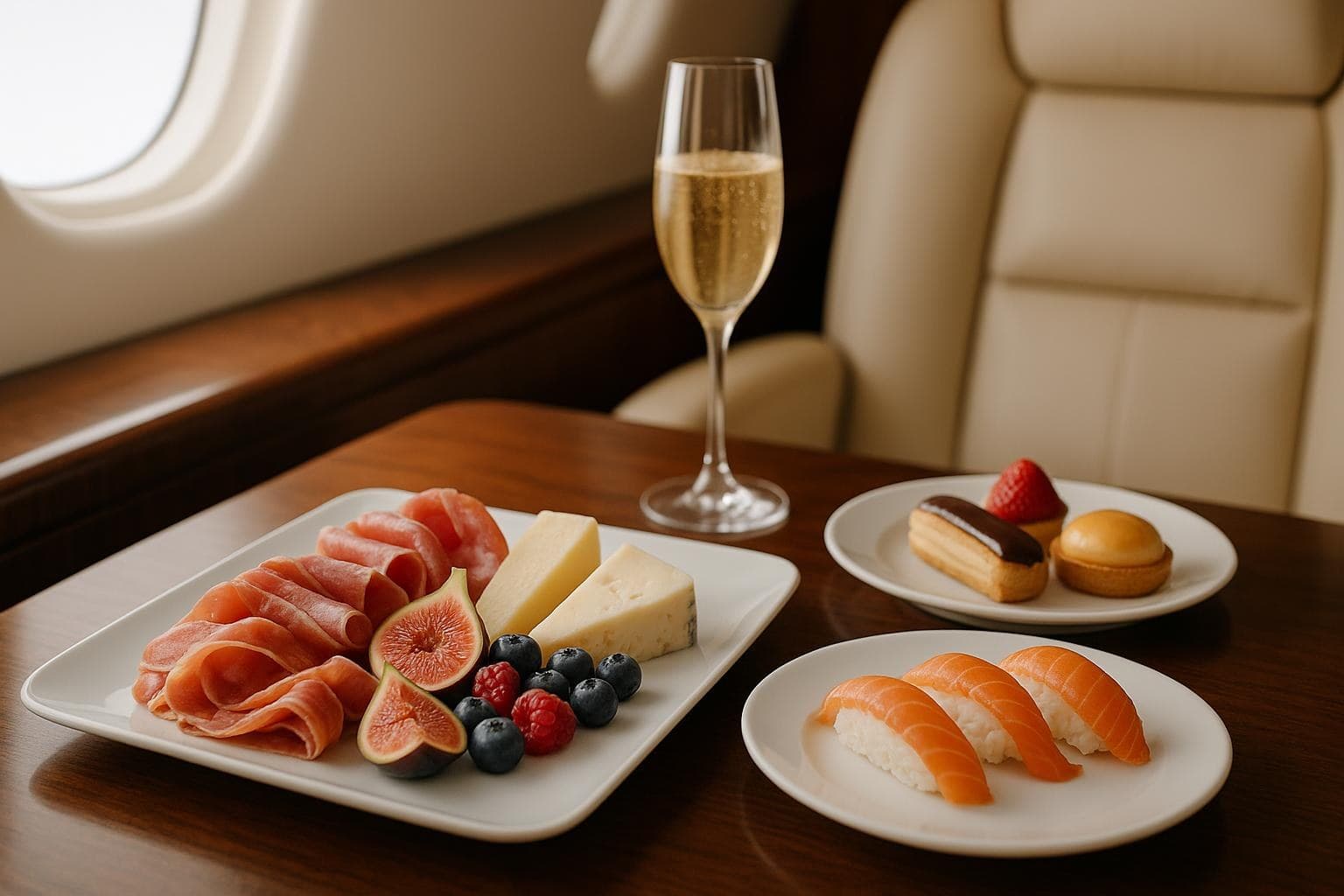
- Galley: standard from light jets up. On midsize and larger it is a real galley capable of hot catering; on very light jets it is often just a refreshment centre.
- Beds: the dividing line. No very light or (almost no) light and midsize jet offers a bed. Beds appear on super-midsize jets and become common on heavy and ultra-long-range aircraft — and even then they are usually berthable seats or divans, not a fixed stateroom bed.
- Showers: genuinely rare. Reserved for the largest ultra-long-range jets such as the Global 7500. If a shower matters, you are booking the top of the market.
- Baggage: cabin size drives hold size too. If you are travelling with skis, golf clubs or a large group's luggage, read our private jet baggage allowance guide before you assume the interior has room.
How to Choose the Right Cabin for Your Trip
The right private jet interior is not the biggest one — it is the smallest cabin that fits your trip, because interior space you do not use is the most expensive thing you can pay for in charter. Work through three questions:
- How long is the flight? Under 90 minutes, a seated very light or light cabin is comfortable and cheapest. Two to four hours, step up to midsize for a stand-up-ish cabin and a real lavatory. Over four hours or overnight, super-midsize and above justify their cost.
- Do you need to stand, work, or sleep? Standing means 1.75 m of cabin height (midsize-plus). Working across a table means 2 m of width (super-midsize-plus). Sleeping in a bed means heavy or ultra-long-range.
- What is the trip worth to you? Within the cabins that fit, comfort scales with price. A four-hour flight in a flat-floor heavy cabin is a different day from the same trip in a light jet — only you can price that difference.
For a full walkthrough of matching aircraft to mission and budget, see how much a private jet costs in Europe, or browse the complete private jet fleet with every cabin's specifications.
Private Jet Interior: Frequently Asked Questions
Can you stand up inside a private jet?
It depends on the cabin height. Very light and light jets have seated cabins of about 1.41–1.45 m, so most adults cannot stand fully upright. Midsize jets reach around 1.69–1.83 m, where shorter passengers can stand; super-midsize, heavy and ultra-long-range jets offer genuine stand-up cabins of 1.82–1.95 m.
Do private jets have beds?
Some do. No very light jet and almost no light or midsize jet has a bed. Beds appear on super-midsize jets (about 1 in 4 in the fleet) and are common on heavy and ultra-long-range aircraft — usually berthable seats and divans rather than a fixed bedroom. Only the largest flagships, like the Global 7500, have a permanent stateroom bed.
Do private jets have Wi-Fi?
Almost universally, yes. 151 of the 152 aircraft in the Flyius fleet carry Wi-Fi, including nearly every very light jet. Performance varies between older air-to-ground and modern satellite systems, so confirm the connectivity type if reliable high-speed internet is essential for your flight.
Do private jets have showers?
Rarely. Onboard showers are reserved for the largest ultra-long-range jets, such as the Bombardier Global 7500, which has a full ensuite with a stand-up shower. If a shower is a requirement, you are chartering at the very top of the market — most private jet interiors, even large ones, do not have one.
How wide is a private jet cabin?
Cabin width runs from about 1.43 m on a very light jet to 2.59 m on a Gulfstream G650. The practical threshold is around 2 m: below it, seats sit close and the aisle is narrow; at 2.2 m and above you get a flat floor, swivel-recline seats and room to pass comfortably.
Which private jet has the best interior?
For sheer cabin, the ultra-long-range flagships lead — the Gulfstream G650 and Bombardier Global 7500 offer the tallest, widest and longest interiors with bedrooms and, on the Global, a shower. But "best" depends on your trip: for most European charters, a midsize or super-midsize cabin delivers stand-up comfort at a fraction of the cost.
The Bottom Line
A private jet interior is defined by its category, and its category is defined by cabin height and width. Very light and light jets give you a seated, connected cabin for short hops from around €2,200 an hour. Midsize jets add a near-stand-up cabin and a real lavatory. Super-midsize and heavy jets bring flat floors, distinct zones and convertible beds. Only ultra-long-range flagships deliver the bedrooms and showers of the photographs — at a price that only makes sense on long-haul flights. Match the cabin to the mission and you pay for space you actually use.
When you want to see the exact interior for your route and group, request a Flyius quote or browse the full fleet — we will match the right cabin to your trip and return a verified price in minutes.
*Written by Sophie Marchant, Senior Business Aviation Editor. Reviewed for operational and cabin-specification accuracy by Thomas Werner, Aviation Operations Reviewer. All cabin dimensions, amenity data and charter rates are drawn from the Flyius fleet database and reflect typical 2026 European operations; individual aircraft configurations vary, and final pricing depends on availability, routing, and date.
Looking to book a private jet?
Get a Free QuoteWritten by
Flyius
Flyius publishes these charter guides. A firm price is confirmed only after an operator quote.