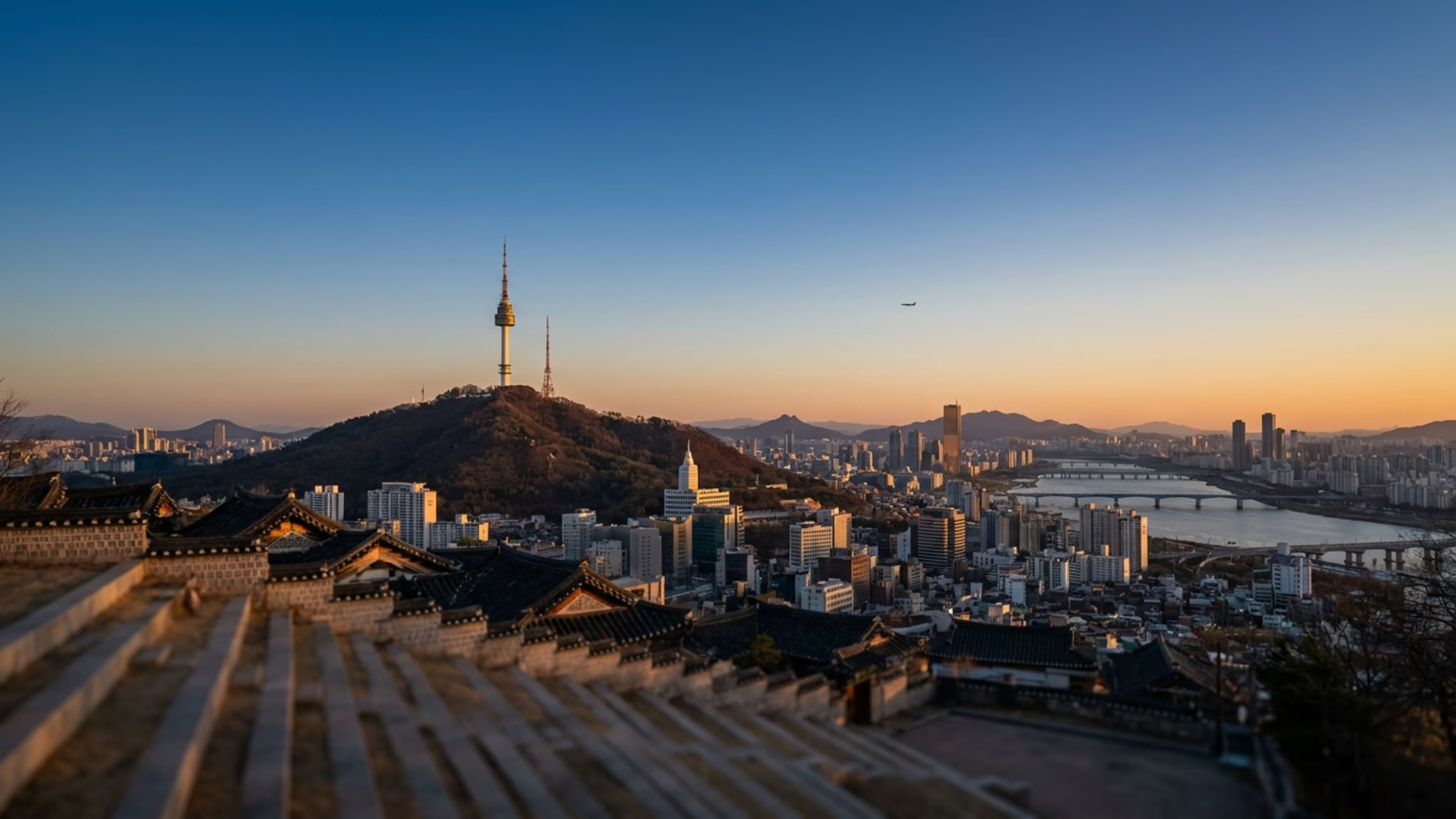
Seoul private jet aviation hub
ARGUS Certified
Instant Quotes

Private aviation hub

Private jet charter in Seoul

The complete Seoul private aviation guide — 14+ routes, top FBO terminals, transparent pricing from €4,500, instant quotes from 15+ certified operators.

Routes

14+

Starting at

€4,500

Primary Airport

Gimpo

Sophie Marchant

Written by Sophie Marchant · Senior Business Aviation Editor · 9+ years aviation experience

Reviewed by Thomas Werner · Aviation Operations Reviewer

Last updated

The hub

Seoul, a private aviation
crossroads of the continent

Seoul operates as the financial and industrial nerve centre of South Korea, concentrating the global headquarters of Samsung, Hyundai Motor Group, LG, SK Group and Lotte within a single metropolitan corridor. The city's GDP output rivals many sovereign nations, and inbound private aviation traffic reflects a dense calendar of M&A activity, investor roadshows, and board-level visits to the Gangnam and Yeouido financial districts. Charter demand peaks during Seoul Fashion Week, Frieze Seoul, and major semiconductor industry summits drawing principals from Tokyo, Singapore, Hong Kong and the Gulf.

For private aviation, Seoul is served by two distinct airports with complementary roles. Incheon International Airport (ICN), located 52 kilometres west of central Seoul on an artificial island, is the primary hub for long-haul and intercontinental private jet arrivals, handling customs and immigration through its dedicated general aviation terminal. Gimpo International Airport (GMP), 17 kilometres from the Gangnam business district, is the preferred field for short-haul and regional missions across Northeast Asia — particularly Seoul–Tokyo, Seoul–Beijing, Seoul–Shanghai and Seoul–Osaka rotations operated under bilateral agreements.

Ground transfer times from Gimpo to Gangnam run 20–30 minutes via the Olympic Expressway under typical conditions, while Incheon to central Seoul requires 45–70 minutes depending on traffic, with the AREX express rail offering a 43-minute alternative to Seoul Station. The Banyan Tree, Four Seasons, Park Hyatt and Signiel Seoul represent the primary UHNWI accommodation tier. Private terminal facilities at both airports include dedicated VIP lounges, high-security handling protocols, and pre-cleared customs coordination available by prior arrangement.
  • Dedicated VIP Terminal
  • Closest to Gangnam
  • High Security
Build my charter
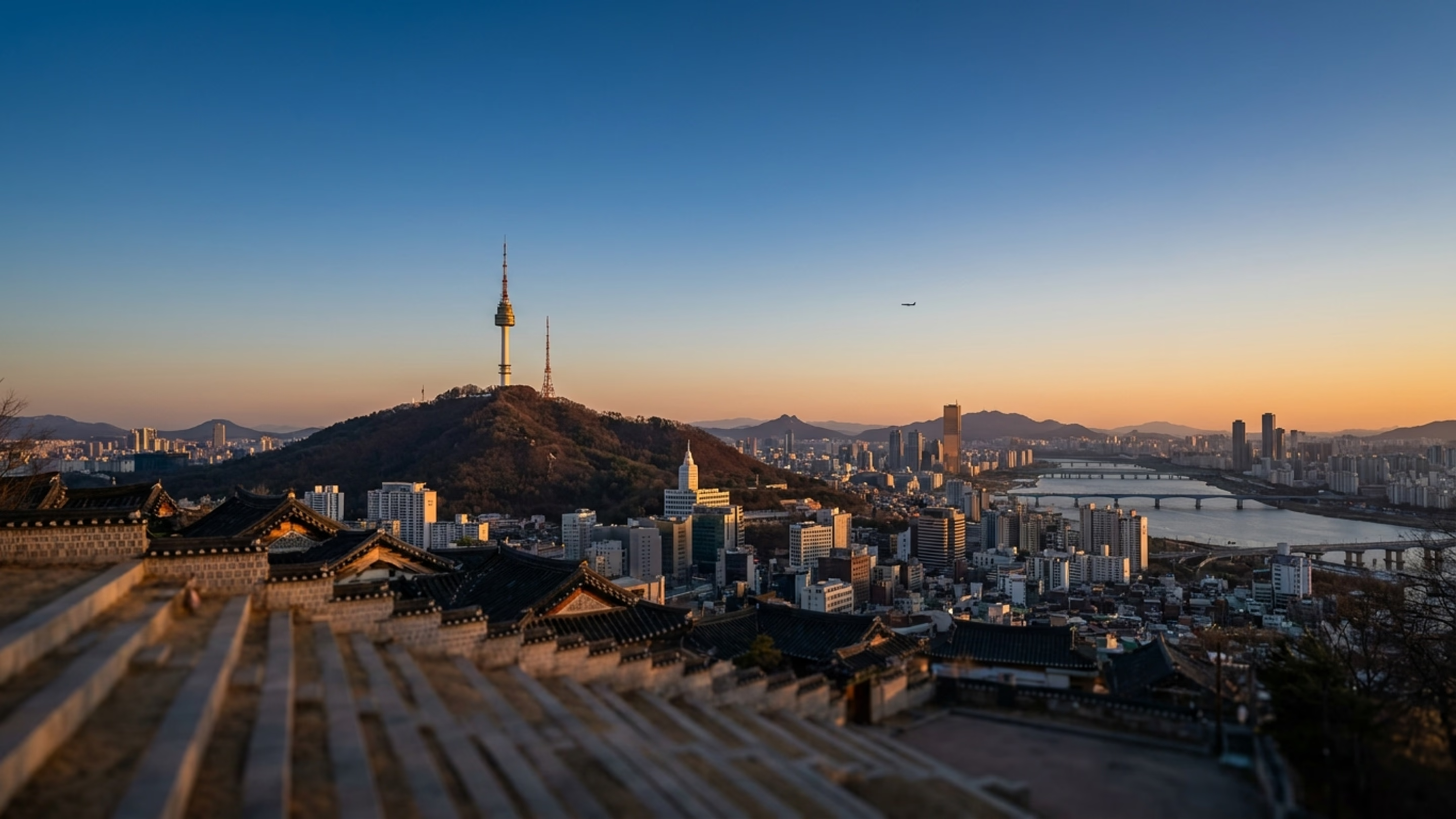
Seoul private jet FBO and destination overview
The inside view

Flying private to Seoul

Seoul: Northeast Asia's Most Active Private Aviation Market

Seoul operates as the financial and industrial nerve centre of South Korea, concentrating the global executive headquarters of Samsung, Hyundai Motor Group, LG, SK Group, and Lotte within a single metropolitan corridor. The city's private aviation market is anchored by continuous M&A activity, semiconductor industry summits, investor roadshows, and a cultural calendar that draws principals from Tokyo, Singapore, Hong Kong, and the Gulf throughout the year. Seoul is uniquely served by two functionally distinct airports: Incheon International Airport (IATA: ICN, ICAO: RKSI) for long-haul and intercontinental arrivals, and Gimpo International Airport (IATA: GMP) for short-haul and regional Northeast Asian missions.

Incheon International Airport: The Long-Haul Gateway

Incheon International operates 24 hours on an artificial island 52 kilometres west of central Seoul, connected to the city by the AREX express rail (43 minutes to Seoul Station) and highway links (50–70 minutes to Gangnam by executive vehicle). The airport handles customs and immigration through a dedicated general aviation terminal with high-security protocols and pre-cleared processing for pre-arranged arrivals. Overnight parking fees at Incheon are above the Northeast Asian regional average due to sustained apron demand; operators should factor parking costs explicitly into multi-day programme budgets. For intercontinental missions from North America, Europe, or the Middle East, Incheon is the mandatory arrival airport — Gimpo does not process intercontinental customs.

Gimpo International Airport: The Regional Workhorse

Gimpo sits 17 kilometres from the Gangnam business district — a transfer of 20 to 30 minutes via the Olympic Expressway, making it the fastest ramp-to-boardroom option in the Seoul network. The airport operates under bilateral agreements covering primary Northeast Asian city-pairs: Seoul–Tokyo Haneda, Seoul–Beijing Capital, Seoul–Shanghai Hongqiao, and Seoul–Osaka Itami. The general aviation apron accommodates light to super-midsize aircraft; ultra-long-range jets requiring full fuel uplift for transoceanic missions must operate from Incheon. Slot coordination at Gimpo is tight during morning and evening banking hours; advance PPR submission is required.

Corporate Demand Drivers

Seoul's private aviation demand calendar is dense and predictable. The semiconductor industry generates continuous inbound traffic from TSMC partners in Taiwan, fabless design companies in Silicon Valley, and memory ecosystem players in Tokyo. Hyundai Motor Group's global expansion and LG's battery ventures drive investor visits from Frankfurt, Detroit, and Atlanta. The Korean financial calendar concentrates activity around quarterly earnings and the KOSPI investor relations season. Cultural demand peaks three times annually: Seoul Fashion Week in March and October, and Frieze Seoul in September — the latter established as Asia's most commercially significant contemporary art fair, attracting principals predominantly from London, New York, and Hong Kong.

Ground Logistics and Regional Connectivity

High-security handling is a baseline expectation at both Incheon and Gimpo: airside vehicle collection, discrete boarding, and customs pre-clearance by prior arrangement. Chauffeur fleets operating Genesis G90, Mercedes S-Class, and BMW 7 Series are standard at both airports. The primary UHNWI accommodation cluster — Banyan Tree Club & Spa Seoul, Four Seasons Hotel Seoul, Park Hyatt Seoul, and Signiel Seoul — sits within the Gangnam and Jongno corridors. For broader Korean itineraries, Busan's Gimhae Airport is 55 minutes by air from Gimpo, and Jeju International is approximately 60 minutes, serving the island's luxury resort market.

Departures

Departures from Seoul

Departures from Seoul typically operate out of dedicated business-aviation terminals with FBO services, VIP lounges and customs clearance. The right field for your outbound charter depends on FBO availability, peak-hour slot windows and the runway length your jet category needs. Light Jets suit short regional hops, Midsize Jets cover longer European sectors, Heavy Jets support larger groups, and Ultra Long Range aircraft handle non-stop Seoul → North America or Asia missions. Confirm 24–48 hours ahead to lock in your preferred FBO; last-minute outbound is possible from 4 hours notice when crew and aircraft are positioned locally.

Arrivals

Arrivals in Seoul

Inbound flights to Seoul land at the dedicated private aviation terminal or an adjacent field closer to downtown — your concierge picks the optimal arrival based on customs hours, ground-transfer time and the runway length your jet category needs. Most Seoul arrivals can be confirmed 24–48 hours ahead; during high-demand weeks (sports finals, fashion weeks, ski breaks, summer peaks) inbound slots fill 5–7 days out. The arrival terminal typically offers VIP lounges, dedicated customs and immigration channels, conference rooms, premium catering and pre-arranged luxury ground transport. Helicopter transfers from the airport to nearby resorts, downtown helipads or onward destinations can be added to any inbound charter.

Airports & FBO

Where private jets meet Seoul

Every Seoul-area private aviation field listed, with runway length, customs availability and FBO services so you can pick the optimal terminal for your charter.

RKSI / ICN

Incheon International Airport

Runway: 3,750 m
Customs24/7 opsFBOPremium handling

RKSS / GMP

Gimpo International Airport

Runway: 3,200 m
Customs24/7 opsFBOPremium handling

FBO services

SGBAC (Seoul Gimpo Business Aviation Center)Avjet Asia
Transparent pricing

Private jet pricing for Seoul

Indicative ranges — request a fresh quote for your exact date and routing

Outbound

€7,000–€37,000

€10,000–€55,000

€16,000–€85,000

Inbound

€4,500–€38,000

€7,500–€57,500

€12,000–€87,500

Prices are indicative market ranges. Final quote depends on aircraft availability, specific date, routing and fuel surcharges.

Network

Top operators serving Seoul

These are the certified operators that fly in and out of Seoul most often through our network. Each is independently audited (ARGUS, Wyvern or IS-BAO) before any aircraft is quoted on Flyius.

N

NetJets Europe

HQ · Portugal

ARGUS PlatinumWyvern WingmanIS-BAO Stage 3

Fleet size

150

Aircraft types

Citation Latitude · Citation Longitude · Challenger 350

V

VistaJet

HQ · Pan-Europe / Malta

ARGUS PlatinumWyvern WingmanIS-BAO Stage 3

Fleet size

70

Aircraft types

Super midsize · large · ultra-long-range jets

J

JetFly

HQ · Luxembourg

ARGUS PlatinumWyvern WingmanIS-BAO Stage 3

Fleet size

8

Aircraft types

PC-12 · PC-24 · Pilatus

A

Air Partner

HQ · United Kingdom

ARGUS Gold

Fleet size

0

Aircraft types

All types - charter broker

A

Air Charter Service

HQ · United Kingdom

Fleet size

L

LunaJets

HQ · Switzerland

Fleet size

Every operator listed holds a valid AOC, current insurance and a third-party safety audit. We refuse to broker flights on unvetted aircraft.

See all certified operators
Empty leg alerts

Discounted private jet alerts from Seoul

No live empty leg is currently published from Seoul. Set an alert and our concierge will monitor repositioning flights, nearby airports and flexible departure windows for you.

  • Be notified when a repositioning aircraft matches your preferred route.
  • Check nearby airports automatically when they offer better availability.
  • Compare empty leg opportunities with standard charter quotes before booking.
View empty leg alerts

Empty legs are subject to fixed aircraft positioning, date flexibility and operator confirmation.

Sustainability

Emissions and offset for flights from Seoul

Indicative CO₂ per category based on the median distance of routes ex-Seoul, with SAF (Sustainable Aviation Fuel) offset cost at current market rates.

Category · CO₂ (per route) · kg / km · SAF offset cost
Light Jet

3,021.6 kg

kg / km:2.4SAF offset cost:€12,086
Midsize Jet

3,902.9 kg

kg / km:3.1SAF offset cost:€15,612
Heavy Jet

5,287.8 kg

kg / km:4.2SAF offset cost:€21,151
Ultra Long Range

7,050.4 kg

kg / km:5.6SAF offset cost:€28,202

Emissions estimated using EBAA/EUROCONTROL business-aviation factors (light 2.4 kg/km, midsize 3.1, heavy 4.2, ultra 5.6). SAF offset priced at €4/kg CO₂ — current market midpoint.

Indicative ranges
Private jet on tarmac at Seoul
Safety & operators

Audited operators serving Seoul

Every charter quoted on Flyius uses a third-party-audited operator

ARGUS Platinum

Top-tier independent safety audit.

Wyvern Wingman

Pilot vetting and operational safety.

IS-BAO Stage 3

IBAC business aviation standard.

Our safety standards
City guide

Travelling to Seoul

Why people fly private to Seoul

Highlights

  • Dedicated VIP Terminal
  • Closest to Gangnam
  • High Security

Major events

  • Seoul Fashion Week
  • Frieze Seoul

Nearby destinations

  • busan
  • incheon
FAQ

Everything you need about Seoul

Pricing, airports, booking lead times, customs and ground transport — answered

Which airport do private jets use in Seoul?
Most business-aviation traffic uses Gimpo International (GMP/RKSS), which has a dedicated business-aviation terminal on the west side of the city and is the closest field to central Seoul, making it the preferred choice for corporate flights. Incheon International (ICN/RKSI) handles long-haul and larger-cabin arrivals, particularly intercontinental widebody charters. Note that South Korea requires landing permits and slots to be arranged with lead time, so operators generally file well in advance.
How much does a private jet to or from Seoul cost?
Short regional hops within North Asia, such as Seoul to Tokyo or Beijing, start from about €13,000 one way on a light or midsize jet. A super-midsize or heavy jet on longer sectors like Seoul to Singapore runs roughly €28,000–€46,000 depending on aircraft and routing. Final pricing depends on cabin size, positioning, crew duty limits and airport slot availability, which can be tight at Gimpo.
When is private-jet demand highest in Seoul?
Demand peaks around major trade and cultural events, including the biennial Seoul International Aerospace and Defense Exhibition (ADEX) held in October at nearby Seongnam, and business travel tied to the spring and autumn corporate calendar. The Busan International Film Festival in early October and general end-of-quarter corporate activity also lift traffic through the region. Cherry-blossom season in April and the autumn foliage weeks draw additional leisure charter interest.
What are the most common private-jet routes to and from Seoul?
The busiest corridors serve North Asian corporate hubs, with Seoul to Tokyo and Seoul to Beijing among the most frequent short sectors. Seoul to Shanghai and Seoul to Osaka are also heavily flown for business travel. Longer regional demand runs south to Singapore, typically on super-midsize or heavy jets given the distance.
How do you get from the airport into central Seoul?
From Gimpo, the drive into the central business districts of Gangnam or Jung-gu takes roughly 30 to 40 minutes by car outside peak hours, one of the shorter airport transfers among major Asian capitals. Incheon sits farther west and typically requires 60 minutes or more by road. FBO handling can arrange chauffeured cars airside, and Gimpo's proximity is the main reason corporate flyers favour it over Incheon.
How much does it cost to fly out of Seoul by private jet?
Outbound prices from Seoul depend on destination, aircraft size and routing. Current guide prices on visible Flyius routes: Light Jets from €4,500–€38,000, Midsize Jets from €7,500–€57,500, Heavy Jets from €7,500–€57,500–€87,500. Live availability and fuel surcharges can shift the final quote.
Seoul private jet aviation hub
Your next flight

Ready to fly private from Seoul?

Instant quote from 15+ certified operators. No commitment, transparent pricing.