Runway and aircraft fit
Tokyo Haneda Airport (HND/RJTT) lists a runway of 3,000 m. Final aircraft suitability depends on payload, weather, performance data and operator approval.
Language
Currency
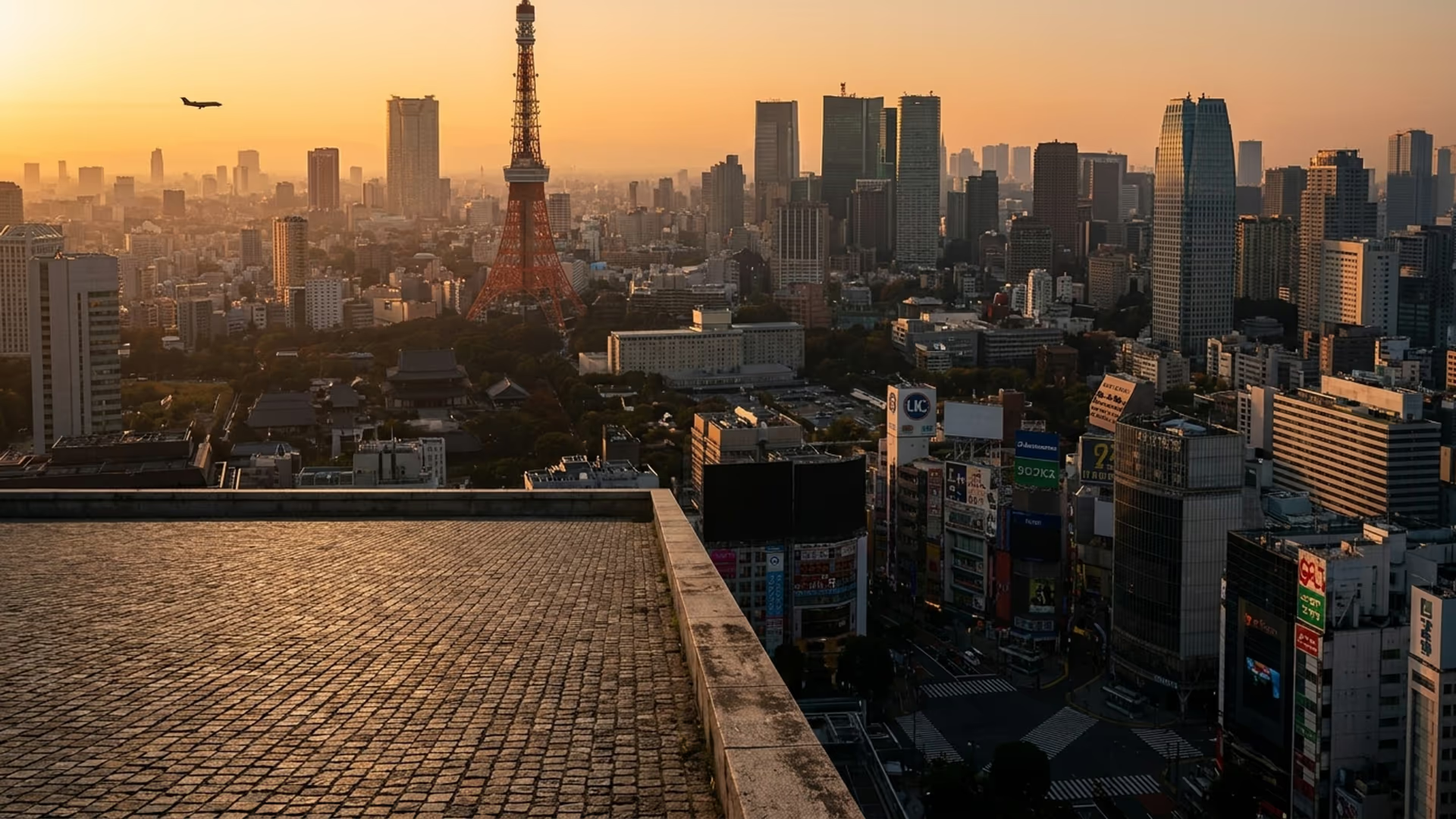
Tokyo Haneda Airport
Gateway to Tokyo • Compare prices from 15+ certified operators • Instant quotes, no commitment

Written by Sophie Marchant · Senior Business Aviation Editor · 9+ years aviation experience
Reviewed by Thomas Werner · Aviation Operations Reviewer
Last updated
From
€11,000
ICAO Code
RJTT
IATA Code
HND
Runway
3.0 km
Airport operations
Operational guidance for private jet arrivals and departures at Tokyo Haneda Airport (HND/RJTT), focused on handling, runway suitability, customs and access to Tokyo.
Tokyo Haneda Airport (HND/RJTT) lists a runway of 3,000 m. Final aircraft suitability depends on payload, weather, performance data and operator approval.
Private aviation handling at Tokyo Haneda Airport is arranged with approved local handlers. Terminal access, crew services and passenger handling are confirmed before departure.
Tokyo Haneda Airport (HND/RJTT) supports customs or immigration handling for eligible private flights, subject to prior notice and passenger documentation.
Tokyo Haneda Airport may support extended or 24-hour operations, but slots, night rules, noise restrictions and parking are always confirmed with the handler.
Light, midsize, super-midsize and heavy jet options for Tokyo are shortlisted against runway performance, passenger count, baggage and route length.
If Tokyo Haneda Airport is slot-constrained or not ideal for your aircraft, nearby options around Tokyo include Fukuoka Airport, Osaka Kansai International, Naha Airport.
Airport operating conditions can change. Flyius verifies runway performance, slots, customs and handling with the operator or local handler before confirming your charter.
Location & Access
Interactive map showing Tokyo Haneda Airport location, nearby attractions, and easy access to Tokyo city center.
Coordinates
35.5494, 139.7798
City access
Access to Tokyo
Typical transfer
Confirmed with chauffeur dispatch
Nearby alternatives
Fukuoka Airport, Osaka Kansai International
Haneda's rehabilitation as a full international hub — formalized through successive slot expansions in 2010, 2014, and 2020 — repositioned it from a domestic-dominant field to Tokyo's primary point of entry for executive and charter traffic. With four runways and a dedicated international pier, HND now rivals Singapore Changi for sheer operational throughput on transpacific corridors, while sitting considerably closer to the Tokyo CBD than Narita. The landside transfer to Minato, Chiyoda, or Shibuya wards runs 30–45 minutes via the Keikyu Airport Line or by road on the elevated Metropolitan Expressway, compared to 60–90 minutes from NRT depending on traffic conditions.
HND operates H24 with on-site customs and immigration available around the clock through the dedicated international terminal. Slot coordination is mandatory — Haneda is a Level 3 coordinated airport under the IATA system, meaning all arrivals and departures require pre-allocated slots from JCAB (Japan Civil Aviation Bureau). PPR is effectively handled through the slot request process; plan a minimum of 72 hours lead time for private charter operations, and longer for peak periods surrounding Golden Week (late April–early May) and Obon (mid-August). The handling partner for business aviation at HND is Jetex, operating from the international general aviation facility. Ramp access is controlled and crew movement between ramp and terminal is tightly managed by airport authority personnel — standard for a Tier-1 Japanese international aerodrome.
Central Tokyo business districts — Marunouchi, Roppongi, Akasaka — are approximately 30 minutes by taxi or private car under normal traffic conditions. The Keikyu Airport Express reaches Shinagawa Station in 11 minutes, connecting directly to the JR Yamanote Line for broader metro access. For onward domestic connections, Haneda's domestic terminals handle JAL and ANA services to Osaka Itami, Sapporo, and Fukuoka with a same-terminal experience rarely matched elsewhere in Asia. Positioning flights from Singapore or Dubai to HND are operationally straightforward given the H24 field and no curfew restrictions, though slot availability remains the binding constraint. Ground transport to Yokohama takes approximately 25 minutes via the expressway, making HND the preferred entry point for clients based in Kanagawa Prefecture.
Customs, immigration, and biosecurity clearance for arriving private charter passengers is conducted at the international terminal. Japan's customs protocols for private aviation include advance passenger manifest submission (General Declaration) and, for non-Japanese nationals, fingerprinting and facial recognition on entry — standard JCAB/MOJ procedure. Outbound general aviation declarations must be coordinated through the handling agent. Catering for charter departures from HND benefits from Tokyo's exceptional ground provisioning ecosystem: bespoke Japanese cuisine, certified halal catering, and bonded liquor are all available with 24-hour notice. For private jet operations throughout Japan, Haneda serves as the de facto coordination hub given its H24 customs access and superior slot liquidity relative to regional fields.
Get instant quotes from 15+ certified operators for flights to or from Tokyo Haneda Airport. No commitment, transparent pricing, exceptional service.
24/7 Concierge Available
Trusted by
15+
Operators
24/7
Support
Alternative Airports
Compare options for your private jet charter to Tokyo
These certified operators fly into and out of Tokyo Haneda most often through our network. Each is independently audited (ARGUS, Wyvern or IS-BAO) before any aircraft is quoted on Flyius.

HQ · Malta
Fleet size
70
Aircraft types
Super-midsize jets · Large-cabin jets · Ultra-long-range jets

HQ · Switzerland
Fleet size
60
Aircraft types
Challenger 300 · Challenger 650 · Global 5000

HQ · United Kingdom
Fleet size
—

HQ · Switzerland
Fleet size
—

HQ · United Kingdom
Fleet size
—

HQ · United Kingdom
Fleet size
—
Every operator listed holds a valid AOC, current insurance and a third-party safety audit. We refuse to broker flights on unvetted aircraft.
See all certified operatorsIndicative CO₂ per category based on the median distance of routes ex-Tokyo Haneda, with SAF (Sustainable Aviation Fuel) offset cost at current market rates.
| Category | CO₂ (per route) | kg / km | SAF offset cost |
|---|---|---|---|
| Light Jet | 11,064 kg | kg / km:2.4 | SAF offset cost:€44,256 |
| Midsize Jet | 14,291 kg | kg / km:3.1 | SAF offset cost:€57,164 |
| Heavy Jet | 19,362 kg | kg / km:4.2 | SAF offset cost:€77,448 |
| Ultra Long Range | 25,816 kg | kg / km:5.6 | SAF offset cost:€103,264 |
Emissions estimated using EBAA/EUROCONTROL business-aviation factors (light 2.4 kg/km, midsize 3.1, heavy 4.2, ultra 5.6). SAF offset priced at €4/kg CO₂ — current market midpoint.
Indicative rangesFrequently Asked Questions
About Flying to Tokyo
Get instant quotes from 15+ certified operators. No commitment, no hidden fees, transparent pricing.