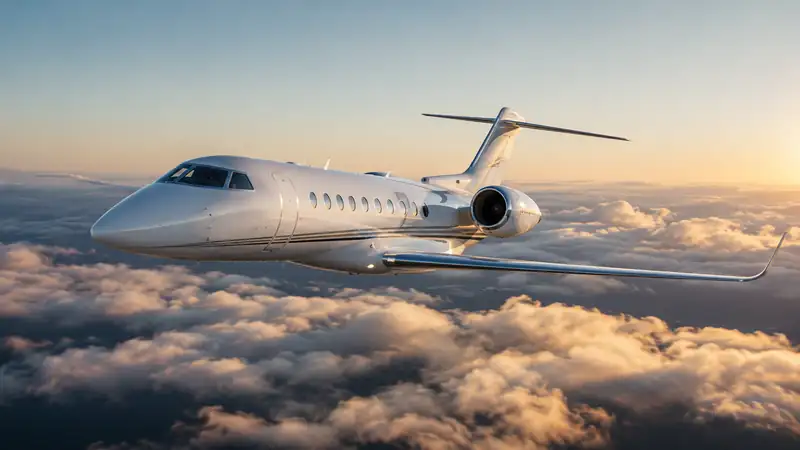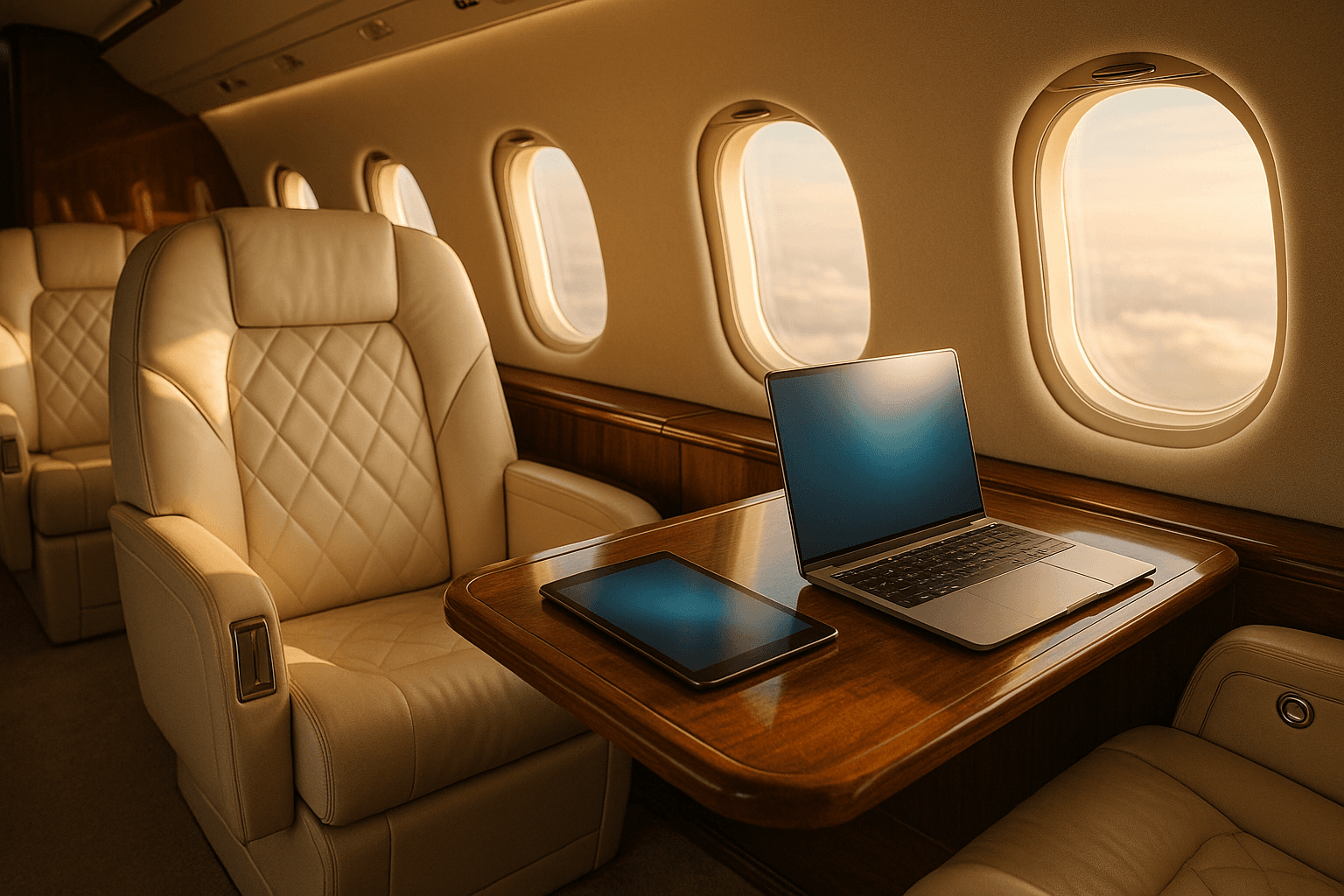
Almost every private jet now has WiFi — 166 of 167 Flyius jets are equipped. What actually differs is the connectivity system on board, which decides your speed and whether you stay online over the ocean.
Do private jets have WiFi? Almost all of them do. Across the Flyius fleet of 167 charter aircraft, 166 are equipped with onboard WiFi — that's 99.4% — and the same 166 carry a satellite phone. So in 2026 the honest answer isn't "some do, some don't." It's that connectivity is now standard equipment, right down to four-seat light jets. The question that actually decides your flight is a different one: which system is installed on the specific tail you charter. That single detail is the difference between sending email and running a live video call over the Atlantic. This guide explains how private jet WiFi really works, what each system can and can't do, how coverage and cost change over the ocean, and the exact questions to ask before you book — using real equipment data and hourly charter rates from the Flyius fleet.
Quick answer: is WiFi standard on private jets now?
Yes. On the Flyius fleet, WiFi is fitted to virtually every published aircraft, and satellite telephony is almost as universal. Cabin entertainment (moving-map, streaming-ready screens or media servers) sits just behind. Here is the picture across the whole fleet:
| Cabin amenity | Aircraft equipped | Share of fleet |
|---|---|---|
| Onboard WiFi | 166 of 167 | 99.4% |
| Satellite phone | 166 of 167 | 99.4% |
| Cabin entertainment | 156 of 167 | 93.4% |
The only aircraft in the fleet without a satellite phone is the four-seat Citation Mustang, the smallest very-light jet — a useful reminder that the very lightest, oldest airframes are where amenities thin out first.
But "equipped with WiFi" is a hardware checkbox, not a promise about speed. A jet flagged as WiFi-equipped might carry a decade-old air-to-ground modem that drops out at the coastline, or a brand-new low-orbit terminal that streams 4K over the Pacific. Same checkbox, completely different flight. To book intelligently, you need to understand the three systems behind that checkbox.
How private jet WiFi actually works: the three systems
Every onboard internet setup on a business jet is one of three types. They differ in how the signal reaches the aircraft, and that determines coverage, speed and price.
1. Air-to-ground (ATG)
Air-to-ground WiFi works like a giant mobile phone connection. A modem under the fuselage talks to a network of cellular towers on the ground, which point their signal upward at aircraft overhead. It's mature, relatively cheap to run, and perfectly good for email, messaging and light browsing across a continent.
Its hard limitation is geography: ground towers can't reach far past the coastline. Over open water the signal typically fades out within roughly 50 miles of shore, and there is no ATG network at all over most of the world's oceans, deserts and polar routes. An ATG-only jet is a domestic tool. Fly it transatlantic and the internet stops when the land does.
2. Ka-band and Ku-band satellite
Satellite systems point the aircraft's antenna up instead of down — at satellites in geostationary orbit roughly 35,800 km (about 22,300 miles) above the equator. Because the coverage footprint is global, a satellite-equipped jet keeps a connection over oceans, deserts and remote airspace where ATG has nothing. Ka-band is the faster, more modern flavour; older Ku-band systems still fly widely and handle browsing and calls, but stream video less comfortably.
Satellite is what makes a jet genuinely intercontinental for work. The trade-off is that it costs more to run than ATG, and older installations can feel slower than the home broadband passengers are used to.
3. Starlink (low-earth-orbit satellite)
Starlink is the story of business aviation connectivity in 2026. Instead of a handful of distant geostationary satellites, it uses a large constellation of satellites in low-earth orbit — much closer to the aircraft — which slashes latency and lifts real-world speeds dramatically. On Starlink-equipped tails, independent reports put real download speeds in the region of 135–310 Mbps with latency low enough for smooth video calls. In practice that means several passengers streaming, sharing screens and joining Zoom or Teams at once, over the ocean, as if they were in an office.
The catch is cost, and it moved in 2026: SpaceX raised Starlink Aviation subscription pricing, with the Global Unlimited plan reported at around $20,000 per month (effective 7 August 2026) and regional plans lower. That's an operator's cost, not usually a line on your charter invoice — but it's exactly why a Starlink tail can command a premium and why availability is still growing across fleets.
| Connectivity system | Typical real-world speed | Ocean / global coverage | Best for |
|---|---|---|---|
| Air-to-ground (ATG) | Basic–moderate | No — fades near the coast | Email, messaging, browsing on domestic legs |
| Ka/Ku satellite | Moderate–good | Yes | Intercontinental work, calls, some streaming |
| Starlink (LEO) | High (≈135–310 Mbps) | Yes | Multiple users streaming and video-calling anywhere |
Speeds and prices above are general industry figures for context; they describe the technology, not a Flyius charge.
What can you actually do online at 43,000 feet?
Match your expectations to the system, not to the "WiFi available" label:
- Email, messaging and browsing — comfortable on all three systems. Even a modest ATG or older satellite link handles inboxes, WhatsApp, maps and web pages.
- Voice and video calls — reliable on modern satellite and excellent on Starlink. On older ATG links, expect voice to work and video to stutter, especially with several people online.
- Streaming and screen-sharing — a Ka-band or Starlink tail streams and shares screens well; ATG-only aircraft will struggle once more than one passenger is watching.
- Multiple heavy users at once — this is where Starlink pulls clearly ahead. A cabin of executives each on a live call is a Starlink use case, not an ATG one.
If your flight is a working session — a deal team that must stay live gate-to-gate — the connectivity system belongs on the same priority list as the cabin layout and interior. It's part of the workspace.
Private jet WiFi by aircraft size
Connectivity broadly improves as you move up the cabin classes, because larger, newer, longer-range jets are the ones that fly the ocean routes where premium satellite systems earn their keep. The table below pairs each Flyius cabin class with its real hourly charter range and what to expect from the connectivity on board.
| Cabin class | Hourly charter (from fleet) | Typical connectivity | What to expect |
|---|---|---|---|
| Very light | €2,600–€3,600 | WiFi standard; lightest jets vary | Great for email/browsing on short domestic hops |
| Light | €2,800–€4,200 | WiFi standard | Solid browsing and calls on continental legs |
| Midsize | €4,200–€7,200 | WiFi + satphone standard | Comfortable work; many carry satellite links |
| Super-midsize | €5,500–€9,000 | Satellite common | Calls and streaming on longer legs |
| Heavy | €7,500–€13,000 | Satellite standard | Intercontinental work-ready |
| Ultra-long-range | €12,000–€16,000 | Premium satellite / Starlink-ready | Full office in the sky, ocean to ocean |
Hourly ranges are real Flyius fleet charter rates by category.
In practice, when connectivity has to be flawless over long distances, clients gravitate to the ultra-long-range class: aircraft like the Gulfstream G650ER (around €15,500/hour, 7,500 nm range) and the Global 7500 (around €16,000/hour, 7,700 nm) are the tails most likely to carry the newest, fastest systems. A super-midsize such as the Challenger 350 (around €8,200/hour) is the sweet spot for connected work on medium-haul legs, while a popular light jet like the Phenom 300E keeps you online comfortably on shorter hops. Even the WiFi-equipped little jets are online — but they're the tails where you most need to confirm exactly which system is fitted.
Why two identical jet types can have very different WiFi
Here's the subtlety that most "does it have WiFi" articles miss entirely: the connectivity system is fitted to the individual airframe, not baked into the model. Two aircraft of the exact same type — same manufacturer, same designation — can carry completely different equipment depending on when each was built and how recently its owner refreshed the cabin.
An aircraft that first flew in the 2000s may still run the air-to-ground or early Ku-band system it was delivered with, while a freshly refurbished example of the same type has had a modern Ka-band or Starlink terminal retrofitted. From a spec sheet they look identical. In the air they are not. This is why the fleet-wide "99.4% have WiFi" figure, while true, only gets you to the doorstep — the connectivity that matters to your trip lives at the level of the single tail you're quoted.
It's also why connectivity is trending upward across the whole industry right now. As low-earth-orbit systems become easier and cheaper to install, operators are retrofitting them during scheduled maintenance and cabin refreshes, so the share of jets that can genuinely stream over an ocean grows month by month. The practical consequence for you as a charter client is simple: never assume, and never rely on the aircraft type alone. Ask which system is on the specific airframe on your specific dates — the same care you'd take confirming the cabin has the beds or layout you're expecting.
Does private jet WiFi work over the ocean?
This is the question that trips people up, because it's where the "WiFi available" label is most misleading. Over the ocean, an air-to-ground jet goes dark and a satellite jet stays connected. There is no ATG tower in the middle of the Atlantic.
So on a transatlantic or intercontinental charter, the connectivity system isn't a nice-to-have — it's the whole game. A route like London to New York covers 5,536 km and takes roughly 8 hours 15 minutes in the air; London to Dubai is 5,516 km and about 8 hours 10 minutes; and an ultra-long leg like London to Singapore runs 10,853 km and close to 16 hours. That's most of a working day — or a full night's sleep — during which an ATG-only aircraft would have no internet at all past the coastline. For those flights you want a satellite or Starlink tail, which is exactly why long-range jets are built and equipped the way they are. If you're comparing aircraft for an ocean crossing, our guide to transatlantic private jets pairs naturally with this one.
How much does private jet WiFi cost?
There are two very different cost stories here, and mixing them up causes most of the confusion.
If you own or operate the jet, connectivity is a capital and subscription expense. Installing a modern system runs roughly $225,000 on a light jet up to $350,000–$400,000 on a large-cabin aircraft, and a Starlink Aero terminal alone is around $145,000 before the monthly plan. Subscriptions scale with ambition: Starlink Aviation's Global Unlimited plan is reported at about $20,000 per month in 2026, with regional and capped plans costing less.
If you charter, you almost never see those numbers. On a charter flight, connectivity is typically bundled into the aircraft — domestic ATG service is often included at no extra charge, and on satellite-equipped jets the operator either includes a reasonable data allowance or applies a modest usage fee for very heavy use. The practical takeaway: don't budget for WiFi as a separate big-ticket item on a charter, but do confirm the arrangement in advance, because policies differ by operator and aircraft. Connectivity almost never moves the needle next to the hourly charter rate itself.
What to ask before you book
Because "WiFi available" hides so much, treat connectivity like any other spec and ask your broker these questions before you sign:
- Which system is on this exact tail — ATG, Ka/Ku satellite, or Starlink? The aircraft type is a hint; the specific airframe is the answer.
- Does it cover my whole route? Any leg over open ocean or remote terrain needs satellite or Starlink, not ATG.
- Can several of us run video calls at the same time? If yes, you want a modern satellite or Starlink tail.
- Is there a data cap or usage fee, and what happens if we exceed it? Get the policy in writing.
- What's the fallback if the system is down on the day? Good operators can offer an alternative aircraft or a satellite-phone backup.
A broker who can answer all five without hesitation is telling you they actually know the aircraft. That's the standard to hold them to — the same rigour you'd apply to choosing the jet itself.
Frequently asked questions
Do all private jets have WiFi?
Almost. On the Flyius fleet, 166 of 167 aircraft are WiFi-equipped (99.4%). The rare exceptions are the oldest, smallest airframes. What varies far more than whether a jet has WiFi is which system it uses, and therefore how fast it is and whether it works over water.
How fast is private jet WiFi?
It depends entirely on the system. Air-to-ground is fine for email and browsing; modern Ka-band satellite handles calls and some streaming; Starlink delivers the fastest experience, with real-world speeds commonly reported around 135–310 Mbps — enough for several passengers to stream and video-call at once.
Can you stream Netflix or take Zoom calls on a private jet?
On a satellite or Starlink-equipped jet, yes — streaming and video calls work well, even over the ocean. On an older air-to-ground jet, expect basic browsing and email to work but video to struggle, particularly with multiple users.
Does private jet WiFi work over the ocean?
Only if the aircraft has satellite or Starlink connectivity. Air-to-ground systems rely on ground towers and lose signal within about 50 miles of the coast, so they don't work over open water. This is why long-range and transatlantic charters use satellite-equipped tails.
Is WiFi free on a private jet charter?
Usually there's no separate big charge. Domestic air-to-ground service is often included, and satellite jets typically bundle a data allowance, with at most a modest fee for very heavy use. Always confirm the exact policy with the operator before you fly.
Which private jets have the best WiFi?
The newest ultra-long-range jets — such as the Gulfstream G650ER and Bombardier Global 7500 — are the tails most likely to carry premium Ka-band or Starlink systems, because they're built for the ocean routes where fast global connectivity matters most.
The bottom line
In 2026, "do private jets have WiFi?" is essentially a solved question — 166 of 167 Flyius jets are connected. The real skill is booking the right connectivity for your trip: air-to-ground is plenty for a domestic hop, but any ocean crossing demands a satellite or Starlink tail, and a cabin full of people on live calls means Starlink. Decide what you need to do online, then insist on an aircraft whose system can actually do it.
Ready to fly connected? Request a private jet quote and tell us your route and how you plan to work on board — we'll match you to an aircraft whose connectivity fits the mission, not just the checkbox.
Written by Sophie Marchant, Senior Business Aviation Editor, and reviewed for operational accuracy by Thomas Werner, Aviation Operations Reviewer. Fleet figures and hourly charter rates are drawn from the live Flyius aircraft database; connectivity performance and pricing figures are general 2026 industry references provided for context.
Looking to book a private jet?
Get a Free QuoteWritten by
Flyius
Flyius publishes these charter guides. A firm price is confirmed only after an operator quote.