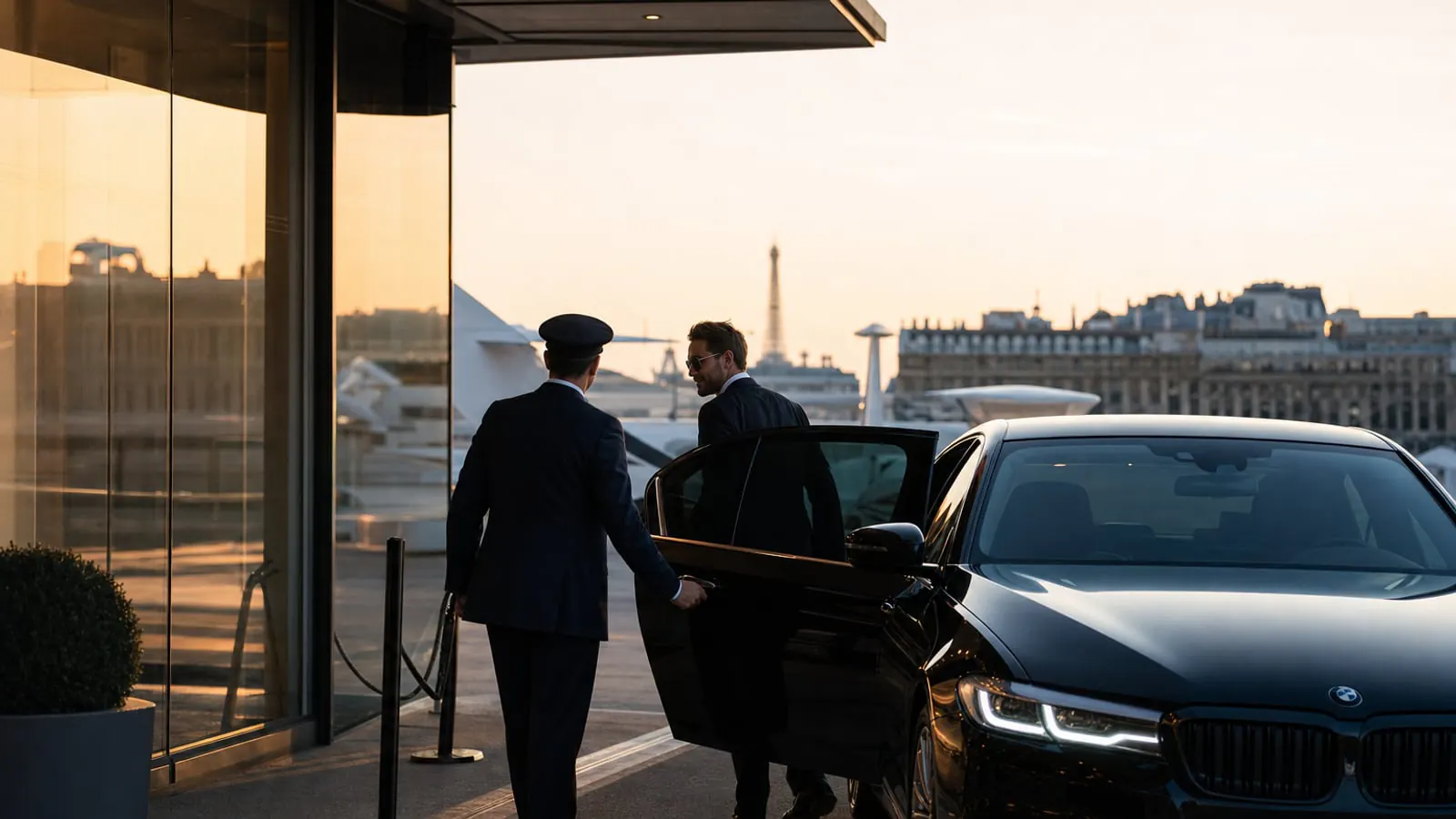
Van Nuys curfew vs Burbank for LA private jets — the four-airport decision, operational limits, and when each field actually works.
Flying private to Los Angeles is less about the flight than the arrival. Verified 2026 charter prices run from $4,500 for the 55-minute hop from Las Vegas on a light jet to $110,000 coast-to-coast from New York on an ultra-long-range aircraft. But the number that actually shapes your trip is which of four airports you land at — because in LA the airport, not the aircraft, decides whether you reach Beverly Hills in 20 minutes or 70. Van Nuys is the world's busiest general-aviation airport and the private-flyer default; Hollywood Burbank sits two miles from the studios; LAX is technically possible but rarely worth it; and Santa Monica is a fading option most guides still get wrong. This guide gives you real route pricing from Flyius data, the airport-by-airport decision that defines a Los Angeles trip, the Van Nuys noise curfew that can strand a late-night departure, and the aircraft choice that makes or breaks a transcontinental run.
Why Los Angeles Is a Private-Aviation City
No major world city rewards private aviation quite like Los Angeles. The metro sprawls across 120 kilometres of freeway, its business is concentrated in the entertainment, finance, and technology sectors that fly private by default, and its single commercial mega-hub — LAX — is among the most congested airports on earth. For a traveller whose time is the scarce resource, the calculus is simple: a private flight into a reliever airport collapses both the terminal experience and the ground transfer.
That demand has produced something rare — a cluster of four viable private-jet airports ringing the city, each serving a different part of it. Choosing correctly is worth more than any onboard amenity. Land at the wrong field and you can spend more time on the 405 freeway than you did in the air. This is the decision no charter brochure explains properly, so we start there.
The 4-Airport Los Angeles Decision
Here is how the four Los Angeles-area private airports actually compare for a charter arrival. Ground times are typical off-peak; LA traffic can double them, which is precisely why airport choice matters.
| Airport | Code | Best for | Typical transfer |
|---|---|---|---|
| Van Nuys | VNY / KVNY | The default: Beverly Hills, Bel Air, Hollywood, the Westside | 20–40 min to Beverly Hills |
| Hollywood Burbank | BUR / KBUR | The studios (Burbank, Glendale), Pasadena, downtown | 15–30 min to the studios |
| LAX | LAX / KLAX | International connections, South Bay, when only LAX will do | 20–45 min, traffic-dependent |
| Santa Monica | SMO / KSMO | The beach Westside — but light jets only, and closing | 10–20 min to Santa Monica |
Van Nuys (VNY): the private-flyer default
For most Los Angeles charters, Van Nuys is the answer. It is the world's busiest general-aviation airport, purpose-built around private flight, with the deepest concentration of premium FBOs, maintenance, and crew infrastructure in the country. It sits in the San Fernando Valley with fast canyon and freeway access to Beverly Hills, Bel Air, Hollywood, Malibu, and the Westside. If you have no specific reason to use another field, you fly into VNY.
The trade-off is that VNY's popularity is also its constraint — it is busy, and it is regulated. Which brings us to the detail that catches out first-time private flyers.
The Van Nuys curfew and noise budget
Van Nuys operates under a mandatory nighttime noise ordinance — one of the strictest of any private-jet airport in the world, and something almost no charter guide mentions. In practice:
- Older, louder (Stage 2) jets are prohibited from departing between 10:00 p.m. and 7:00 a.m. No exceptions beyond medical and military flights.
- Quieter (Stage 3) aircraft — most modern business jets — are restricted from 11:00 p.m., and even then operators are asked to avoid the late window under the voluntary Quieter Nights program.
- Touch-and-go and training operations are barred overnight.
The practical consequence: if your itinerary has you leaving a late Los Angeles dinner or event for a red-eye home, your aircraft has to be curfew-compliant, and your operator has to plan the departure slot around the ordinance. A late-night wheels-up on a non-compliant jet simply is not going to happen at VNY — and finding that out on the tarmac at 10:30 p.m. is an expensive surprise. Book a modern super-midsize or heavy jet for any trip that involves a late departure, and confirm the curfew position when you book, not when you board.
Hollywood Burbank (BUR): the studios' airport
If your Los Angeles is Burbank, Glendale, Pasadena, or the studio lots, Hollywood Burbank is the smarter field — it sits barely two miles from the Hollywood Hills and puts you inside the studio ecosystem before a VNY arrival has cleared the canyon. It mixes commercial and general-aviation traffic, so slot coordination matters at peak hours, and like its neighbour it observes a voluntary nighttime curfew from 10:00 p.m. to 7:00 a.m. that responsible operators respect. For entertainment-industry travel, Burbank is often the quiet winner.
LAX: possible, rarely worth it
You can charter into LAX — it has full FBO facilities — but for pure private travel it is usually the weakest choice. You inherit the congestion, the slot pressure, and the ground-handling costs of the world's busiest origin-and-destination airport, in exchange for very little. LAX earns its place only in specific cases: connecting to or from an international commercial flight, heading to the South Bay, or when an aircraft's size or an international customs requirement genuinely dictates it. Otherwise, VNY or BUR beats it every time.
Santa Monica (SMO): the fading Westside option
Santa Monica is the closest field to the beach Westside — minutes from Santa Monica, Venice, and Brentwood — but two facts limit it. Its runway was shortened to roughly 3,500 feet in 2017, which restricts it to smaller light jets and turboprops; and under the agreement between the city and the FAA, the airport is scheduled to close at the end of 2028. For now it remains usable for a compact light jet with the beach as your destination, but plan around its constraints and its expiry date rather than building a trip on it.
2026 Charter Prices: Verified Routes to Los Angeles
All prices below are one-way charter costs for the whole aircraft, sourced from Flyius route data. They include aircraft, crew, and standard handling, and exclude landing and FBO fees, catering, and crew accommodation. Round-trip pricing is available on request.
| Route | Distance | Flight Time | Light Jet | Midsize | Heavy | Ultra-Long-Range |
|---|---|---|---|---|---|---|
| Las Vegas → Los Angeles | 380 km | 55 min | $4,500 | $7,500 | $12,000 | $20,000 |
| San Francisco → Los Angeles | 543 km | 1h 15 | $4,500 | $7,500 | $12,000 | $20,000 |
| Seattle → Los Angeles | 1,544 km | 2h 45 | $12,000 | $19,000 | $28,000 | $43,000 |
| Dallas → Los Angeles | 1,990 km | 3h 35 | $16,000 | $24,000 | $36,000 | $55,000 |
| Miami → Los Angeles | 3,749 km | 5h 40 | $30,000 | $45,000 | $67,500 | $105,000 |
| New York → Los Angeles | 3,944 km | 6h 00 | $32,000 | $47,000 | $70,000 | $110,000 |
Prices reflect standard demand. Award-season weeks (late winter), major sporting events, and summer weekends push both price and availability, so book early for those windows. West Coast hops from Las Vegas or San Francisco are the value entry point to private LA; the transcontinental runs are where aircraft choice starts to matter.
For a live quote on any origin, request a Flyius charter quote and receive availability fast.
Choosing the Right Aircraft for a Los Angeles Charter
Because so many Los Angeles trips are either short West Coast hops or long transcontinental runs, aircraft choice splits cleanly by mission. Here is how the categories map to real LA itineraries.
Light jets — the West Coast workhorse
For the hops that make up most private LA traffic — Las Vegas, San Francisco, San Diego, Phoenix, and down to Cabo — a light jet is the right tool and the value pick. The Citation CJ3 and Phenom 300E carry six to seven passengers with roughly 1,200–1,800 nautical miles of range, which comfortably covers the entire West Coast and the Mountain West. For a Vegas weekend or a Bay Area day trip, this is all the aircraft you need.
Midsize jets — regional comfort
Step up to a Citation XLS+ or Citation Latitude when you want a stand-up cabin and eight seats for regional flying — the Pacific Northwest, the Rockies, or ski country like Aspen. With around 1,800 nautical miles of range they cover the western United States non-stop with room to spread out.
Super-midsize — the transcontinental sweet spot
This is where Los Angeles gets interesting. The Challenger 350 and Praetor 600 offer roughly 3,200–3,900 nautical miles of range — enough to fly coast to coast — with a genuinely large cabin at a fraction of heavy-jet cost. Eastbound (LA to New York, with a tailwind) they do it non-stop and in real comfort, which makes them the smart-money choice for the transcon run.
There is a nuance the flagship route hides: westbound, into the headwind, the coast-to-coast leg is harder. A New York to Los Angeles flight at 3,944 km is close to the practical limit for some super-midsize jets in winter, when jet-stream headwinds are strongest — which occasionally forces a brief fuel stop. If a guaranteed non-stop westbound run matters to you, that pushes the decision up a category.
Heavy & ultra-long-range — guaranteed non-stop and full cabin
For a full cabin, transcontinental non-stop in either direction regardless of winds, or international origins, you want a heavy or ultra-long-range jet. The Challenger 650 and Gulfstream G650 fly New York or Miami to Los Angeles non-stop with twelve to nineteen passengers and cabins built for the six-hour block time. The Global 7500 adds intercontinental reach — London, Tokyo, or the Middle East straight into Los Angeles. If the trip is long, full, or international, this is the tier that removes every compromise.
Timing, Slots, and Getting the Details Right
Los Angeles rarely has a hard seasonal slot crunch like a Mediterranean island, but three timing realities are worth planning around. Award season (roughly January to March) concentrates entertainment-industry demand and tightens both aircraft and FBO availability across VNY and BUR. Summer weekends and the Vegas–LA shuttle corridor run hot on Fridays and Sundays. And the Van Nuys curfew shapes every late-night departure, as covered above.
The operator's job is to line up the aircraft, the airport, and the slot as one plan — the right jet into the right field with a compliant departure window. When those three fit together, a Los Angeles trip is as seamless as private aviation gets: wheels-up minutes after you arrive at the FBO, and your villa or the studio lot inside half an hour of landing. A Los Angeles charter with Flyius is built around exactly that fit.
Frequently Asked Questions
Which airport do private jets use in Los Angeles? Van Nuys (VNY) is the default — the world's busiest general-aviation airport, with the best FBO infrastructure and fast access to Beverly Hills, Hollywood, and the Westside. Hollywood Burbank (BUR) is better for the studios and Pasadena, LAX is used mainly for international connections, and Santa Monica (SMO) suits small light jets bound for the beach Westside.
How much does a private jet to Los Angeles cost in 2026? Verified Flyius one-way prices start from about $4,500 for a light jet on a West Coast hop such as Las Vegas to Los Angeles, rise to around $32,000 for a light jet on the New York to Los Angeles transcontinental run, and reach roughly $110,000 for an ultra-long-range jet on that same coast-to-coast route. Aircraft category and origin drive the number more than anything else.
Can you fly a private jet into LAX? Yes — LAX has full FBO facilities and accepts private charter. But for most trips Van Nuys or Burbank is faster and cheaper to handle. LAX makes sense mainly for international commercial connections or specific South Bay destinations.
How long is a private flight from New York to Los Angeles? About six hours non-stop by Flyius route data. Eastbound (LA to New York) is typically faster thanks to tailwinds; westbound into the headwind is slower and, in winter, can push some smaller jets to a fuel stop — which is why a heavy or ultra-long-range aircraft is the reliable choice for a guaranteed non-stop westbound run.
Is there a curfew at Van Nuys Airport? Yes. Van Nuys enforces a mandatory nighttime noise ordinance: older, louder (Stage 2) jets cannot depart between 10:00 p.m. and 7:00 a.m., and quieter (Stage 3) aircraft are restricted from 11:00 p.m. Any late-night departure needs a modern, curfew-compliant jet and an operator who plans the slot around the rule.
What is the best aircraft for a coast-to-coast Los Angeles charter? A Challenger 350 or Praetor 600 super-midsize is the sweet spot — coast-to-coast range, a large cabin, and sensible cost, ideal eastbound. For a guaranteed non-stop westbound leg, a full cabin, or international origins, step up to a Challenger 650, Gulfstream G650, or Global 7500.
The Bottom Line
A private jet to Los Angeles is a two-part decision: pick the aircraft for your route — a light jet for the West Coast hops, a super-midsize or heavy jet for the transcontinental run — and pick the airport for your destination, defaulting to Van Nuys unless the studios, an international connection, or the beach Westside points you elsewhere. Get both right, respect the Van Nuys curfew on late departures, and Los Angeles becomes one of the most effortless cities in the world to arrive in. When you are ready, request a Flyius quote with your route and dates, and we will match the aircraft, the airport, and the slot to your trip.
This guide was written by Sophie Marchant, Senior Business Aviation Editor, and reviewed for operational accuracy by Thomas Werner, Aviation Operations Reviewer, drawing on Flyius route and airport data. Charter prices are verified Flyius figures and reflect 2026 market conditions; airport access and curfew details reflect published operating rules and can change, so confirm specifics with your broker at the time of booking.
Looking to book a private jet?
Get a Free QuoteWritten by
Flyius
Flyius publishes these charter guides. A firm price is confirmed only after an operator quote.