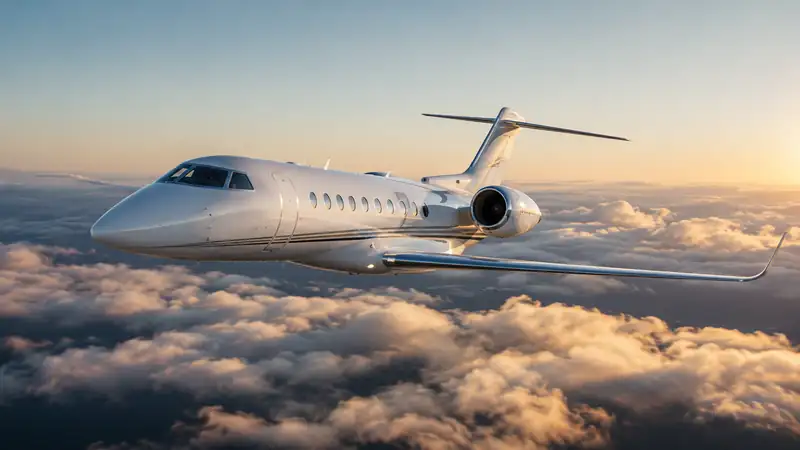
Private jet range runs from about 1,500 km for the smallest jets to over 15,000 km non-stop for an ultra-long-range flagship. A data-backed 2026 guide to range by aircraft category, the longest-range jets, and which real routes each class can fly non-stop.
A private jet's range runs from roughly 1,500 km for the smallest very-light jets to more than 15,000 km non-stop for an ultra-long-range flagship such as the Gulfstream G800 (8,200 nm / 15,186 km). Most business jets sit between those extremes: a light jet covers about 1,500–4,000 km, a midsize 2,800–6,200 km, a heavy jet 3,200–11,000 km, and an ultra-long-range jet 9,000–15,000 km. But the number that decides your trip is not the brochure maximum — it is the real range once you load passengers, bags and a headwind, which is usually 10–20% lower.
This guide explains how far a private jet can actually fly, breaks range down by aircraft category using real figures from the Flyius fleet, ranks the longest-range business jets in service, and shows which real routes each category can cross non-stop. Every distance below is a published or planning figure held in the Flyius fleet and route data — the exact non-stop capability for your date, payload and airports is confirmed when you request a quote.
Quick answer: private jet range by category
The table below groups the Flyius fleet into the six standard business-jet categories and shows the still-air maximum range of each, a typical mission it flies non-stop, and indicative charter pricing.
| Category | Typical range | Example non-stop mission | Typical seats | Indicative €/hour |
|---|---|---|---|---|
| Very light jet | 1,500–2,900 km (825–1,550 nm) | London → Geneva, short domestic | 4–7 | €2,600–3,600 |
| Light jet | 1,500–4,000 km (800–2,165 nm) | Paris → Nice, regional Europe | 6–8 | €2,800–4,200 |
| Midsize jet | 2,800–6,200 km (1,500–3,340 nm) | London → Moscow, coast-to-coast hops | 8–9 | €4,200–7,200 |
| Super-midsize jet | up to 7,400 km (to 4,018 nm) | New York → Los Angeles | 9–12 | €5,500–9,000 |
| Heavy jet | 3,200–11,100 km (1,750–6,000 nm) | London → New York | 12–19 | €7,500–13,000 |
| Ultra-long-range jet | 9,300–15,200 km (5,000–8,200 nm) | London → Singapore | 16–19 | €12,000–16,000 |
These are still-air maximum ranges from the Flyius fleet data. Pricing is indicative charter rate per flying hour and varies with aircraft, availability and routing. For a fuller cost picture, see the cost of flying private in Europe.
What "range" actually means (and why the brochure number lies a little)
Manufacturers quote a still-air range: the distance an aircraft can fly with a defined payload, in calm air, at its most efficient altitude, with fuel reserves. It is a genuine engineering figure — but three things routinely shorten it on a real charter day, and understanding them is the difference between a confident non-stop plan and an unexpected fuel stop.
- Payload. Fuel and weight compete. Fill every seat and load the baggage hold, and the aircraft must carry less fuel to stay within its maximum take-off weight — so range falls. A jet advertised at 4,000 nm "with four passengers" may only make 3,400 nm with a full cabin and bags. This is why range and seat count always have to be read together.
- Winds. The jet stream is the single biggest variable on long east–west legs. A westbound transatlantic crossing fights a headwind that can erase several hundred kilometres of effective range, while the eastbound return rides a tailwind. The same aircraft can fly a route non-stop one way and need a tech stop the other.
- Altitude, temperature and runway. Hot days, high-elevation airfields and short runways all reduce the fuel an aircraft can safely take off with, trimming usable range. Departing a short Alpine or island strip near maximum weight can force a lighter fuel load — and therefore a stop — that the same jet would not need from a long runway.
On top of that, every flight carries mandatory fuel reserves (to reach an alternate airport and hold), which are never available for the trip itself. The practical rule: treat published range as a ceiling, subtract roughly 10–20% for a realistic loaded, into-wind figure, and keep a margin. A good operator plans to this real number, not the brochure — which is exactly the check we run before confirming any long leg.
Private jet range by category, in detail
Very light and light jets: the short-hop workhorses
Very light jets — the HondaJet, Citation Mustang, Phenom 100 class — carry four to seven passengers roughly 1,500–2,900 km. Light jets such as the Phenom 300E (3,723 km / 2,010 nm) and Citation CJ4 (4,010 km / 2,165 nm) stretch that to about 4,000 km. Together they cover the bulk of intra-European and short domestic demand: a Paris to Nice hop, London to Geneva, or a same-day business out-and-back. They are quick and economical, but a full cabin on a leg near their limit can force a fuel stop — so they are rarely the right tool for anything transcontinental.
Midsize and super-midsize: the transcontinental sweet spot
Midsize jets span roughly 2,800–6,200 km (1,500–3,340 nm) and add stand-up cabins and bigger baggage holds. Super-midsize jets push further — the Citation Longitude reaches 6,482 km (3,500 nm) and the Praetor 600 reaches 7,227 km (3,900 nm) — enough to fly New York to Los Angeles (3,944 km) comfortably non-stop and to make shorter transatlantic crossings from the US East Coast in favourable winds. This band is the natural home for four-to-eight-hour missions where you want a full cabin without paying for ultra-long-range capability you won't use.
Heavy jets: non-stop transatlantic, with room
Heavy jets range from about 3,200 km up to 11,100 km (6,000 nm) and seat 12–19. The long-legged members — the Falcon 7X (11,019 km / 5,950 nm), Gulfstream G550 (11,112 km / 6,000 nm) and Challenger 605 (7,408 km / 4,000 nm) — cross the Atlantic non-stop with a full cabin, which is why a London to New York charter is typically a heavy or ultra-long-range aircraft. Heavy jets are the practical floor for reliable intercontinental travel: enough range, cabin and baggage to make an 8-hour day civilised.
Ultra-long-range jets: the world non-stop
Ultra-long-range jets are a class apart, with still-air ranges of 9,300–15,200 km (5,000–8,200 nm). This is the only category that reliably links continents in a single hop — London to Singapore (10,853 km), New York to the Middle East, or the Pacific in one leg. The Global 7500, Gulfstream G650ER, G700 and G800 headline the segment, pairing that range with the largest cabins in business aviation. If your travel pattern is genuinely global, this is the category that removes the fuel stop from the equation.
Which private jets have the longest range?
Ranked by still-air maximum range in the Flyius fleet, the ten longest-range business jets are:
| Rank | Aircraft | Range | Max seats |
|---|---|---|---|
| 1 | Gulfstream G800 | 15,186 km / 8,200 nm | 19 |
| 2 | Gulfstream G700 | 14,353 km / 7,750 nm | 19 |
| 3 | Bombardier Global 7500 | 14,260 km / 7,700 nm | 19 |
| 4 | Gulfstream G650ER | 13,890 km / 7,500 nm | 19 |
| 5 | Gulfstream G650 | 12,964 km / 7,000 nm | 19 |
| 6 | Gulfstream G600 | 12,223 km / 6,600 nm | 19 |
| 7 | Gulfstream G-V | 12,038 km / 6,500 nm | 16 |
| 8 | Dassault Falcon 8X | 11,945 km / 6,450 nm | 16 |
| 9 | Global Express XRS | 11,852 km / 6,400 nm | 16 |
| 10 | Falcon 7X / Global 6000 / G550 | 11,019–11,112 km / 5,950–6,000 nm | 14–19 |
The top of this list — the G800 at 8,200 nm — can connect almost any two cities on earth non-stop. For most travellers, though, the deciding factor is not raw maximum range but whether the aircraft clears their route with a full cabin and a headwind margin. Our types of private jets guide breaks down how these categories differ on cabin, speed and cost, not just distance.
Can a private jet cross the Atlantic or Pacific non-stop?
The Atlantic: yes, routinely — but only with the right category. A London to New York crossing is 5,536 km (about 3,000 nm) great-circle, and the westbound headwind pushes the real fuel requirement higher. Heavy and ultra-long-range jets do it non-stop with a full cabin; a capable super-midsize can manage shorter or eastbound transatlantic legs but may need a tech stop westbound in winter winds. As a planning floor, look for at least 4,000 nm of published range for dependable transatlantic service, and 6,000 nm+ for a comfortable margin in any conditions.
The Pacific and ultra-long-haul: this is ultra-long-range territory. Legs like London to Singapore (10,853 km) or transpacific crossings sit beyond every other category's reach and demand a Global 7500, G650ER, G700 or G800. Even here, payload and winds matter: an aircraft rated at 7,700 nm may plan a fuel stop on a maximum-payload day against a strong headwind.
Long, but not transoceanic: routes such as London to Dubai (5,516 km) or New York to Los Angeles (3,944 km) are well within heavy-jet range and are often the sweet spot where a heavy jet flies non-stop for less than an ultra-long-range charter would cost. For how flight time — as opposed to distance — is built on these legs, see private jet flight times.
How to match range to your trip
Range only matters relative to your route. A simple way to choose:
- Find your leg distance. Use the great-circle distance between your two cities (the route pages on Flyius list it for each city pair).
- Add a real-world margin. Assume you'll get 10–20% less than the published maximum with a full cabin and typical winds, so pick an aircraft whose brochure range comfortably exceeds your leg — not one that just scrapes it.
- Match the category, then the cabin. Once a category clears the distance with margin, choose within it on seats, baggage and cost rather than more range you won't use. A heavy jet that flies your route non-stop usually beats an ultra-long-range jet that flies it with fuel to spare but at a higher rate.
- Confirm against payload and airports. A short runway, a hot-and-high departure or a maximum-weight cabin can turn a "non-stop" leg into a one-stop. This is the check an operator runs before quoting.
Get those four right and you avoid the two classic mistakes: chartering more aircraft than the trip needs, or booking a jet that can't actually make the leg non-stop on the day. If you'd like it done for you, request a Flyius quote with your city pair and passenger count and we'll confirm the real non-stop options and pricing.
Frequently asked questions
How far can a private jet fly without refuelling?
It depends entirely on the category. A very light jet manages roughly 1,500–2,900 km, a light jet up to about 4,000 km, a midsize up to ~6,200 km, a heavy jet up to ~11,100 km, and an ultra-long-range jet up to 15,186 km (the Gulfstream G800, 8,200 nm). Those are still-air maximums; a full cabin and headwinds typically reduce the usable figure by 10–20%.
Can a private jet fly across the Atlantic non-stop?
Yes. Heavy and ultra-long-range jets cross the Atlantic non-stop with a full cabin — a London to New York leg (5,536 km) is a routine mission for a Falcon 7X, Gulfstream G550 or any ultra-long-range aircraft. Some super-midsize jets can manage shorter or eastbound transatlantic legs but may need a technical stop westbound against winter headwinds.
Which private jet has the longest range?
In the Flyius fleet, the Gulfstream G800 has the longest range at 15,186 km (8,200 nm), narrowly ahead of the Gulfstream G700 (14,353 km / 7,750 nm) and the Bombardier Global 7500 (14,260 km / 7,700 nm). All three can connect almost any two cities on earth in a single hop.
Why is a jet's real range less than the advertised figure?
Advertised range is a still-air figure with a defined payload and fuel reserves. On a real trip, a fuller cabin means less fuel can be carried within weight limits, headwinds increase fuel burn, and hot or high-altitude airports reduce the safe take-off weight. Together these commonly cut usable range by 10–20% versus the brochure maximum.
Do private jets need to refuel on long flights?
Only when the leg exceeds the aircraft's real range for that day's payload and winds. Light and midsize jets may need a technical stop on transatlantic or long transcontinental routes, while heavy and ultra-long-range jets such as the Falcon 7X, G650ER or Global 7500 fly those legs non-stop. A fuel stop typically adds 45–60 minutes to the day.
What range do I need for my trip?
Take your city-pair distance, then choose an aircraft whose published range exceeds it by a clear margin (roughly 20%) to absorb payload and winds. As rough guides: intra-European legs suit light and midsize jets; US transcontinental and shorter transatlantic legs suit super-midsize and heavy jets; and true intercontinental travel needs a heavy or ultra-long-range jet.
Methodology and sources
All range, seat and pricing figures in this guide are drawn from the Flyius fleet data and are still-air published maximums unless stated otherwise; route distances are great-circle figures from the Flyius route network. Real-world range varies with payload, winds, altitude, temperature, airport performance and mandatory fuel reserves, and is typically 10–20% below the published maximum on a loaded, into-wind leg. These figures are for planning and comparison only — they are not a guarantee of non-stop capability or a quote. To confirm the real non-stop options and price for your itinerary, request a Flyius quote or explore representative pricing on the private jet cost index. To go deeper, read types of private jets, private jet flight times and what an FBO is.
Reviewed for operational accuracy by Thomas Werner, Aviation Operations Reviewer, focusing on range-versus-payload realism, transatlantic and transpacific feasibility, and aircraft-category suitability.
Looking to book a private jet?
Get a Free Quote
Written by
Sophie Marchant
Senior Business Aviation Editor
Sophie Marchant is a senior business aviation editor covering private jet routes, charter pricing, airport access, and premium travel operations across Europe and key international markets. Her editorial work combines operator pricing benchmarks, airport and FBO research, Eurocontrol traffic context, and interviews with charter brokers, dispatch teams, and aviation operations specialists. Before j