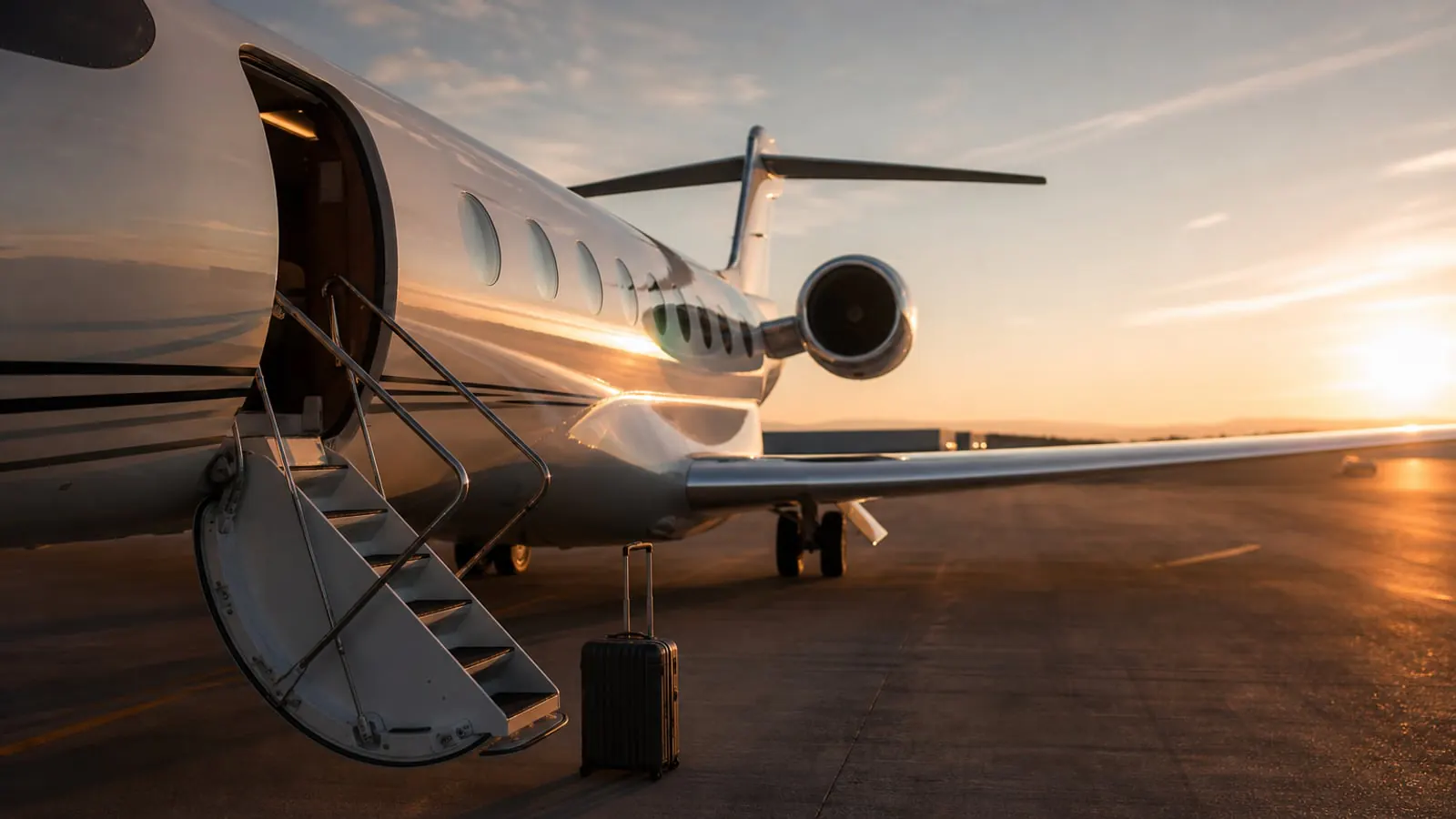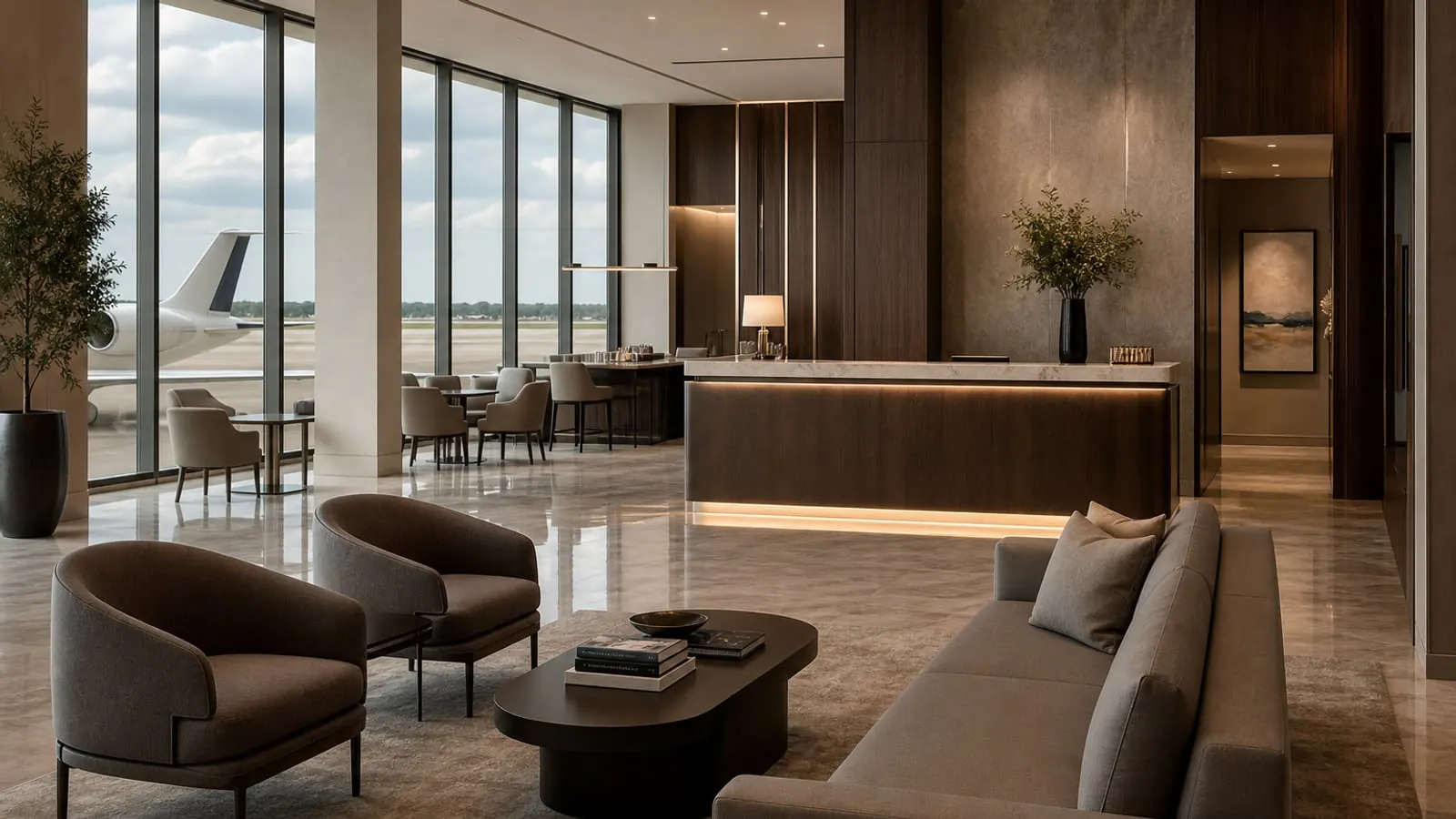
An FBO is the private aviation facility that coordinates passengers, crew and aircraft on the ground. Learn what it does, how the passenger journey works and which fees enter a charter quote.
An FBO, or Fixed-Base Operator, is a company providing ground services to private and business aircraft at an airport. Depending on the location, it may operate a dedicated passenger terminal and lounge, handle documents and customs coordination, arrange fuel and catering, support crew, manage baggage and coordinate the aircraft on the ramp. “FBO” and “private terminal” are often used interchangeably by passengers, but technically the FBO is the service provider; the terminal is one of the facilities it may operate.
Quick answer
| Question | Answer |
|---|---|
| What does FBO stand for? | Fixed-Base Operator |
| Is an FBO a private terminal? | Often, but an FBO is the company/service operation; some handlers use shared or smaller facilities |
| How early should passengers arrive? | Commonly 15–30 minutes for a straightforward domestic/Schengen charter, but the operator may require longer |
| Is there security at an FBO? | Screening and document controls depend on the airport and route; “no security” is not a safe universal claim |
| Who pays the FBO? | The operator normally pays handling charges and includes them in the charter quote, unless stated otherwise |
| Can the client choose the FBO? | Sometimes, but parking, operator agreements, customs and availability may determine the choice |
What an FBO does
Passenger services
A passenger-facing FBO may provide:
- private reception and lounge;
- identity and document checks;
- security screening where required;
- customs and immigration coordination;
- baggage transfer;
- direct or escorted ramp access;
- chauffeur and helicopter coordination;
- refreshments and catering support;
- meeting rooms and privacy services.
Aircraft services
Behind the passenger experience, the FBO or ground handler may coordinate:
- fuel;
- aircraft parking;
- towing;
- ground power;
- water and lavatory service;
- de-icing;
- hangar space;
- catering loading;
- cleaning;
- maintenance support;
- slot and airport liaison.
Crew services
Crew support can include:
- briefing rooms;
- weather and flight-planning support;
- transport and accommodation;
- rest facilities;
- permits and handling coordination;
- operational communication with the airport.
The lounge is the visible part. The operational coordination is the part that keeps the itinerary working.
FBO, ground handler and private terminal: the difference
| Term | Practical meaning |
|---|---|
| FBO | A fixed-base business providing aviation services at an airport |
| Ground handler | A company coordinating ground operations; it may or may not operate a full private terminal |
| Private terminal | The passenger facility used for business-aviation arrivals and departures |
| GA terminal | General aviation terminal; may serve private, business and other non-airline traffic |
| Executive terminal | Marketing term commonly used for a premium private-aviation facility |
At major business-aviation airports, one company may perform all these roles. At a smaller airport, passengers may use a modest handling office rather than a luxury lounge while still receiving a fast private-aviation process.
What happens when you depart through an FBO?
A typical departure looks like this:
- The operator sends the passenger manifest and handling request before the flight.
- The FBO confirms the arrival instructions and any document requirements.
- Passengers arrive at the specified private terminal or meeting point.
- Identity, travel documents and required screening are completed.
- Baggage is accepted and moved to the aircraft.
- Passengers wait in the lounge or proceed toward the aircraft when cleared.
- Boarding occurs directly or via an escorted vehicle to the aircraft stand.
The exact sequence varies. Some airports permit controlled vehicle access near the aircraft; others require all passengers to pass through the terminal and security process.
How early should you arrive?
“Arrive 15 minutes before departure” is a useful illustration, not a universal rule.
Fifteen to thirty minutes may be realistic when
- the route is straightforward;
- passenger documents were submitted correctly;
- the airport has efficient private handling;
- there is no complex customs process;
- the aircraft and crew are ready;
- baggage and catering were declared in advance.
More time may be required when
- travelling internationally or outside Schengen;
- carrying pets, firearms, unusual equipment or high-value goods;
- using an airport with mandatory screening processes;
- customs or immigration must be called in;
- the passenger list changes late;
- the airport is congested or event traffic is high.
Follow the time stated in the final flight brief, not a generic internet promise.
FBO versus commercial terminal
| Journey element | Scheduled airline terminal | Private aviation / FBO |
|---|---|---|
| Schedule | Airline timetable | Charter itinerary, subject to airport constraints |
| Passenger process | Centralised check-in, security and gate | Private or dedicated handling process |
| Arrival time | Commonly much earlier | Often shorter, as confirmed by operator |
| Lounge | Shared premium lounge if eligible | Private or business-aviation lounge where available |
| Boarding | Gate and airline boarding sequence | Direct or escorted transfer to aircraft |
| Baggage | Airline check-in and reclaim | Coordinated directly with aircraft handling |
| Privacy | Limited | Significantly higher |
Private aviation is faster because the process is designed around one aircraft and manifest—not because legal checks disappear.
How FBO fees enter a charter quote
The client normally receives one charter price rather than paying the FBO at reception. The operator’s costing can include:
- passenger handling;
- aircraft handling;
- landing and airport charges;
- parking;
- fuel-related service charges;
- security;
- customs or immigration call-out;
- de-icing;
- ground power;
- catering handling;
- late-hours service;
- event or congestion surcharges.
Two aircraft quotes for the same route can differ because they use different airports, FBOs, parking assumptions or aircraft positions.
Can you choose the FBO?
At an airport with several FBOs, a client may express a preference. The final choice can depend on:
- aircraft parking availability;
- operator credit or handling agreements;
- customs capability;
- fuel arrangements;
- proximity to the aircraft stand;
- ground-transport access;
- passenger privacy;
- event congestion;
- cost.
A visually impressive lounge is not always the fastest or most operationally suitable option.
Examples by airport type
Dedicated business-aviation airport
At airports such as Paris-Le Bourget or Farnborough, the whole airport is structured around business aviation. Multiple FBOs may compete on service, parking and facilities.
Major mixed-use airport
At Nice, Geneva or London Luton, business aviation operates alongside scheduled traffic using dedicated terminals or handling areas. Slots and traffic flow may affect the itinerary.
Small regional airport
A regional airport may offer a very fast passenger process without a large luxury lounge. It can still be the best choice because it is closer to the destination and has lower congestion.
How to evaluate an FBO for a trip
Ask:
- What is the exact arrival address?
- How early should passengers arrive?
- Is screening required?
- Are customs and immigration available at the requested time?
- Can the chauffeur reach the terminal or aircraft side?
- How will baggage be transferred?
- Is the aircraft parked on site?
- Are pets or special equipment accepted?
- Are handling and late-hours fees included?
- Is there a fallback if parking or the preferred FBO changes?
Frequently asked questions
What does FBO mean in private aviation?
Fixed-Base Operator: a company providing passenger, aircraft and crew services at an airport.
Is an FBO the same as a VIP lounge?
No. The lounge is only one passenger facility. The FBO also coordinates ground handling, fuel, parking, baggage, crew and aircraft services.
Is there security at a private jet terminal?
There can be. Requirements depend on airport, country, route and local procedures. The process is usually more private and efficient, but legal screening and document controls still apply.
Do passengers pay FBO fees separately?
Usually not. The operating carrier generally includes handling and airport costs in the charter price, unless the offer explicitly lists them as additional.
Can a car drive directly to the private jet?
At some airports under controlled conditions. At others, passengers must enter through the FBO and be escorted to the aircraft. Confirm the exact procedure before travel.
How early should I arrive?
Use the operator’s final briefing. Fifteen to thirty minutes is common for simple itineraries, while international, pet or special-handling flights may require longer.
Does every airport have an FBO?
No. Some airports have several FBOs, some have one handler, and some offer only basic general-aviation facilities.
Editorial standard and methodology
FBO procedures and fees vary by airport and can change with security, customs, parking and event conditions. Flyius articles should avoid universal promises such as “no security” or “always arrive 15 minutes before departure.” The operating carrier’s flight brief and the selected handler’s current instructions are authoritative for the trip.
For practical airport examples, continue to the Paris private jet airports guide, London private jet airports guide, Geneva private jet airport guide and French Riviera airports comparison.
Looking to book a private jet?
Get a Free QuoteWritten by
Flyius
Flyius publishes these charter guides. A firm price is confirmed only after an operator quote.