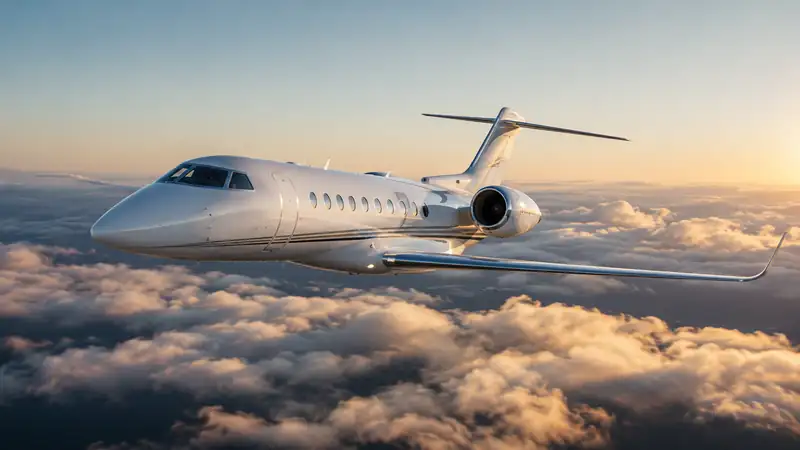
Not every private jet crosses the Atlantic non-stop. Here is which aircraft actually make it westbound against the headwinds, which need a fuel stop in Iceland or Canada, and what a transatlantic charter costs.
Almost any heavy or ultra-long-range private jet crosses the Atlantic non-stop, but most super-midsize jets — and every light jet — cannot do it reliably in both directions. The deciding factor is not the brochure range; it is the westbound leg from Europe to North America, where a headwind can add the equivalent of several hundred nautical miles of fuel burn. A Gulfstream G650ER or Bombardier Global 7500 crosses any transatlantic city pair with a full cabin, year-round. A heavy jet like the Falcon 7X handles the core New York–London and Paris routes comfortably. A super-midsize jet may make the same crossing eastbound with a tailwind, then need a fuel stop in Iceland or Canada coming back.
This guide explains exactly which private jets cross the Atlantic non-stop, why direction matters more than distance, which real routes each aircraft category can fly, where jets stop when they can't make it in one hop, and what a transatlantic charter actually costs. Every distance, flight time and price below is drawn from the Flyius route and fleet data — the non-stop capability for your specific date, passenger load and airports is confirmed when you request a quote.
Quick answer: which private jets cross the Atlantic non-stop
The Atlantic is not one distance. New York to London is about 2,990 nautical miles in still air; London to Miami is nearly 3,840. Add a winter headwind westbound and a full passenger load, and the fuel you actually need climbs well above the map distance. Here is how each category stacks up against two benchmark crossings.
| Category | Typical range (Flyius fleet) | New York ⇄ London (2,990 nm) | Miami ⇄ London (3,839 nm) | Reality |
|---|---|---|---|---|
| Light jet | 800–2,165 nm | ✗ | ✗ | Two or more fuel stops |
| Midsize jet | 1,500–3,340 nm | Only light payload, ideal winds | ✗ | Usually one stop |
| Super-midsize jet | up to 4,018 nm | Eastbound yes; westbound often one stop | ✗ | Possible, not guaranteed |
| Heavy jet | 4,000–6,000 nm | ✓ both directions | Top models ✓ | The transatlantic workhorse |
| Ultra-long-range jet | 6,000–8,200 nm | ✓ full payload | ✓ full payload | Crosses anything, any direction |
The short version: if you want a guaranteed non-stop crossing in either direction with a full cabin, you are chartering a heavy or ultra-long-range jet. Everything smaller is conditional.
The number that really decides it: winds, not miles
Every list of "jets that can cross the Atlantic" ranks aircraft by maximum range. That number is measured in still air, with a light load and no reserves. Real crossings are governed by three things the brochure ignores.
Direction. The North Atlantic jet stream flows broadly west to east. Flying eastbound — New York to London, Boston to Paris — you ride a tailwind that shortens the trip and cuts fuel burn. Flying westbound — London to New York — you fight that same air mass as a headwind. The westbound leg is almost always the binding case: an aircraft that crosses comfortably eastbound can come up short going home. When an operator tells you a super-midsize jet "can do the Atlantic," always ask which direction.
Payload. Range and weight trade off directly. A jet quoting 3,500 nm at two passengers may only offer 3,000 nm with eight passengers, luggage and full fuel. On a crossing that already sits near the aircraft's limit, a full cabin is often what forces a fuel stop.
Reserves and alternates. No professional crew plans to land on fumes. A legal transatlantic flight carries fuel to reach the destination, hold, and divert to an alternate — frequently Shannon, Keflavík or Gander. Those reserves can eat 300–500 nm of "usable" range before you carry a single passenger.
This is why a still-air distance of 2,990 nm for New York to London effectively demands an aircraft comfortable well beyond 3,500 nm before you call the crossing routine in both directions — and why the real dividing line runs through the super-midsize class.
The real routes — and the distance you're actually flying
These are the great-circle distances and typical planning flight times held in the Flyius route data for the most-flown transatlantic city pairs. Block times shift with the winds described above — expect eastbound legs to run shorter and westbound legs longer than the planning average.
| Route | Distance | Distance | Typical flight time |
|---|---|---|---|
| New York ⇄ London | 5,536 km | 2,990 nm | ~8h 15m |
| Toronto ⇄ London | 5,683 km | 3,069 nm | ~8h 27m |
| New York ⇄ Paris | 5,833 km | 3,150 nm | ~8h 40m |
| London ⇄ Miami | 7,109 km | 3,839 nm | ~10h 29m |
Notice the jump. The classic northern crossings cluster around 3,000 nm — within reach of the whole heavy class and, in good conditions, some super-midsize jets. Add Florida or the Caribbean and you are near 3,840 nm, which pushes the trip firmly into heavy-and-above territory. For a fuller view of how these times compare with shorter hops, see our guide to private jet flight times.
Category by category: what actually crosses
Ultra-long-range jets — cross anything, any direction
This is the class built for the mission. Every aircraft here clears the longest transatlantic pairs with a full cabin, in either direction, without a second thought — and most of them keep going to the Middle East or Asia from Europe.
| Aircraft | Range | Typical seats | Indicative €/hour |
|---|---|---|---|
| Bombardier Global 7500 | 7,700 nm | 13 | €14,500–17,500 |
| Gulfstream G650ER | 7,500 nm | 14 | €14,500–16,500 |
| Global 6000 | 6,000 nm | 13 | €12,500–14,500 |
The Gulfstream G700 and G800 and the Dassault Falcon 8X sit in the same class with 6,450–8,200 nm of range; the G800 tops the Flyius fleet at 8,200 nm. On a crossing, the advantage is not just non-stop capability but the cabin: full-height standing room, a proper galley, and a private rear stateroom for sleeping through a westbound red-eye. If sleeping matters on your schedule, our guide to private jets with bedrooms shows which cabins have a real bed.
Heavy jets — the transatlantic workhorses
Heavy jets are what most transatlantic charters actually fly. They clear the New York, Boston, Toronto and Paris crossings comfortably in both directions, seat a full board, and cost meaningfully less per hour than an ultra-long-range flagship.
| Aircraft | Range | Typical seats | Indicative €/hour |
|---|---|---|---|
| Gulfstream G550 | 6,000 nm | 14 | €12,000–14,000 |
| Falcon 7X | 5,950 nm | 12 | €11,500–13,500 |
| Gulfstream G450 | 4,350 nm | 12 | €10,000–12,000 |
| Challenger 605 | 4,000 nm | 12 | €8,800–10,800 |
The Gulfstream G550 (6,000 nm) is effectively an ultra-long-range aircraft and will reach Miami–London or beyond. The G450 and Challenger 605, at around 4,000–4,350 nm, own the core 3,000 nm northern crossings but tighten up on the longest legs against a strong westbound headwind with a full cabin — the case where an operator may build in a technical stop or trade a seat or two for fuel.
Super-midsize jets — possible, not guaranteed
This is where the honest answer matters most. The best super-midsize jets have the range on paper to cross the northern Atlantic — the Embraer Praetor 600 is rated at 3,900 nm and the Citation Longitude at 3,500 nm — and eastbound, with a tailwind and a modest load, they do it non-stop.
| Aircraft | Range | Typical seats | Indicative €/hour |
|---|---|---|---|
| Praetor 600 | 3,900 nm | 8 | €7,800–9,400 |
| Citation Longitude | 3,500 nm | 8 | On request |
| Challenger 350 | 3,200 nm | 9 | €7,400–9,000 |
The catch is the return. Westbound from London to New York against the headwind, with the cabin full, a super-midsize jet frequently plans a fuel stop — most often Keflavík (Iceland), Shannon (Ireland), Gander or Goose Bay (Canada), or Santa Maria in the Azores. So a super-midsize crossing can be genuinely non-stop one way and a one-stop the other. If your group is small and your dates flexible, it can be the most cost-effective way over; if you need a guaranteed non-stop round trip, step up to a heavy jet.
Midsize and light jets — realistically multi-stop
A midsize jet tops out around 3,340 nm and only reaches the Atlantic's edge in ideal conditions; a light jet, at 2,165 nm or less, cannot cross without two or more stops. These aircraft are superb for regional Europe and US domestic legs — see how far a private jet can fly by category — but the ocean is not their mission.
Where jets stop when they can't make it non-stop
When an aircraft can't cover a crossing in one hop, the route is planned through one of a handful of well-equipped North Atlantic gateways. A technical fuel stop typically adds roughly 45–75 minutes on the ground — enough to refuel, complete paperwork and swap nothing else — and passengers usually stay on board or step into a small FBO.
- Keflavík (KEF), Iceland — the standard mid-ocean stop for eastbound and westbound legs alike.
- Shannon (SNN), Ireland — a long-standing transatlantic gateway on the European side, with pre-clearance facilities.
- Gander (YQX) and Goose Bay (YYR), Canada — the classic North American tanker stops for jets heading home.
- Santa Maria (SMA), Azores — the southern option for routes toward Florida, the Caribbean and Iberia.
A fuel stop is a planning choice, not a failure — it is often what lets a smaller, cheaper jet serve a route that would otherwise demand a much larger aircraft.
What a transatlantic crossing costs
Because only heavy and ultra-long-range jets cross the northern Atlantic non-stop in both directions, real transatlantic pricing starts at the heavy tier. These are indicative one-way charter prices from the Flyius route data; the light and midsize figures are shown for reference, but remember those categories cannot make the crossing non-stop.
New York ⇄ London — indicative one-way
| Aircraft category | Indicative price |
|---|---|
| Light jet (with stops) | €28,000 |
| Midsize jet (with stop) | €44,000 |
| Heavy jet | €70,000 |
| Ultra-long-range jet | €90,000 |
London ⇄ Miami — indicative one-way
| Aircraft category | Indicative price |
|---|---|
| Light jet (multi-stop) | €35,000 |
| Midsize jet (with stops) | €55,000 |
| Heavy jet | €87,500 |
| Ultra-long-range jet | €90,000 |
Charter is priced by the aircraft and the flying hours, not per seat, so the per-person cost falls sharply as you fill the cabin. For the mechanics behind these numbers, see our breakdown of private jet cost per hour. A one-way transatlantic charter also opens the door to repositioning and empty-leg savings when your dates line up.
How to choose the right jet for your crossing
Work through four questions in order:
- Which direction is the binding leg? If you need a guaranteed non-stop westbound return, plan around the harder headwind case and lean heavier.
- How many passengers? A full board pushes a marginal aircraft over the edge; the same route that a super-midsize does with four passengers may need a heavy jet with eight.
- How long is the leg? Northern crossings near 3,000 nm open up the heavy class and, conditionally, super-midsize jets. Florida and Caribbean crossings near 3,840 nm want heavy-and-above.
- Do you need to sleep or work? A heavy or ultra-long-range cabin gives you stand-up room and a bed for the overnight; a super-midsize is comfortable but tighter for eight-plus hours.
Get those four right and the aircraft chooses itself — and if you'd rather not, send us the route and dates and we'll confirm the exact non-stop options.
Frequently asked questions
Can a light jet cross the Atlantic? Not non-stop. A light jet's range tops out around 2,165 nm, well short of the ~2,990 nm from New York to London, so any crossing needs two or more fuel stops. For an ocean crossing you want a heavy or ultra-long-range jet.
Why do some private jets stop in Iceland or Canada? Because the aircraft doesn't have the range — or the headwind-adjusted fuel margin — to make the crossing in one hop. Keflavík, Shannon, Gander, Goose Bay and Santa Maria are the standard North Atlantic fuel stops, and a technical stop usually adds only about 45–75 minutes on the ground.
Is a transatlantic flight faster eastbound or westbound? Eastbound (west to east, e.g. New York to London) is faster because the jet stream provides a tailwind. Westbound is slower and burns more fuel against the headwind, which is why the return leg is the harder one for range and often decides which jet you need.
How long is a private jet flight from New York to London? About 8 hours 15 minutes as a planning average in the Flyius data. In practice, expect a little under that eastbound with a tailwind and a little over it westbound. New York to Paris runs about 8h 40m, and London to Miami about 10h 29m.
What is the smallest jet that can cross the Atlantic non-stop? In the right conditions, a top super-midsize jet such as the Praetor 600 (3,900 nm) can cross the northern Atlantic non-stop eastbound. For a guaranteed non-stop crossing in both directions with a full cabin, a heavy jet is the practical minimum.
Do I need a bigger jet flying west than flying east? Often, yes. The westbound headwind increases fuel burn, so an aircraft that crosses comfortably eastbound may need a fuel stop — or a bigger jet — for the return. Always plan the crossing around the westbound leg.
The bottom line
Crossing the Atlantic by private jet is less about the map distance than about the wind and the weight. Ultra-long-range jets erase the question entirely; heavy jets handle every mainstream crossing and are what most transatlantic charters fly; super-midsize jets can do it eastbound but often need a fuel stop coming home; and midsize and light jets belong on shorter missions. Decide your direction, your passenger count and your route length, and the right aircraft follows.
Ready to cross? Request a quote with your city pair and dates, and we'll confirm the exact non-stop options and pricing from the live fleet.
Looking to book a private jet?
Get a Free QuoteWritten by
Flyius
Flyius publishes these charter guides. A firm price is confirmed only after an operator quote.