Most jets cannot land at Courchevel’s altiport. Compare Chambéry, Geneva and other gateways, aircraft limits, and the real 2026 arrival plan.
Most private jets cannot land at Courchevel’s altiport — the real plan is Chambéry, Geneva or another gateway plus the mountain transfer. Every other private jet lands at a valley gateway — usually Chambéry or Geneva — and finishes by helicopter or car. Plan that two-leg journey properly and you are on the snow in Courchevel 1850 while everyone else is still negotiating hairpins. This guide gives you verified 2026 charter prices from live Flyius route data, the altiport-versus-gateway decision in full, and the peak-season logistics thin quote pages skip.
Why Most Private Jets Can't Land at Courchevel
Courchevel Altiport is one of the most demanding runways in commercial aviation, and understanding why is the foundation of any sensible plan.
- Altitude: 2,008 m (6,588 ft). Thin mountain air lengthens every takeoff and landing roll and steals engine and wing performance — before you even reach the runway.
- Length: just 537 m. For comparison, a typical midsize jet wants well over 1,200 m. Charter rules inflate the required landing distance by a 1.6 safety factor, which mathematically rules out almost every jet.
- Gradient: ~18.6%. The runway climbs uphill steeply, so aircraft land uphill to brake and take off downhill — a technique that has nothing in common with a normal flat-field approach.
- No go-around. Once committed on short final, a pilot cannot abort and circle. There is no second chance, which is why the approach is unforgiving of error or sudden weather.
- VFR only, no instrument approach. Operations are visual-flight-rules only. Low cloud, snow showers or poor visibility can close the altiport within minutes, with no instrument procedure to fall back on.
- Special pilot qualification (QMO). Crews must hold the French mountain-airfield qualification (qualification de site / montagne) specific to Courchevel before they are legally allowed to land. The practical upshot: heavy and ultra-long-range jets cannot use CVF at all, and even most light jets are excluded once the 1.6 landing-distance factor is applied. The aircraft that genuinely operate into the altiport are STOL turboprops — the Pilatus PC-12, Daher TBM and King Air families — plus helicopters. That is why a credible Courchevel plan starts not with "which jet" but with "which airport, then which transfer."
The Four Gateways: Choosing Your Airport
For any mission flown on a jet, you are choosing a valley gateway and a transfer. Four airports realistically serve Courchevel, and the right one depends on your aircraft size, your origin and the conditions.
Chambéry-Savoie (CMF / LFLB) — the closest
Chambéry is the nearest full gateway, about 95 km from the resort. It takes light and most midsize jets, has customs and de-icing, and is the winter favourite because the road transfer is the shortest of the valley fields and a helicopter hop is just minutes. Its catch is the terrain-constrained approach and a winter slot system that saturates on peak Saturdays — book early.
Geneva (GVA / LSGG) — the all-rounder
Geneva Cointrin is the gateway most long-haul and larger-cabin arrivals choose. Its long runway, 24-hour operations and deep FBO bench take any aircraft up to ultra-long-range, and its helicopter network into the Alps is the best developed in the region. The trade-off is distance: a road transfer to Courchevel runs roughly 2 to 2.5 hours, which is exactly why Geneva arrivals so often finish by helicopter.
Lyon Saint-Exupéry & Grenoble-Isère — the alternatives
Lyon Saint-Exupéry (LYS) is a strong wet-weather and large-aircraft alternative with reliable all-conditions operations, around 2.5 hours by road. Grenoble-Isère (GNB) is a popular winter charter field roughly 2 hours out. Both are useful when Chambéry slots are gone or weather complicates the Savoie approaches.
Annecy — the scenic light-jet option
Annecy-Haute-Savoie-Mont Blanc suits light jets and turboprops and offers a beautiful lakeside approach, with a road transfer comparable to Geneva.
Quick gateway decision
| Your aircraft / situation | Best gateway | Why |
|---|---|---|
| Turboprop or STOL light aircraft, QMO crew | Courchevel (CVF) | The only way onto the snow directly — weather permitting |
| Light / midsize jet | Chambéry (CMF) | Closest full gateway; shortest transfer |
| Heavy / ultra-long-range jet | Geneva (GVA) | Only nearby field that takes the largest cabins, 24h |
| Peak Saturday, Chambéry full | Grenoble (GNB) or Lyon (LYS) | Capacity and all-weather reliability |
| Scenic light-jet arrival | Annecy (NCY) | Lakeside approach, light-jet friendly |
From Jet to Slopes: Helicopter vs Car
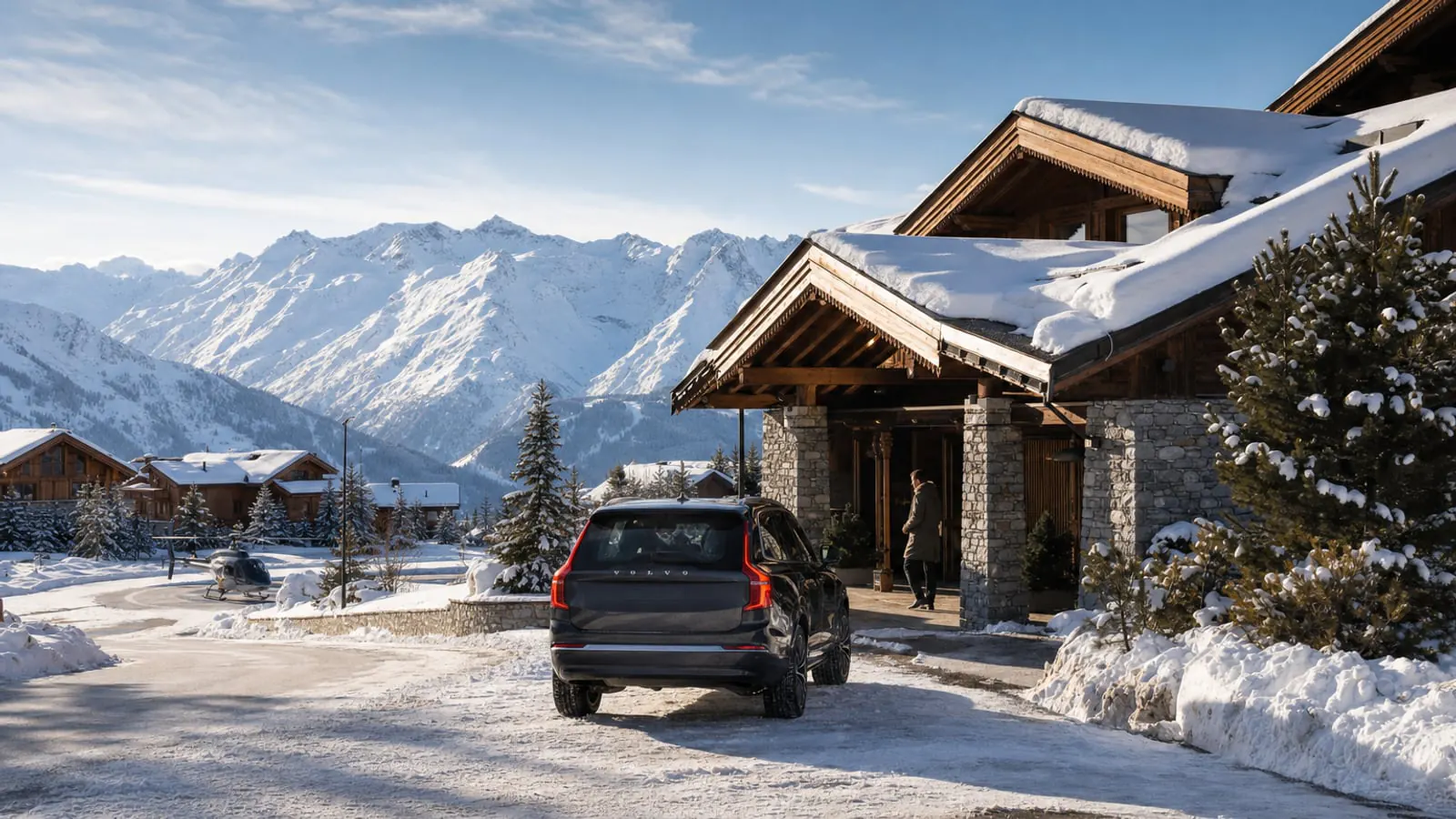
The transfer is where a polished Courchevel arrival is won or lost, and it should be booked as part of the same itinerary as the jet. Helicopter is the signature Courchevel finish. From Chambéry the flight is only around 15 minutes; from Geneva roughly 25 to 35 minutes, sweeping over the Belledonne and Vanoise ranges before settling onto the altiport — which, conveniently, doubles as the region's main heliport. In deep-winter conditions, when the road over the Col is slow or chained, the helicopter is not a luxury so much as the reliable option. Private car is perfectly civilised when you have landed close and the weather is kind. Chambéry to Courchevel is about 1 to 1.5 hours; Geneva is the long one at 2 to 2.5 hours, longer on a peak changeover Saturday. A good charter desk holds the helicopter or car against your jet's actual landing time, so a short flight delay never costs you the connection — and always builds in a weather contingency, because the last stretch up to 1850 is mountain driving.
How Much Does a Private Jet to Courchevel Cost in 2026?
The figures below are one-way indicative charter prices to reach Courchevel, taken directly from live Flyius route data, by aircraft category. They price the flight into the valley gateway; the helicopter or car transfer onto the snow is arranged on top and quoted per leg.
| Route to Courchevel | Flight time | Light jet | Midsize | Heavy | Ultra-long-range |
|---|---|---|---|---|---|
| Geneva → Courchevel | ~30 min | €4,500 | €7,500 | €11,500 | — |
| Paris → Courchevel | ~1h05 | €4,500 | €7,500 | €12,000 | €20,000 |
| London → Courchevel | ~1h40 | €7,000 | €10,000 | €15,000 | €24,000 |
| For reference, a London → Chambéry light-jet charter runs from about €6,000 — useful if you are pricing the gateway leg explicitly. A few things drive where you land in those ranges: |
- Aircraft category. Short Alpine hops from Geneva or Paris sit comfortably on a light jet. Larger groups, more luggage or longer legs push you to midsize, heavy and ultra-long-range cabins — and remember those bigger jets land at Geneva, not the altiport.
- Peak dates. Christmas–New Year and the February school holidays compress availability and lift prices across every Alpine gateway. Book weeks, not days, ahead.
- One-way vs round trip and repositioning. A jet that has to fly empty to reach you adds cost; an empty-leg repositioning in your direction can cut it sharply, and the Alps generate plenty of them around peak ski weekends. For a precise, current quote on any of these routes — jet plus transfer, door to door — request a Courchevel quote from Flyius and we will model the full itinerary against your dates and party size. You can also see live aircraft and pricing on our Courchevel private jet charter page.
Which Aircraft for Courchevel?
Because the altiport and the gateways demand different things, think in two tiers. To land at the altiport itself, you need a STOL turboprop and a QMO-qualified crew: the Pilatus PC-12, Daher TBM 900-series or a King Air, typically carrying 4–8 passengers. These are the aircraft you actually see parked on the CVF apron. Pure jets are, with very narrow exceptions, not operated there. To fly into a valley gateway on a jet, match the cabin to your route and group:
- Light jets — a Phenom 300E or Citation CJ4, ideal for the short hops from Geneva, Paris or Annecy with up to 6–7 passengers. The Pilatus PC-24 deserves a special mention: a light jet engineered for short and challenging runways, it is the jet best suited to tight Alpine fields when conditions allow.
- Midsize and super-midsize — a Citation XLS+ or Challenger 350, the sweet spot for London and longer legs with more cabin, range and luggage space for a full ski party.
- Heavy and ultra-long-range — for transcontinental arrivals into Geneva, where the long runway and 24-hour operations take the largest cabins without compromise. If you are weighing cabin sizes and hourly economics more broadly, our guide to how much a private jet costs breaks the categories down by route and aircraft. You can also browse the full light-jet and midsize fleets.
Timing It Right: Season, Peak Dates & PPR
Courchevel Altiport operates only in the winter season, roughly mid-December to mid-April, and only in suitable VFR weather — there is no summer jet traffic to the altiport. Two windows dominate demand:
- Christmas and New Year. The busiest fortnight of the Alpine year. Apron space at CVF saturates, helicopter shuttles fill, and prior permission required (PPR) is mandatory and granted sparingly. Secure the jet, the gateway slot and the transfer together, early.
- February school holidays. A second peak as French, British and other half-term weeks overlap. Saturdays are the crunch; arriving midweek eases both pricing and slot pressure. Throughout the season, PPR is mandatory at the altiport, weather can close it at short notice, and your operator should always file a gateway Plan B — typically Chambéry or Geneva with a helicopter held in reserve — so a clouded-in altiport never strands your trip. For the wider picture of an Alpine ski season by private jet, see our guide to the best private-jet ski destinations in the Alps, and for the gateway in depth, the Geneva private-jet airport guide.
Flying to Courchevel Responsibly
A private jet to Courchevel carries a real carbon cost, and the short Alpine routes are far lighter than the long ones. On a midsize jet, Flyius route data puts Geneva → Courchevel at about 310 kg of CO₂, Paris → Courchevel around 1,581 kg, and London → Courchevel near 2,635 kg. Choosing the right-sized aircraft for the distance, flying the shortest sensible routing into the nearest viable gateway, and offsetting or using sustainable aviation fuel where available all meaningfully reduce the footprint. In the Alps the shortest routings are usually the fastest, too — another reason a well-chosen gateway pays off.
Frequently Asked Questions
Can a private jet land at Courchevel?
Almost never. Courchevel Altiport (CVF) has a 537 m runway at 2,008 m elevation with an 18.6% slope and a no-go-around rule, so it is restricted to STOL turboprops, very light aircraft and helicopters flown by specially qualified (QMO) mountain pilots. Heavy and most light jets cannot land there; they use a valley gateway such as Chambéry or Geneva and transfer by helicopter or car.
How much does a private jet to Courchevel cost in 2026?
Indicatively, from about €4,500 one-way on a light jet from Geneva or Paris, around €7,000 from London, and up to roughly €24,000 on an ultra-long-range jet from London. These are charter prices into the valley gateway; the helicopter or car transfer onto the snow is arranged separately. Christmas, New Year and February half-term raise prices across every Alpine gateway.
Which airport is best for Courchevel?
Chambéry-Savoie (CMF) is the closest full gateway for light and midsize jets, about 95 km out. Geneva (GVA) is the all-rounder for heavy and ultra-long-range aircraft, with the best helicopter network but a longer 2–2.5 hour road transfer. Lyon, Grenoble and Annecy are useful alternatives when Chambéry is full or weather complicates the Savoie approaches.
How long is the transfer from Geneva or Chambéry to Courchevel?
By helicopter, roughly 15 minutes from Chambéry and 25–35 minutes from Geneva, landing at the altiport itself. By road, Chambéry is about 1–1.5 hours and Geneva about 2–2.5 hours, longer on peak Saturdays. Booking the transfer with the jet as one itinerary keeps the handover seamless.
Why can't big jets land at Courchevel?
The runway is only 537 m long, sits at 2,008 m altitude and climbs at roughly 18.6%, and charter rules multiply the required landing distance by 1.6. Combined with the no-go-around rule and VFR-only operations, this puts the airfield beyond the performance of heavy and ultra-long-range jets, and most light jets too. Turboprops and helicopters are the practical answer.
When is Courchevel Altiport open?
Only during the winter ski season, roughly mid-December to mid-April, and only in suitable visual weather. There are no summer jet operations to the altiport, and prior permission required (PPR) applies throughout the season.
The Bottom Line
A private jet to Courchevel is really a jet-plus-transfer itinerary, and treating it that way is the whole secret. Unless you are on a QMO-flown turboprop, land your jet at the right valley gateway — Chambéry for the shortest hop, Geneva for the largest cabins — hold a helicopter or car against your arrival, and you are on the slopes of 1850 while everyone else is grinding up the mountain road. Match the aircraft to your route, book early for Christmas, New Year and February half-term, and the most theatrical runway in the Alps becomes a footnote to an effortless arrival. Ready to plan it properly? Request a private jet quote to Courchevel and Flyius will model the full door-to-door itinerary — jet, gateway and transfer — around your dates.
Written by Sophie Marchant, Senior Business Aviation Editor at Flyius. Reviewed for operational accuracy by Thomas Werner, Aviation Operations Reviewer, who has 17 years of experience in European business-aviation operations, mountain-airfield procedures and FBO handling. All prices, flight times and CO₂ figures are drawn from live Flyius route data and reflect 2026 indicative charter rates.
Courchevel private jet planning checklist
For Courchevel, the booking decision is less about the aircraft and more about the altiport-or-gateway chain. Before requesting a quote, confirm four things: whether you want to land at the altiport (turboprop and QMO crew only) or a valley gateway, the party size and luggage volume, whether the final leg should be helicopter or car, and whether your dates fall in the Christmas–New Year or February peaks. For most travellers on a jet, the cleanest flow is to price the charter into Chambéry or Geneva, then add the transfer that best fits the weather and the schedule. Useful next reads: plan the wider ski season in the best private-jet ski destinations in the Alps, study the main gateway in the Geneva private-jet airport guide, benchmark cabin economics in how much a private jet costs, and if your dates are flexible, check empty-leg flights for repositioning bargains around peak ski weekends. First time on a private flight? Our first-time flying private guide covers what to expect at the FBO.
Looking to book a private jet?
Get a Free QuoteWritten by
Flyius
Flyius publishes these charter guides. A firm price is confirmed only after an operator quote.