Runway and aircraft fit
Moscow–Domodedovo (DME/UUDD) lists a runway of 3,794 m. Final aircraft suitability depends on payload, weather, performance data and operator approval.
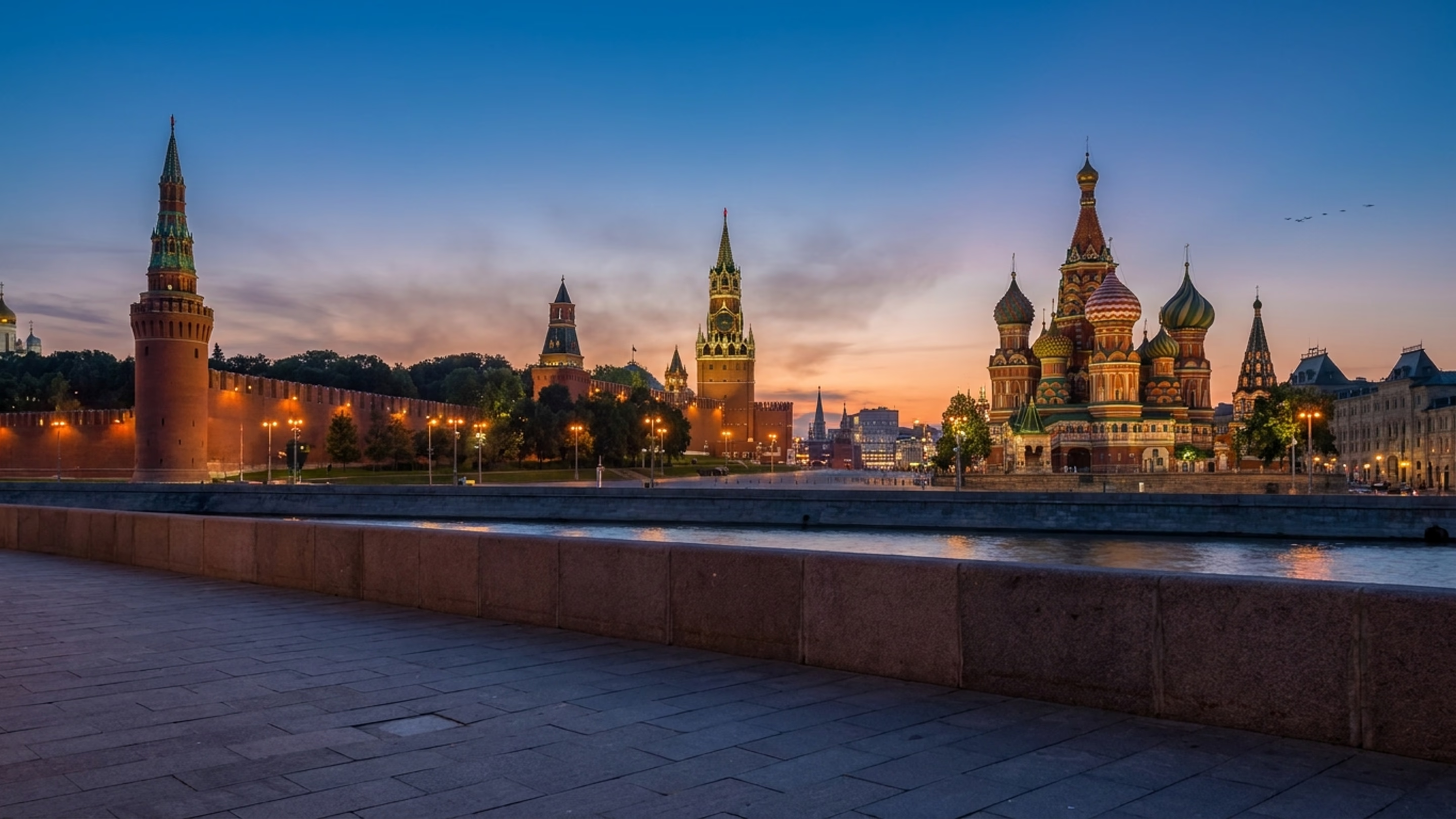
Private Jet Charter
Gateway to Moscow · Codes, runway & FBO guidance · Runway, FBO & quote requests
ICAO Code
UUDD
Charter price
On request
Runway
3794 m
Tell us your travel details — no contact details yet.
Domodedovo International Airport
DME
Adults
Ages 2+
Empty-leg opportunities may also be considered when relevant.
No contact details·Free
Or directly: +33 7 66 61 37 42·WhatsApp
Flyius is a quote request and intermediation platform for private aviation options. No company registration number or registered office is published on this page. Flyius does not own or operate aircraft and is not a direct or indirect air carrier. Flights must be performed by a commercial operator authorized for the route and aircraft; the actual operator is identified in the flight documents.
ICAO Code
UUDD
Charter price
On request
Runway
3794 m
Last updated
Charter price
On request
ICAO Code
UUDD
IATA Code
DME
Runway
3.8 km
Airport facts
Operational guidance for private jet arrivals and departures at Moscow–Domodedovo (DME/UUDD), focused on handling, runway suitability, customs and access to Moscow.
Moscow–Domodedovo (DME/UUDD) lists a runway of 3,794 m. Final aircraft suitability depends on payload, weather, performance data and operator approval.
Private jet handling at Moscow–Domodedovo is arranged with approved local handlers. Terminal access, crew services and passenger handling are confirmed before departure.
Moscow–Domodedovo (DME/UUDD) supports customs or immigration handling for eligible private matches, subject to prior notice and passenger documentation.
Moscow–Domodedovo may support extended or 24-hour operations, but slots, night rules, noise restrictions and parking are always confirmed with the handler.
Light, midsize, super-midsize and heavy jet options for Moscow are shortlisted against runway performance, passenger count, baggage and route length.
If Moscow–Domodedovo is slot-constrained or not ideal for your aircraft, nearby options around Moscow include Russia.
Airport operating conditions can change. Flyius verifies runway performance, slots, customs and handling with the operator or local handler before confirming your charter.
For private jet clients routing into Moscow, the first decision is not which aircraft to book — it is which airport to use. Domodedovo sits roughly 42 km south of the city centre and is the right choice when your mission involves ultra-long-range aircraft arriving from North America, the Gulf, or East Asia, when your ground destination is in the southern or southeastern districts of Moscow, or when Vnukovo (UUWW) is slot-constrained during peak diplomatic or business travel periods. Sheremetyevo (UUEE) to the northwest serves as the primary hub for Aeroflot and handles the bulk of scheduled widebody traffic; Domodedovo, by contrast, offers a more operationally predictable environment for business aviation when properly coordinated in advance.
The airport operates continuously, with customs and border control available around the clock — a practical advantage for clients arriving on transatlantic or transpacific routings where block times rarely align with standard office hours. Handling quality at Domodedovo is rated premium by the operators who work there regularly, and the facility has the ramp depth to park large-cabin and ultra-long-range jets without the congestion that can affect smaller Moscow reliever fields.
Domodedovo has a dedicated business aviation terminal separate from the main commercial concourses, which means your passengers are not walking through a busy international terminal to reach the aircraft. The FBO infrastructure supports full ground handling, fuelling, catering coordination, and crew rest facilities. Passengers clear customs and immigration within the business aviation zone, which materially reduces ground time compared with processing through the main terminal.
The airport's size works in favour of private operators in one specific way: ramp space. Aircraft as large as the Boeing BBJ or Airbus ACJ can be parked and serviced without the tight choreography required at Vnukovo during busy periods. For clients travelling with security details, the layout also allows for discreet vehicle access close to the aircraft steps. Confirm specific apron positioning requirements with your handling agent at the time of booking, as stand allocation at a large airport is subject to commercial traffic scheduling.
Domodedovo's primary runway measures 3,794 metres, which places it among the longest at any Moscow-area airport. In practical terms, this means the field is fully suitable for ultra-long-range jets including the Gulfstream G700, Bombardier Global 7500, and Dassault Falcon 10X operating at or near maximum take-off weight. Transatlantic non-stop operations — Moscow to New York, Los Angeles, or São Paulo — are achievable without fuel or payload compromises that would apply at shorter runways.
Large-cabin jets such as the Gulfstream G650ER, Global 6000, and Falcon 8X are well within the runway's capability in all normal operating conditions. Mid-size and super-midsize aircraft (Citation Longitude, Challenger 350, Phenom 300) operate here without restriction, though for these categories Vnukovo's proximity to the city centre may offer a better overall trip time depending on the ground destination. Turboprop and very light jet operations are technically feasible but operationally inefficient at a large international airport; handling fees and slot coordination overhead rarely justify the choice unless no alternative is available.
Elevation at Domodedovo is modest — under 600 feet above sea level — so density altitude is not a performance consideration except in rare summer heat events. Winter operations are relevant: Moscow experiences significant snowfall and sub-zero temperatures between November and March. The airport maintains active de-icing facilities, but clients should build schedule buffer during winter months and confirm de-icing availability with the handling agent, particularly for early-morning departures.
Domodedovo operates 24 hours a day, seven days a week, with customs and border control available continuously. This is not universal across Russian airports, and it is one of the operational arguments for choosing UUDD over smaller fields when arrival or departure times are dictated by long-haul block times rather than client preference.
Russia requires advance overflight and landing permits for all private and charter aircraft, and these must be secured before departure — not on arrival. Lead times vary depending on the operator's country of registration and the nature of the flight, but a minimum of 72 hours is a practical baseline; allow more during public holidays or periods of elevated diplomatic activity. Your charter broker or handling agent should manage this process, but travel managers should build permit lead time into the trip planning timeline from the outset. Slot coordination at Domodedovo follows standard IATA procedures; the airport is slot-coordinated, and peak periods — particularly during major Russian business forums, state visits, and the weeks surrounding New Year — require earlier slot requests than usual.
The airport is located approximately 42 km south of central Moscow via the M4 motorway. Transfer time is highly variable: under normal conditions, the drive to the city centre takes between 45 minutes and 90 minutes, but Moscow traffic is among the most congested in Europe, and journey times during morning and evening peaks, or following major events, can extend significantly beyond that range. Clients with fixed schedule constraints should discuss departure timing with their ground transport provider rather than assuming a fixed transfer window.
The Aeroexpress rail service connects Domodedovo to Paveletsky railway station in central Moscow in approximately 45 minutes and operates on a fixed timetable; this is a practical option for clients travelling light without security requirements. For UHNW clients with motorcade or close-protection requirements, the road approach to the business aviation terminal allows for direct vehicle-to-aircraft access, which is the standard arrangement. Helicopter transfers between Domodedovo and central Moscow or other Moscow-area airports are operationally possible but require separate coordination and are subject to Russian airspace restrictions; confirm feasibility well in advance if this is part of the itinerary.
Sheremetyevo International (UUEE), northwest of the city, handles the highest volume of scheduled international traffic and is generally the least preferred option for private jet clients due to commercial congestion and longer ramp distances, though it does have business aviation handling capability. For clients arriving from St. Petersburg or other domestic Russian points, Sheremetyevo's connectivity may be relevant. Zhukovsky International (UUBW), southeast of Moscow, is a newer facility with long runways and lower traffic density; it is worth considering for test flights, ferry operations, or when the other three airports are congested, though its ground transfer distance to central Moscow is the longest of the group.
Routing a private jet into Domodedovo (DME/UUDD) requires coordination across several workstreams that should begin earlier than for most Western European destinations. Permit applications, slot requests, handling confirmation, customs pre-notification, and ground transport briefing should all be initiated simultaneously rather than sequentially. For first-time operators into Russia, working with a handling agent that has an established Moscow presence is strongly advisable — the administrative requirements are specific and the consequences of incomplete documentation are significant.
Fuel availability at Domodedovo is reliable, but pricing and payment terms for private operators should be confirmed in advance. Catering can be arranged to a high standard through the handling agent or independently sourced from Moscow-based providers; lead times of 24 hours or more are standard for complex orders. Crew visas and landing documentation requirements differ from passenger requirements and should be verified with the operator's flight operations department well before departure.
Get quotes on request from charter providers for matches to or from Moscow–Domodedovo. No commitment, transparent pricing and clear handling notes.
Concierge desk Available
Trusted by
Desk
Operators
Help
Support
Nearby airports
Compare nearby private jet airports around Moscow
Location & Access
Interactive map showing Moscow–Domodedovo location, nearby attractions, and easy access to Moscow city center.
Coordinates
55.4088, 37.9063
City access
Access to Moscow
Typical transfer
Confirmed with chauffeur dispatch
Nearby alternatives
Other airports in Russia
Company profiles related to Moscow–Domodedovo. A card explains whether the selection comes from a declared base, headquarters, quote options or the global directory. This is not a ranking of local flight activity.
The directory includes aircraft operators and charter brokers. A broker arranges matches operated by another company. A listing does not certify an AOC, insurance or safety rating; these must be checked for the actual operator and aircraft before booking.
Browse company profilesFrequently Asked Questions
About Flying to Moscow
Share your route and travel preferences. Our team checks availability and sends personalised offers. No commitment.